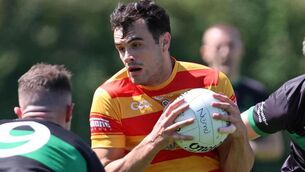
Conor Gormley is Harte’s ultimate firefighter
As most players do, some of the younger crew indulged in a bit of showing off. Keepy uppies and all that jazz. Conor Gormley, himself no stalwart at 20, grabs the ball, boots it into the next field and follows it with a volley of warnings that such trick-acting won’t win them a championship.
His message resonated. Carrickmore shocked Peter Canavan and Co. “He doesn’t like the messing about or that crossbar challenge lads do,” says his friend and club coach Sean Daly. “When you’re at training, you train. You bust your balls and have a laugh after. I remember one training session and he wasn’t happy with the quality of the sprints at the end. We were doing five 50-metre sprints and he made us do them all again because he saw lads winning the first sprint and the same lads winning the second sprint but they weren’t winning the ones in between.
“Nobody questioned him. He just demands the best. If things aren’t going well he’ll just tell you.”
Gormley’s attitude has rarely wavered from the time he was brought into the Tyrone seniors by Art McCrory and Eugene McKenna before he featured on Mickey Harte’s U21 side.
It’s been suspected the bitter rivalry between Errigal Ciarán and Carrickmore had coloured Harte’s thinking in his choice of players but Daly disputes that. “There was talk when Tyrone minors won in 1998 and 99% of people felt Conor should have been on the panel. We won the All-Ireland so you can’t have any questions. Mickey isn’t that kind of person, though. It doesn’t matter who you are as long as you can play.”
Gormley was a pioneer for his club on a Harte team, though. On a pioneering county team. And literally a pioneer himself.
“Conor doesn’t socialise that much,” says Daly. “The night following the first All-Ireland, he was back training with Carrickmore. The only thing you see Conor is at mass or at training. He doesn’t smoke or drink and doesn’t eat biscuits. Any little thing that he can do to get better, he’ll do.”
Gormley made his name — and nickname — in the 2003 final with his physics-defying block on Stevie McDonnell in the closing stages. The incident threatened to stereotype him in many people’s eyes as a man-marker extraordinaire and Harte saw him as his ultimate firefighter. And yet for Carrickmore a year later he was scoring goals to be beat the band — five in four games from midfield. There has always been a creator screaming to be let out of the destroyer and the new role at left wing-back has emancipated him.
“The biggest thing about this year is he’s on more ball than ever,” notes Oisín McConville. “He’s been joining attacks, a bit like [Ryan] McMenamin did a couple of years ago. When they badly need a score he’s the one to drive them forwards.
“He’s still niggling and annoying people but he’s making better decisions. He’s lost a few yards of pace but it’s immeasurable what he gives to Tyrone through leadership. The know-how, how to slow the game down, how to get over the line.
“McMahon and himself are the men with experience in the back-line. If Tyrone are to stay in this game on Sunday it’ll be McMahon and Gormley that keep them there.”
Recent tests in the Tyrone camp wouldn’t tally with McConville’s argument about Gormley’s speed: he is the oldest outfield player in the Tyrone panel but the fastest player over 30 metres.
McConville describes Gormley “as not my favourite person in the world”, something that goes back to the verbals during the great rivalry with Armagh in the ’00s.
But he’s nothing but admiration for the three-time All Star: “We didn’t pay a huge amount of attention. Whoever he was going to pick up he was going to pick up but we would try and get him into the half-back line and as far away from the goals so as to expose the other defenders.
“He always played goal-side of the attacker regardless of where he was. We wanted to keep him away from the honeypot because he was good at pushing people out. He’d always get a hand in the face or the chest. He built his reputation on that but he’s always been a good footballer.”
It’s a source of irritation for some in Tyrone that he’s painted as something he’s not. “People have this impression that Conor Gormley is a real hard-hitting, tough-talking guy. He’s not a Ricey,” insists former player Noel McGinn.
“Some of the players would talk the talk but he’s always been an action-speaks-louder-than-words sort of guy. He’s the man you want in the trenches. When a fella is putting over a couple of scores, Gormley is the man you send for.”
It’s hardly surprising, then, that Gormley will be assigned the detail of marking Cillian O’Connor. But if he has been told, he’s not letting on to anyone.
“Conor works as a coach in my school and the staff and kids love him. But, if he was a poker player, he’d be a millionaire. He always has that smile but it gives nothing away.
“The fact he’s been moved out to the wing, some people might see it as a demotion but it’s given him a new lease of life. He’s developed it in a way that has been very useful for him but also for the team.
“He’s fitter and sharper than he has been for a number of years and is able to read the game better than most players. He doesn’t just cover the wing but across the middle too. He was the best midfielder in the game against Donegal. He just allows other players to fulfil their series of roles in a way. He’s been central to the great form of the likes of Matthew and Mark Donnelly this year.”
Tomorrow marks his 72nd championship appearance for Tyrone and he’s missed just two SFC games since his debut. Daly believes his changes of jobs from an electrician to coach lengthened his career but the latest threat to his proud record came courtesy of the Central Competitions Control Committee (CCCC) following the quarter-final win over Monaghan.
The half-time scuffle was picked up by The Sunday Game but notification of the retrospective proposed ban, while thrown out, came late.
“He knows he’s coming towards the end of his Tyrone career,” Daly states. “He was very confident all along he did nothing wrong and that he basically went in to try and settle a situation that had boiled over. He pushed one fella out of the way.”
Whatever happens against Mayo, he’ll be back in Carrickmore next week.
“I took a session last week and he was there to talk to the boys about tackling but was called away by the county board to look at something but then came straight back and trained on his own.
“Whether it’s mingling with the U21s and having a cup of tea or coaching a couple of underage teams he’ll be around. Always involved. Always there.”
As the title of Harte’s book reads, presence is the only thing.