The physicality, hostility and high stakes in Killarney
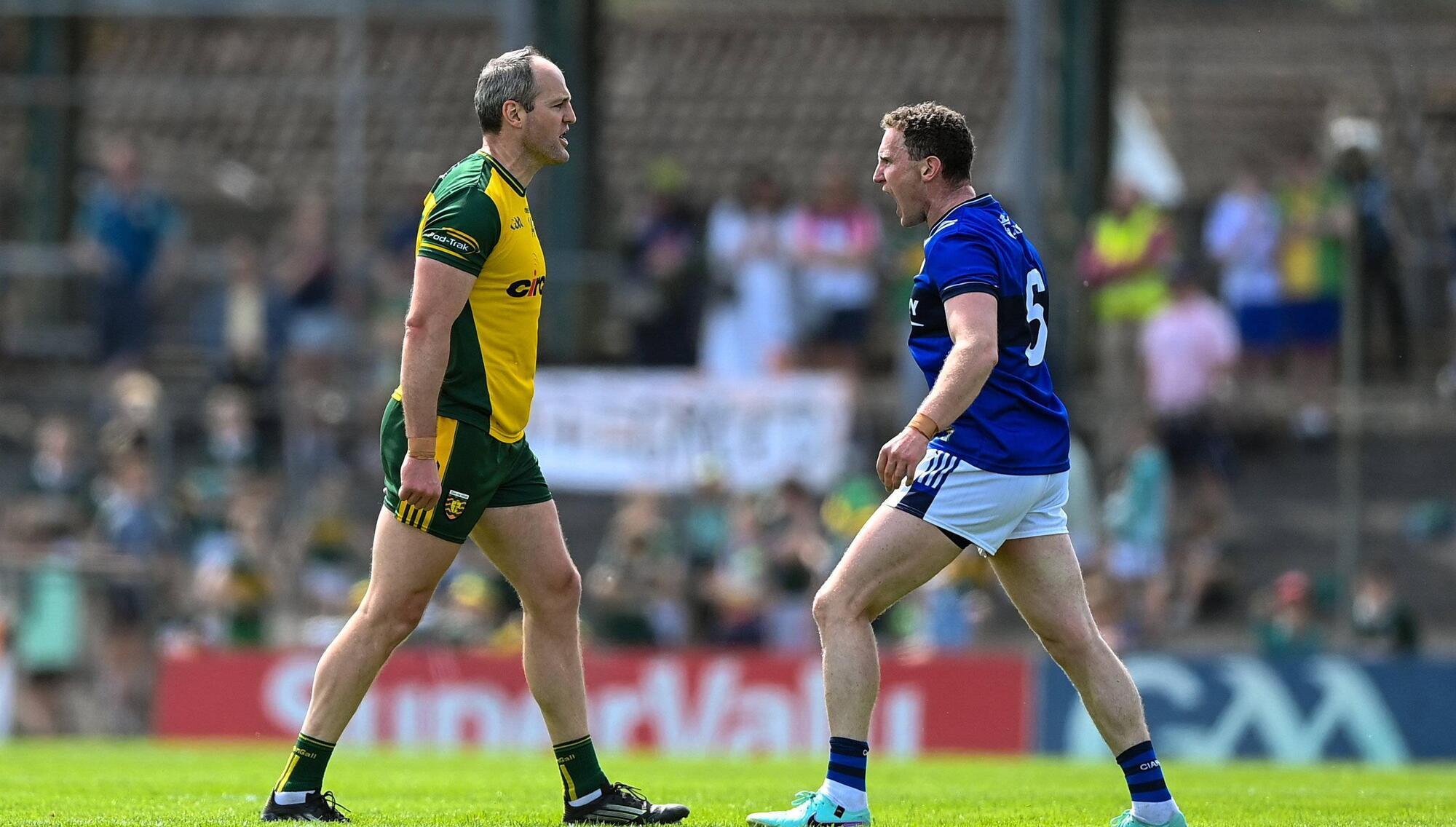
TARGET: Donegal's Michael Murphy confronts Tadhg Morley of Kerry in the early stages of Saturday's fiery All-Ireland SFC clash in Fitzgerald Stadium. Pic: Stephen McCarthy/Sportsfile
As the last few stragglers lingered in Fitzgerald Stadium after Donegal's win over Kerry, Michael Murphy could finally enjoy a moment of pure appreciation. Autograph hunters reached through the wire, while an eager father prised open the sideline gate to push his daughter out for a photo.
Having spent the afternoon cast as both hero and villain, the Glenswilly native could resume his familiar place as icon of his county. After the war comes the return to ordinary things.
From the moment the Donegal bus tore up past match traffic on the N22, with a laminated A4 sign in the front window to declare their identity, to the final hooter, Murphy was at the centre of a storm. Pre-match, the talk was of a thumb injury or a rumour that he hadn’t travelled at all. As he broke from the national anthem, he was met head-on by animated opponents who hadn’t forgotten that unpunished blow in the league final.
As referee Sean Hurson prepared to throw in the ball, Jason Foley and Tadhg Morley had a healthy fistful of his jersey. As Hurson released the ball, neither of them were marking Murphy as an adjacent skirmish attracted their attention, allowing Murphy to race towards the throw-in entirely untethered.
Read More
Come the second half, the atmosphere had turned a tad pantomime. The home support in the 21,738 crowd began to boo his every touch. Later, he smiled that a similar reception would have been dished out, only his possessions were so minimal. A vocal, strong-travelling base reacted defiantly and began to cheer each possession. He jogged off after an hour to applause and headed for the dressing room with two minutes remaining, the contest itself having long concluded.
There was a revealing moment with 14 minutes played. Kerry had a line ball on the Michael O’Connor terrace side and Donegal squeezed suffocatingly. Morley managed to get a kick away to a scampering Michael Burns with Murphy breathing down his neck. His hand caught Burns’ midriff and while the Dr Crokes flyer took off, Morley turned to linesman David Coldrick, incensed. Closed fist, he gestured. He hopped off Murphy, others became embroiled, sparks started to fly, yet the All-Ireland champions eventually worked a score after a long passage, finished fittingly by Morley.
The opening half played out in this matrix of tactical intrigue and terrific matchups and a sheer existential premium on possession. It is a brilliant game and a chess game now. Possession is nine-tenths of the law. An entire season hinges on the ability to control it.
In the first half, there was 1-20 scored. 1-19 came from a kickout. Consider this return for a second. Team wins ball, team minds ball, team triumphs with ball.
Kerry kept the ball for over two and a half minutes before that Morley point. During that spell, selector Kieran Donaghy was roaring a clear instruction: “Rest on the ball.” The safety of possession once gained means it is easier to be defensive against a stiff breeze when in attack.
It is also why the second half was a non-event. With 14 players, Donegal could slow it down and make every play a calculated game of 11-v-10. All they had to do was be patient and find the free man. Why go fast and risk turnovers when the deck can be stacked in another way?
That first half had just five turnovers in total. This difficulty in defending has become a systemic headache under the new rules, so teams try to find other ways to play without possession. That means doubling down on old-school, severe physicality. Finnbarr Roarty was welded to Paudie Clifford in a clear lesson from the 2025 decider and endlessly bounced off him.
“We knew coming to Kerry that it was going to be very, very physical,” said Jim McGuinness afterwards. “We stood up and we dealt with that.”
At this point, he was interrupted by a local journalist who argued it was not one-way traffic.
“We lost the All-Ireland final last year in the first 20 minutes of the game and a huge part of that was physicality,” he replied. “And we got caught, so you're right, it was physical, but you're also right, we were ready. And we didn't take a backward step. What do you want me to do? Do you want me to say, well, that is coming and not deal with that? You can't put that in reverse.
“If the physicality is coming, you either decide that you're going to stand your ground or you're not going to stand your ground. That is the bottom line.”
What of the attention Murphy received just before the throw-in?
“The exact same thing happened in the All-Ireland final. That happens every day in a big game. That is the reality of the situation. We were ready for that. We weren't going to back down.”
This, evidently, has become a point of emphasis within their camp. Back in February, before their first meeting with Kerry since the All-Ireland final, selector Neil McGee said Kerry had brought a fierce physical edge that day and that Donegal hadn’t handled it “properly”. In Croke Park, the 2012 All-Ireland winner again referenced the opening 20 minutes of the decider, as well as the physicality and dog-like persistence of their markers.
Now that the elite few are so economical with the ball, the level of aggression required to stop them or delay them will only increase. Every team now prioritises that competitive edge. Mark McHugh remarked after Westmeath’s remarkable triumph that he had to put “a wee bit of steel” into his side; his initial assessment had been damning: too nice. The greatest sin now is to be seen taking a backward step. It is a challenge to dance along that line between intensity and outright chaos.
Of course, that does not excuse the moments when the line is crossed. Burns was deservedly sent off. David Clifford’s initial shove on Caolán McGonagle, which ignited the flare-up, was harmless enough. He was fortunate that an earlier high elbow did not invite closer inspection. Conor O’Donnell was as lucky his clash with Dylan Casey wasn’t punished.
The point is that nobody sets out to cross the line. But in this new order, contenders are increasingly compelled to live right alongside it.

CONNECT WITH US TODAY



Be the first to know the latest news and updates