Olympic hopeful Tara Donoghue determined to get up to speed
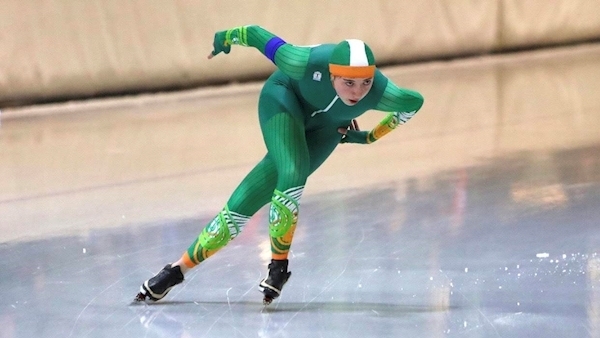
Seventeen-year-old speed skater Tara Donoghue was left feeling somewhat bittersweet after becoming the first Irish ice skater to claim a quota spot at a Youth Olympic Games — only to realise she’s overage by the time the event in Lausanne begins next month.
Qualification was secured at the weekend’s International Skating Union (ISU) Junior World Cup event in Enschede, Netherlands.
The Youth Olympics take place in Switzerland in January 2020 and for the speed skating events competitors must be born after January 1, 2002 — unfortunately for Donoghue she is three weeks overage, meaning she will miss out on Lausanne.
“It’s a huge honour to be the first ice skater to claim a spot for Ireland at the Youth Olympics,” Donoghue said yesterday.
Although it’s bittersweet for me because I am too old by 20 days, the disappointment is going to spur me on to work even harder.
Ice Skating Association of Ireland (ISAI) President Karen O’Sullivan said: “This is an amazing achievement by Tara to earn the first-ever ice skating spot for Ireland at the Winter Youth Olympic Games and is a testament to the bright future she has in the sport.”
The youngster is getting used to firsts, having become the first Irish speed skater to participate in the World Junior Speed Skating Championships in Baselga di Piné, Italy earlier this year.
She competed in both the 1,500m and 3,000m events, finishing in 23rd place in the latter, the highest finish for Ireland in an International Skating Union (ISU) event.
Tara was born in the Netherlands to Irish parents. Her dad Andrew is from Inverin in Galway, while her mother Pauline is from Kilshanny in Clare.
“My mum and dad travelled a lot after finishing their degrees, working in all kinds of places around the world. At some point, they decided to go on holiday to the Netherlands and ended up staying here.
"Before they had children, they used to spend every holiday hiking in the mountains or cycling, so I do definitely come from an active family.”
She explained: “My friend’s sister was doing speed skating, so we tagged along a few times and ended up joining the next season. I think I was around six at the time.
From around the age of 10, I started racing and that was when my love for speed skating really started. This led to being selected by the skating academy at our local rink at the age of 12.
“What I love about the sport is the combination of different types of training. We do dryland training, inline skating, cycling, running, and weight-training during the summer season.

“When the ice rink opens again, usually around the end of September, we change the training sessions around. We do about three ice sessions a week, a weight session, and as much cycling as possible on the off days, to try and keep our endurance up. Furthermore, I have a race nearly every weekend.
“I get a real buzz from the speed that you can achieve on the ice. Speed skating is extremely technically demanding. Subtle changes can make big differences.”
In the Junior World Cup qualifying event in Enschede at the weekend, Tara competed in the 500m, 1000m, 1500m, 3000m, and mass start races. She was happy with how she performed:
“I performed solidly in all my races, achieving times just under my personal bests.
“The World Cups are always a great experience. I get to meet so many people from different backgrounds and nationalities. It’s also a great opportunity to visit other places in the world.
"In the last three years I’ve had the pleasure of going to Inzell (Germany), Innsbruck (Austria), Tomaszów Mazowiecki (Poland), Helsinki (Finland), and Baselga di Piné (Italy) for the World Championships.
“A weekend full of racing is definitely tiring because you have to try and get the utmost out of yourself every single race. In the future, I might specialise in the longer distances and skip the 500m. At the moment the 1,500m and 3,000m are probably my best distances.”
Like many Irish athletes, funding is a major issue. While the Ice Skating Association of Ireland fund her travel and accommodation for international events, there are other costs.
“My parents are my main sponsors as they have to fund the costs of my skating materials, training necessities such as a race bike, etc. and training camps. There’s also the annual fee for the skating academy.
Speedskating is a very expensive sport and I am extremely thankful for their support, because without it I would not be able to compete at this level. Maybe in the future I could get an Irish company to sponsor me.
Her next big events are the Junior World Cup final on February 15-16 in Minsk and the World Championships in Poland the following week.
“I have already got the qualifying times to compete at both these events. Of course, I am also aiming for improvement in my skating technique and hopefully a few more national records this season.”