Irish women living the dream and making more through a stunning 2025
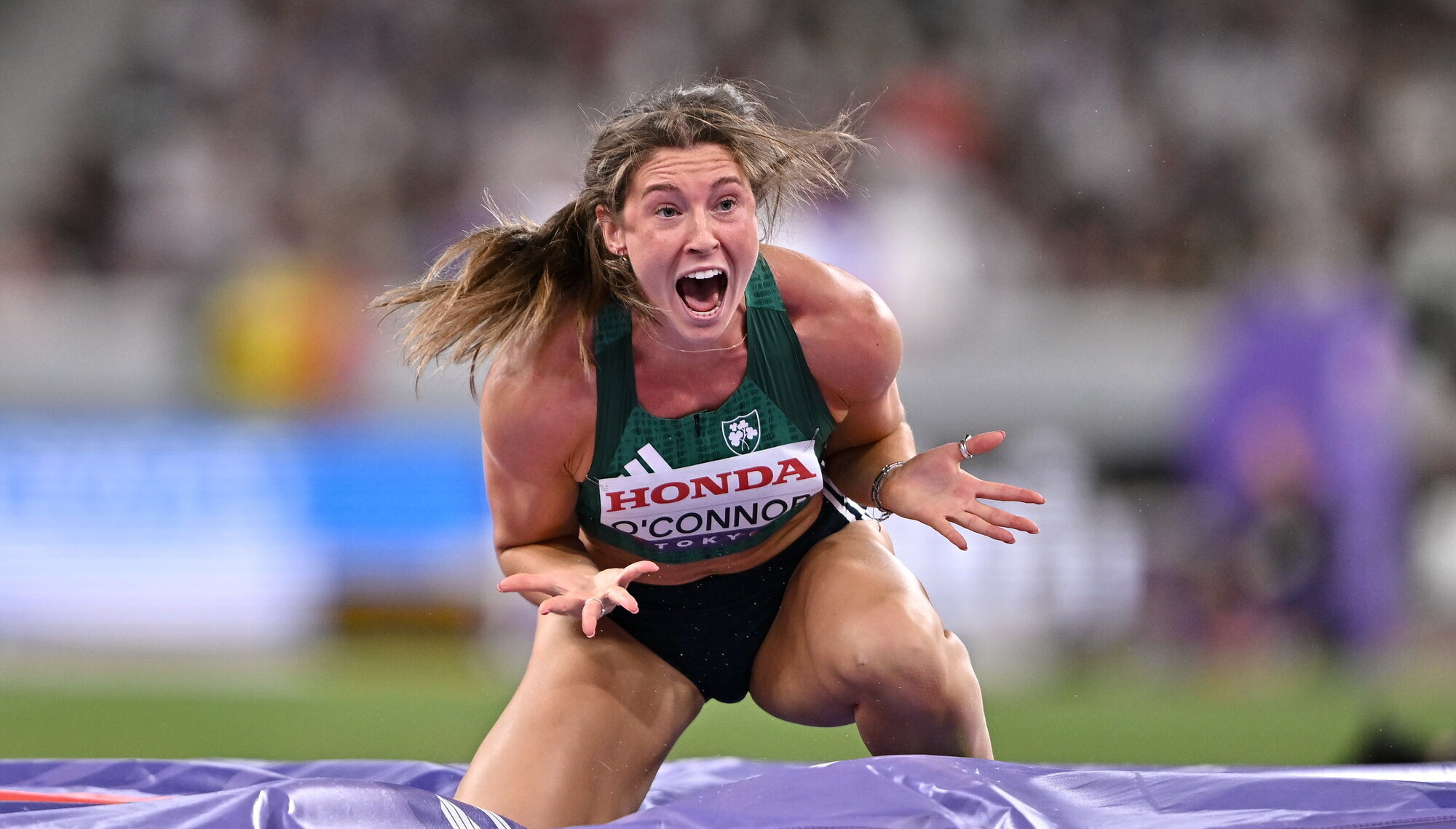
YEAR TO REMEMBER: Kate O'Connor celebrates a clearance of 1.86m, a personal best, in the Women's Heptathlon High Jump event. Picture: Sam Barnes/Sportsfile
Jenny Lehane had been eliminated from the Paris Olympics a full week by the time Kellie Harrington got into the ring at Roland Garros on the western fringes of the city and retained her title with a defeat of Yang Wenlu.
If the rest of the country lost its mind, Lehane’s thoughts were more considered. The Meath boxer came to a moment of realisation. The core of her ambition up to that point had been to qualify for the Games. The goal from then on would be to prosper at them.

Harrington has only recently announced her return from retirement, which means her influence on those around her has been limited to a still-significant presence in boxing’s high-performance unit where she had continued to train this last 18 months.
But the effect she had on Lehane last year will have been mirrored ad nauseum throughout this calendar year as Irish sportswomen stepped one-by-one up to the plate and knocked ball after ball out of the park. Records tumbled. Titles and medals stacked up.
Endless imaginations have been lit, dreams have dawned.
No-one was shocked when Kate O’Connor was named female athlete of the year at the Olympic Sports Awards in Dublin in December. Her performances spoke for themselves, and yet the absence of any grumbles was extraordinary in one way given the competition.

O’Connor had claimed four major medals in a multi-sport event with no Irish imprint. Four national records had fallen by the wayside as she stockpiled a silver at the Worlds on top of bronze at the European Indoors, silver at the World Indoors and gold at the World University Games.
It was a staggering haul, and it was needed to see off three bona fide world champions in Aoife O’Rourke (boxing), Fiona Murtagh (rowing) and Lara Gillespie (cycling). And, in Eve McMahon, a sailor ranked number one in her class worldwide at the age of just 21.
Sarah Healy, who became European Indoor 3,000m champion, backed that up with a first Diamond League win in the 1,500m, posted tenth in the World Championship final, and broke two national records, was another nominee.
The sixth was Ellen Walshe who had by then broken 15 Irish records, and subsequently went on to claim silver in the 200m individual medley at the European Short Course Championships the night of the awards and, a day later, a gold in the 200m butterfly.
Another striking aspect to all this is the litany of glass ceilings shattered. Walshe is the first Irish woman to win a European Short Course title. Gillespie is Ireland’s first female track world champion. Healy is the first to win that particular European event. On it goes.

It’s already been five years since the breakthrough 20x20 campaign came to an end. A two-year initiative to champion girls and women in sport, it worked wonders off the clever catchline of: ‘Can’t See It, Can’t Be It’.
Female sportspeople had long been making waves.
A promo picture taken around that time featured 20 or so elite athletes – Harrington, Cora Staunton, Rena Buckley, Jeny Egan, Louise Quinn, Katie-George Dunlevy among them - wearing their gear and looking determinedly at the camera.
As Lehane’s experience proves, the examples set by our brightest and best can have as much effect on experienced colleagues in the same high-performance programmes as they do on a six- or nine-year old watching the TV or sat in the stands.
Iain Dyer, the high-performance director of Cycling Ireland, made that very point to the Irish Examiner this month when estimating the trickle-down impact of Gillespie’s achievements for the rest of the elite riders and juniors on the way through the pathway.
And exceptional Irish performances weren’t limited to individual pursuits.
They flooded in from a wide and disparate range of team sports: from Katie McCabe’s Champions League title with Arsenal to Claire Melia’s prominence in becoming the first Irish woman to play in a EuroCup final when she lined up for Baxi Ferrol against Villeneuve d'Ascq LM in April.
Aoife Wafer was named player of the tournament in the Six Nations and returned in time for the back end of the World Cup where Ireland reached the last eight. Abbie Larkin’s goal helped the Republic of Ireland take down Belgium in a dramatic Nations League play-off. Sarah Rowe won a league title with Melbourne Victory in Australia.

Rowe followed that up with another AFLW campaign for Collingwood in a year where three of her fellow Irish players - Bláithín Bogue, Erika O’Shea and Vikki Wall – won the league with North Melbourne. Not just that, but Bogue, Jennifer Dunne, Niamh McLaughlin, Áine McDonagh and Dayna Finn were all named in the league’s team of the year.
And that’s not forgetting the habitual excellence in evidence throughout the annual Camogie and Ladies football championships. The Camogie final between Galway and Cork was a five-star thriller. Carla Rowe’s instinctive backheel finish for Dublin against Galway in the football semi-final produced one of the year’s best viral moments.
Ireland’s female para athletes weren’t to be left out.
Katie George-Dunlevy and Linda Kelly claimed another golden double at the World Track Championships, Orla Comerford claimed her own pair of titles in the T13 100m and 200m in Paris in September and Greta Streimikyte topped the list in the T13 1,500m.
Róisín Ní Ríain hoovered up four medals at the World Swimming Championships in Singapore that same month, the silver she secured in the S13 400m freestyle joining the same result in the 100m backstroke and 100m breaststroke and a bronze in the 100m butterfly.
There is no neat way to corral everything here.
We’re nearly 1,000 words in and only now getting around to mentioning Nicola Tuthill who won medals in the hammer at the European U23 Championships, the World University Games and at the European Throwing Cup, and was far from elated at finishing 11th in the Worlds in Tokyo.
How could we not mention Fionnuala McCormack, the 41-year old mother of three who made top-10 in the World Championships and New York City marathons? Or 45-year old Caitriona Jennings’s stunning runs in the 50-mile and 100-mile categories?
That’s one end of the spectrum. The other is 17-year old showjumper Emily Moloney who became a double gold medallist at the summer’s European Youth Championships, in Reisenbeck, Germany. There are times when it’s hard to know where to look.
Have we left anyone out? Of course, we have. Katie Taylor went and retained her various world titles by beating Amanda Serrano again, in Madison Square Garden no less, and all it earns her is a footnote here. It’s been that good a year.