Colin Sheridan: Troy Parrott taking long way round, so can Evan Ferguson
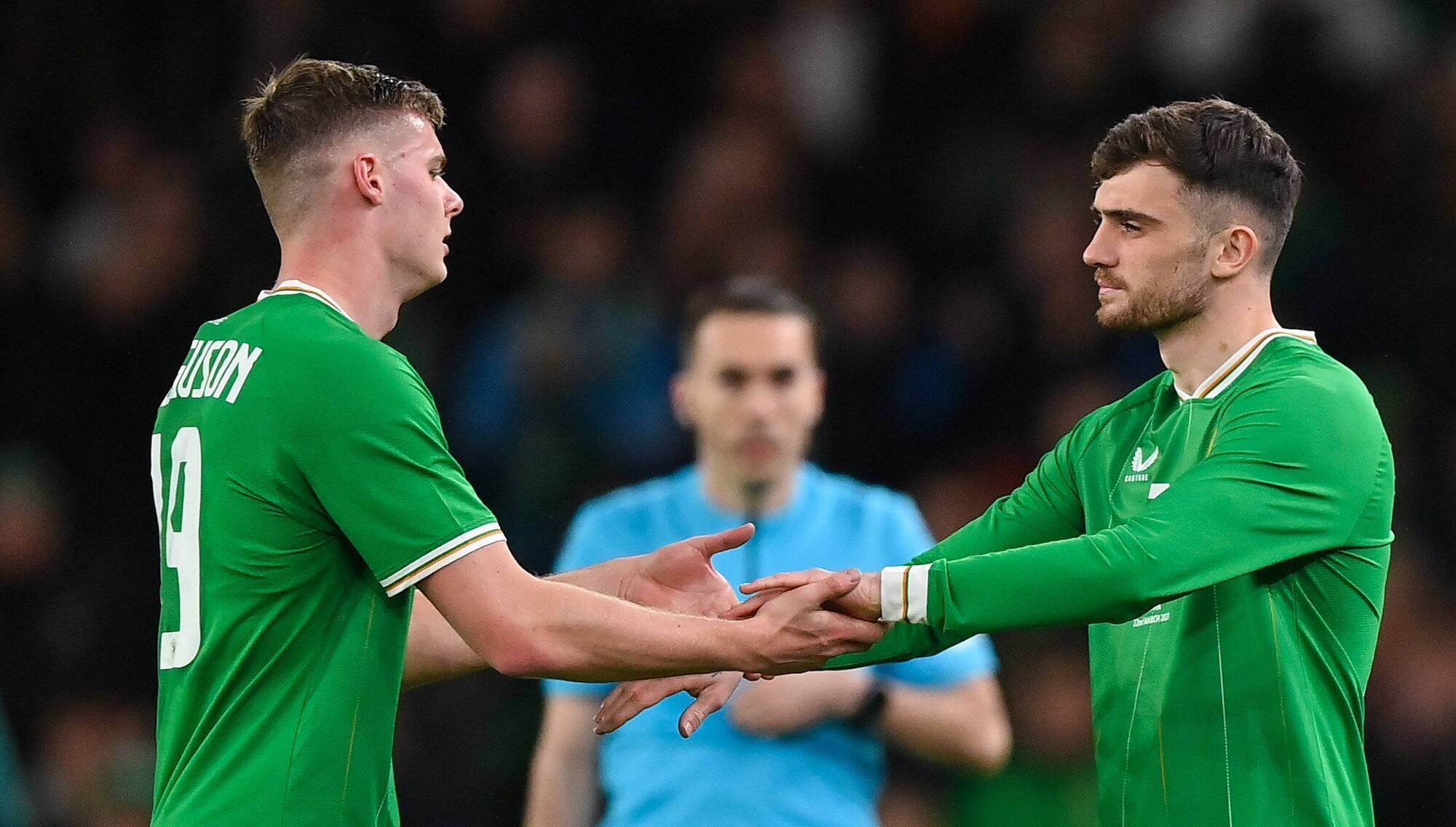
Troy Parrott's career suggests a possibility other than English football for Irish players. Pic: Brendan Moran/Sportsfile

There are two exceptionally difficult things to do as an Irish footballer. The first is to make it. The second, perhaps, is to make it somewhere other than England. Which is why Troy Parrott’s move to Real Betis feels considerably more significant than another Irish player securing a €20 million transfer.
Parrott is 24 now. Betis have signed him until 2031 after a season in which he scored 31 goals and supplied 12 assists for AZ Alkmaar. He leaves the Netherlands for Seville, La Liga and Champions League football having achieved something Irish players have traditionally found extraordinarily difficult: he went abroad and got better.
And then, presented with the opportunity to return to the familiar embrace of English football, he resisted it. That might be the most encouraging part.
There was a time when Parrott’s career seemed to be travelling in precisely the opposite direction. He left Portland Row in Dublin’s north inner city for Tottenham as one of the most coveted teenagers in European football. By 17 he was training with Harry Kane and Son Heung-min and making his Premier League debut.
Then came Millwall, Ipswich, MK Dons, Preston, the great conveyor belt of loan football. None was catastrophic. None suggested inevitability either. There were questions about Parrott then, as there inevitably are about extraordinarily talented young footballers. Could he develop physically? Could he score regularly? Could he cope with being away? Did he possess the mentality?
José Mourinho even questioned that last part publicly. And somewhere along the way another Irish striker appeared.
Evan Ferguson did not so much overtake Parrott as disappear over the horizon. Ferguson was younger, bigger and scoring Premier League goals for Brighton while Parrott was still trying to establish exactly what sort of professional footballer he might become. Ferguson scored a Premier League hat-trick at 18. The usual names of enormous clubs began appearing beside his. For a while, Irish football's future at centre-forward seemed wonderfully straightforward.
It isn't now.
And perhaps that is the useful lesson in placing the careers of Parrott and Ferguson alongside one another.
Development is not linear. Parrott eventually went to Excelsior in Rotterdam and scored. Then he went to AZ and scored considerably more. Last season brought over 30 goals and a dozen assists. For Ireland, too, something changed. The extraordinary performances against Portugal and Hungary last November did more than briefly revive a World Cup dream. They showed a footballer who had acquired something that cannot easily be coached: certainty. Parrott looked like he belonged.
Now Betis have paid accordingly. There is something particularly admirable about choosing Seville. West Ham wanted him. England was available again. Familiar language, familiar football, familiar culture.
Instead, Parrott has chosen Manuel Pellegrini, Betis, La Liga and another adaptation. For an Irish footballer, that matters. We have spent generations exporting footballers almost exclusively across the Irish Sea, sometimes treating England not merely as one pathway but pathway. Parrott's career suggests another possibility. The Netherlands didn't represent exile from serious football. It made him a better footballer. Spain might do so again.
Which brings us back to Ferguson.
His story deserves none of the obituary-writing that football specialises in. He is - rather remarkably - still only 21 years old. His season at Roma was interrupted and eventually ended by an ankle injury requiring surgery. He scored five times in 22 appearances. He is back at Brighton rehabilitating, with Hürzeler saying he is making progress, while another move to Italy - Genoa this time - has been discussed. There remains an exceptional centre-forward in there. We have already seen him.
The concern is simply that Ferguson presently needs what Parrott eventually found: somewhere to play, somewhere to stay fit, somewhere that allows a young footballer to stop being a prospect and become himself.
Three years ago, if asked which of the two would be joining a Champions League club in Spain in 2026, very few of us would have answered Troy Parrott.
That is not an indictment of Ferguson. It is the entire point. Careers turn. Bodies recover. Confidence returns. Footballers develop at different speeds and sometimes in different countries.
Parrott, the kid from Portland Row who appeared destined for Tottenham and then seemed destined for something considerably less, has taken the long way around. Rotterdam. Alkmaar. Now Seville.
Sometimes the long way around turns out to be the best route to greatness.
There was something uncomfortably symbolic about the barricades outside Croke Park on Thursday. More than 200 All-Ireland winners had signed a letter asking the GAA to reconsider its relationship with Allianz. Dr David Hickey, three-time All-Ireland winner, surgeon and humanitarian, wasn't permitted inside to hand it over. Pat Gilroy noticed the symbolism too.
“I certainly don’t feel I belong in there any more,” said the man who managed Dublin to the 2011 All-Ireland, adding that he would not return while “this carry-on continues”.
Those are extraordinary words from somebody woven so deeply into the Association. This campaign isn't disappearing. Nor should it. A year ago, almost 800 current and former inter-county players signed the original petition. Since then, counties have passed motions, Dublin players have protested, Congress was disrupted, and names including Brian Cody, Jimmy Barry-Murphy, Colm O'Rourke, Peter Canavan and Anthony Tohill have joined the call.
At its heart remains an uncomfortable question the GAA cannot barricade away. Allianz was named in UN Special Rapporteur Francesca Albanese's 2025 report examining corporate involvement in the economy sustaining Israel's occupation and war in Gaza. Allianz emphatically rejects allegations of complicity and the GAA, having considered the matter through its Ethics and Integrity Commission, has chosen to continue the relationship.
It is entitled to make that decision. The rest of us are entitled to believe it is profoundly wrong. Gilroy's simplest argument on Thursday was perhaps his strongest: if there is even a tiny possibility that severing this relationship contributes to pressure that saves a human life, what price sponsorship?
Campaigns lose oxygen. Outrage moves elsewhere. Gaza disappears from headlines while suffering does not. Which is precisely why Thursday mattered. The GAA should listen again. And then it should walk away.
A video resurfaced before Saturday's renewal of rugby's greatest rivalry, and perhaps said more about it than anything that followed at Ellis Park. Jonah Lomu visits Joost van der Westhuizen, by then confined to a wheelchair by motor neurone disease. Twenty years earlier, they had been giants of the 1995 World Cup final, Van der Westhuizen famously stopping the apparently unstoppable Lomu. Now both were fighting battles rugby couldn't help them win. Lomu, suffering from a rare kidney disorder, died in 2015, aged 40. Van der Westhuizen followed in 2017, aged 45. New Zealand won 33-16 on Saturday, but that old footage was the weekend's most powerful rugby.
Perhaps only in Bilbao could you bring home the World Cup and still get booed. Athletic Club attempted the most conventional of football ceremonies at San Mamés on Saturday: Unai Simón, Aymeric Laporte and Nico Williams, local heroes and newly-crowned world champions, paraded Spain's Jules Rimet before their supporters. Some cheered, others whistled and many booed. Which, in the Basque Country, is considerably more complicated than ingratitude. Athletic might be Spain's most distinctive football club precisely because a significant part of its identity exists apart from Spain. Its unique recruitment philosophy is inseparable from that sense of Basque nationhood. Three Athletic players conquered the world last month. On Saturday night they couldn’t even appease their hometown fans.