Éamon O'Shea: D-to-D cluster bagels, puckout battleground, sweepers, time. And space.
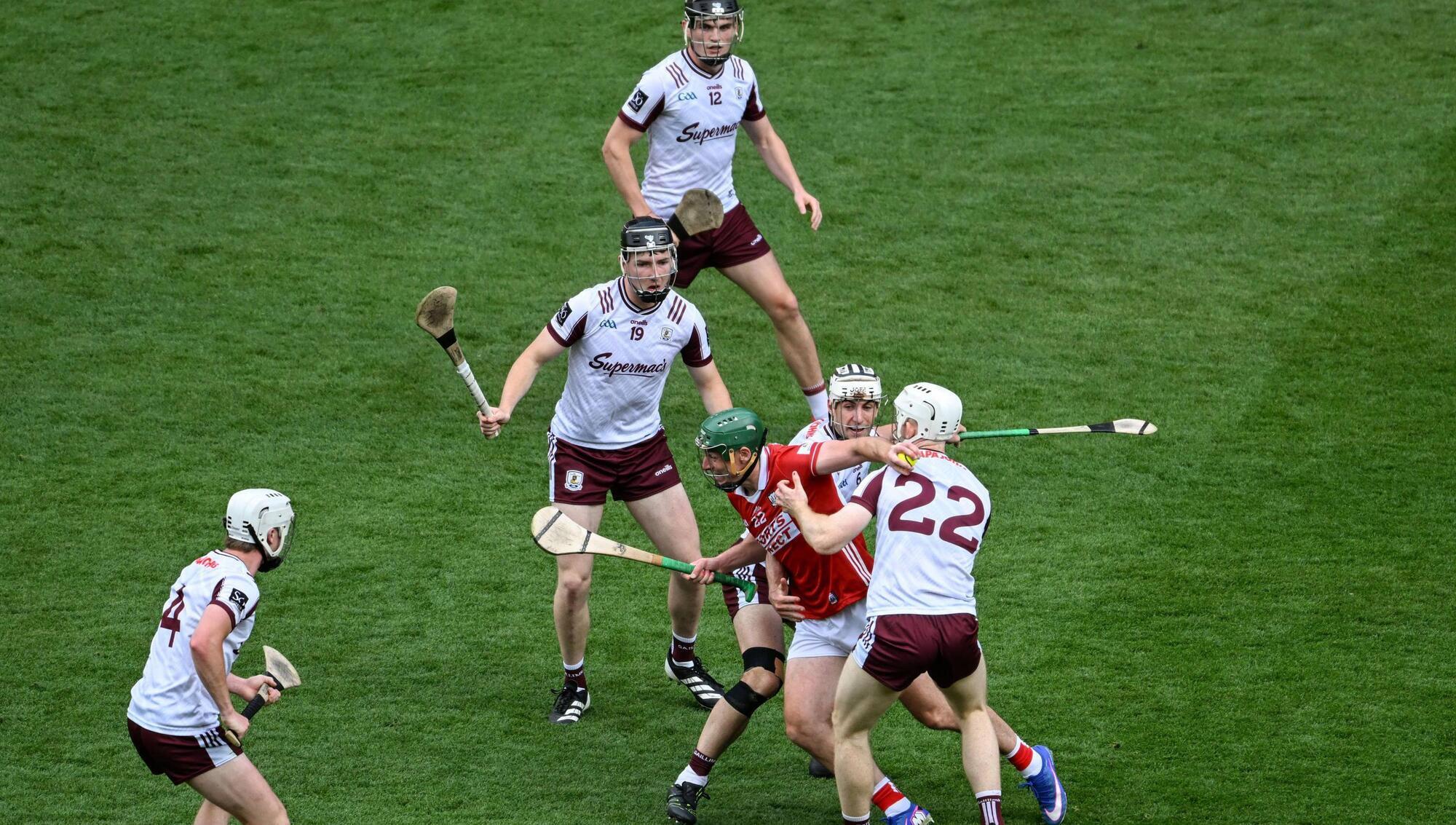
NO TIME, NO SPACE: Cork's Robbie O'Flynn is bottled up by Galway's Darren Morrissey, Darragh Neary, Cian Daniels, Daithí Burke, and Joshua Ryan in the All-Ireland SHC semi-final at Croke Park. Pic: Daire Brennan/Sportsfile
I am indebted to Kai Havertz, the Arsenal and German forward for helping me to understand my hurling career backwards. In a recent World Cup interview in The Guardian, he proclaimed: ‘I make runs that look pointless, but I am making space’.
Exactly Kai, that’s how I felt for years playing club hurling in North Tipperary in the seventies and eighties. In truth, most of my runs were probably pointless. I was less a creator of space and more a waste of.
My own explanation for that pointlessness, drawn from an exceptionally elementary understanding of black holes, is that the gravitational pull of hurling conservatism at that time was so strong that light could not get out – there was no escape.
I was not to know it then, but there was no point in even trying. I simply became a victim of spaghettification.
The latter is not really a human thing. More to do with stars, those of the nuclear fusion variety, rather than the human variety, though I was quite long and thin back then.
Well, time has moved on and space is all the rage nowadays. Although, curiously, the hurling world is now consumed with closing it down rather than opening it up – maybe black hole physics is now on the revised coaching curriculum. Who knew?
The D-to-D cluster bagel is now standard fare in most counties, combined with a one or two up top. Both Limerick and Galway play a version. Both play it very well. Holding on to the ball has become the primary objective, even if that sometimes means curtailing the natural instincts of players to attack.
The battle for possession in the middle third of the pitch is important because it determines who controls the game. The team that exercises most control between the two 45’s will win Sunday's All-Ireland final.
Taking players out of forward duties to gain possession further out the field should in theory create space up-front and therefore lead to more goals. Yes and no. Yes, in a practical sense, less bodies; no because sweeper systems are now more complicated than drone defence technologies.
In the old days you had to get a court order or a papal dispensation from the Vatican to employ a sweeper. Not anymore.
And what type of player does the sweeping job? The choice depends on what your counter-attacking structure looks like. Good strikers get the ball in quicker and longer to the full forward line – think Ronan Maher; good runners can make ground quickly into the opposition half – think Brian Hayes of Dublin; good link players can change the direction of attack very quickly – think Tadgh de Búrca of Waterford.
Or maybe you might be lucky like Galway and have Cathal Mannion – the ‘everywhere man’. Limerick, on the other hand, tend to have multi-skilled operatives and any one of them may have to do a bit of sweeping at any stage of the game.
And where will the sweeper sit on Sunday – top of the D or on either side? Galway, for example, will be mindful against Limerick of the need to protect the space in front of the 13 (Gillane) position more than anywhere else. This may well be a real dilemma for them, if the ‘everywhere man’ is busy elsewhere.
Aaron Gillane may not yet be firing on all cylinders, but the smart thinking would be to assume he will be on Sunday. Class is permanent, especially when pressure ramps up.
And how will Limerick play young Rabbitte – some form of doubling up I wager. Two may not be enough however – this young fellow has the mentality, physique and technical ability to take on any task on a hurling pitch.
When space is restricted, the type of scores in a match are affected. Players are now shooting points from everywhere. Paul Kinnerk was first to recognise this. Shot count is now the most important indicator of dominance.
Missing does not matter much, because puckouts are the new battleground and you will soon have the ball back again, if your puck-out strategy is better than the opposition’s. But who is best at this - Limerick or Galway. Limerick were the market leaders on this metric, but Galway have caught up. And what about use of the ball then?
Maybe one thing though that you need to watch for is the influence of Croke Park topography on structures and spaces - and therefore the outcome of games. Cork, for example, are a Munster team that have not yet figured out the invisible contours of Croke Park; Limerick are a Munster team that have, and that makes them very dangerous. But Galway have been rebuilt to perform in Croke Park.
Sometimes, I am asked by clubs for guidelines for space creation on the hurling pitch. And I am sure it’s an ongoing disappointment for those who ask me, because my answers are never compelling. It’s very difficult to explain how space is created, when it depends so much on the mind. Much easier to give tips on closing it down – the familiar structure versus creativity dilemma.
When I coached Tipperary we never really ran formal coaching drills for space creation and/or goal scoring. Information overload can stifle creativity. The configurations of the coach dissolve in a nanosecond, making his words redundant almost immediately they leave his mouth, particularly in such a fast-moving game. Better you learn to think for yourself. That is why we relied more on our imagination and our innate confidence in our striking than on hard rules.
You are not looking for perfection, but the striker must be as decisive as he is brave. Hesitation is fatal for the receiver, because once he makes his move, the ball must be given – any delay means that the equation must be recalculated. Trust within the group is as important as developing the technical skills to connect on a hurling pitch. Both coaches, Paul Kinnerk and Franny Forde, know this, so not much difference there.
Some coaches worry too much about what can go wrong. Better to think about what can go right! You must take risks to win big. The team that takes the most risks on Sunday will win. The young and the unproven sometimes take the most risk. That’s what makes them so compelling.
That said, space is never constant – it especially looks different when the stakes get higher. It’s waiting now, as you read this piece, in Croke Park, waiting expectantly for those who want to play when the stakes are highest; waiting to disappoint those who show even the slightest hint of anxiety. Measure it in the pulse, see it in the faces on Sunday – space just shrugs its shoulders and exists or doesn’t exist, appears and disappears.
Neither does space require constant movement or lung-bursting runs to find it. Sometimes standing still can open space for others; equally just pivoting in or out of a position can give you that split second for a strike. I had the privilege of working with dedicated space travellers in Tipperary for nearly a decade. Some of them walked into space, some of them jogged into space, and a few of them even ran into space. I’m sure you can assign names to these various categories!
Ultimately, the job of the coach is to activate, stimulate and help connect the human dots, thereby allowing talent to shine in a collective sense. Having a plan is a necessary but not sufficient condition for victory. Even with a plan, every player needs permission to play and to flourish.
Once potential is unlocked and unleashed it cannot be put back in the bottle – the player, the person, the whole, are never the same again.
Find a way to do that and anything is possible. On a hurling pitch and everywhere else.
And you still need a formal prediction for the match on Sunday. You have not been paying attention. I already told you back in June!

CONNECT WITH US TODAY



Be the first to know the latest news and updates