Paul Rouse: Einstein understood well the value of experience
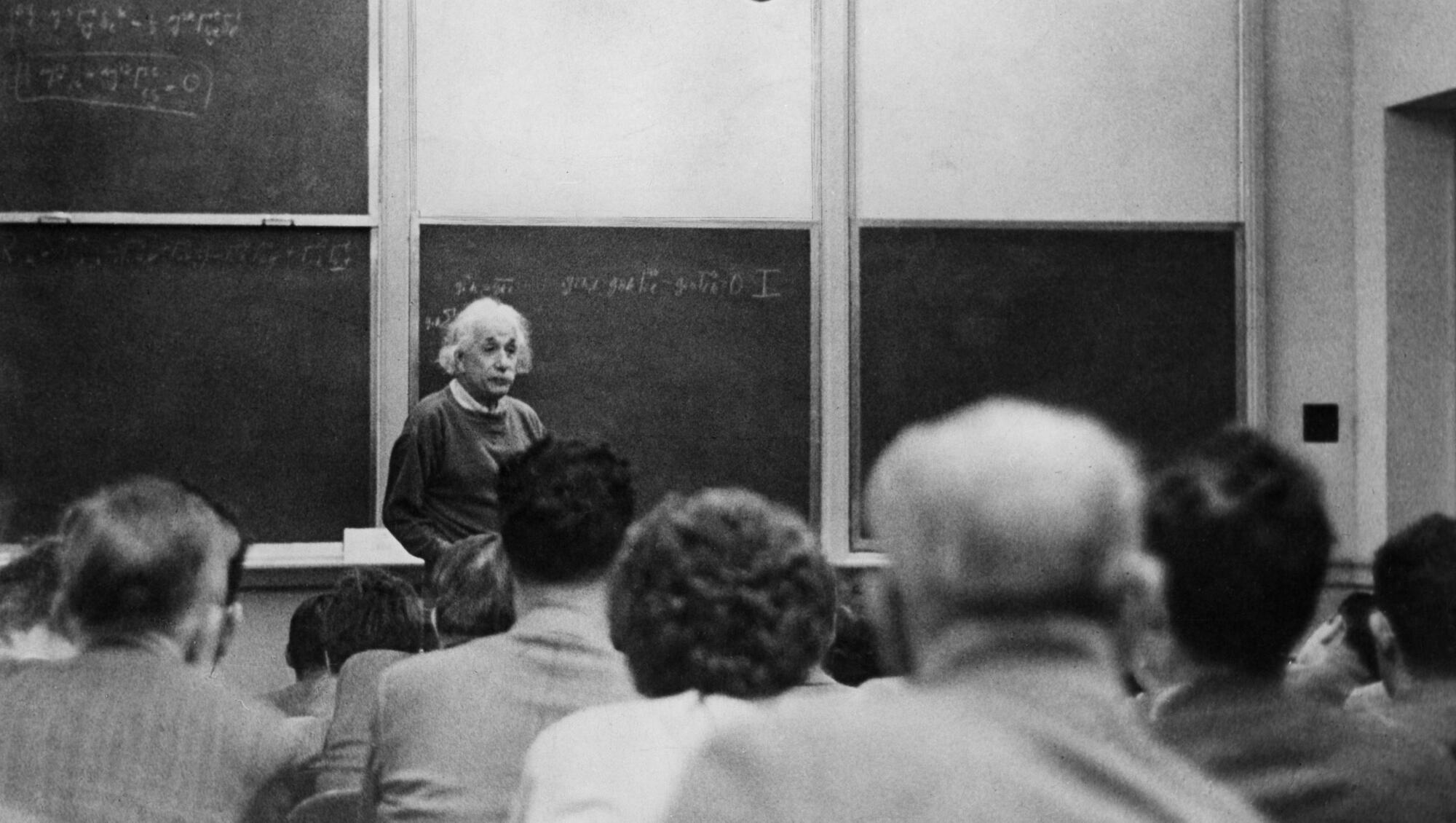
Einstein at his first lecture at the 'Institute for Advanced Studies', Princeton University. Pic: ullstein bild/ullstein bild via Getty Images

There is no evidence that Albert Einstein ever coached a football or hurling team.
Indeed, he had no real interest in sport, apart from sailing. He loved the fact that it was something you could do sitting down. And while Einstein was no sportsman, the words that he spoke – or, in some instances, was claimed to have spoken – are vital to anyone who ever coaches, or has ever been coached.
If nothing else, they are useful as a corrective against the tendency to PlayStation coach from the sidelines, or to imagine that the game isn’t ultimately about the players.
Einstein was a theoretical physicist who – by the 1930s – was the most famous scientist in the world. He had fled Nazi Germany and found refuge in America after 1933. He was by then 54 years of age and went to work at the Institute for Advanced Study at Princeton, in the state of New Jersey.
It was during that period of his life in Princeton that Einstein found himself in a situation where he had no option but to take a golf lesson. It was not something he wished to do, more that he couldn’t find an acceptable way out of it.
It was not a success.
For all that the man assigned to teach him how to pitch and putt was enthusiastic and committed to the task, Einstein did not show any of the sort of ability that might suggest an Indian summer in his sporting life.
The story of what happened next may not actually have taken place (the world of sport is full of myth and legend), but its full truth is irrelevant beside its usefulness as a reminder of what matters.
As Einstein made mistake after mistake, the golf instructor offered tip after tip. This continued until Einstein asked the instructor – whose name was Gigi Carnevale, a young professional whose name is now immortalised in a trophy played for by amateurs in New Jersey – to hand him some golf balls. Einstein then took the golf balls in his hand and threw them at Carnevale shouting ‘CATCH!’ No ball was caught.
At which point Einstein is supposed to have said to his instructor: ‘Young man, when I throw you one ball, you catch it. But, when I throw you four balls, you catch nothing! So when you teach, make only one point at a time!’ This story feels too polished to be entirely true – indeed, it may not have happened at all.
What is certain, though, is that there are other words that Albert Einstein definitely did write that are also vital to everyone who coaches or manages or takes it upon themselves to offer people advice on how to live any aspect of their lives.
It reads: "Being both a father and teacher, I know we can teach our children nothing … Each must learn its lesson anew." Einstein’s basic point is that it is the experience of just trying – trying and succeeding, trying and failing, trying and neither succeeding nor failing – that is the best and truest teacher.
The quote from Einstein sits on the opening page of Andrew Ross Sorkin’s exceptional book, . This book explains the human flaws that drove the world to ruin in the Great Depression.
The economic crash which destroyed so many fortunes and pushed many millions deep into poverty 100 years ago was the product of greed, hubris and the manipulations of men who cared only about themselves.
A similar bubble is currently in creation. It can be seen daily in the rise in stock markets and in the ridiculous valuation of Elon Musk’s company ‘SpaceX’. Ultimately, it is a bubble which is supposed to rest on the way economic productivity is being transformed by Artificial Intelligence. The hype is that this technological change is driving wealth to levels previously unimaginable and will transform human life.
To add to the scale of the hysteria around ‘SpaceX’, the valuation of the company seems to be linked to its promise of an interplanetary future. If Musk’s record of broken promises and predictions wasn’t enough to ring alarm bells, the whole use of ‘space’ to set the valuation of this company might rightly be expected to have done the trick. The opposite is currently the case: people are throwing money by the shovelful into the hype furnace.
The 1920s stock market rise was rooted in similar nonsense: human capacity was being transformed by technological change (things like the radio and the motor car) and everyone was now going to be rich.
Reading this book is a reminder that although history never repeats itself, its echoes are there for all to hear.
Which brings us back to the matter of experience. In the making of a player, there is nothing that can compare to it. The single greatest opportunity to learn is through experience. While it does not guarantee that it will educate, it nonetheless always offers the prospect. That is as true in success as it is in failure, providing there is enough humility at play.
And the bottom line is that allowing any player the time and space to learn is fundamental to coaching.
By contrast, too many sidelines are filled with people who roar: ‘I told you to….’, ‘Didn’t I tell you not to…’, and other variations rooted in the wisdom of hindsight and the insecurity of self-importance.