Colin Sheridan: Sport is America's last shared religion
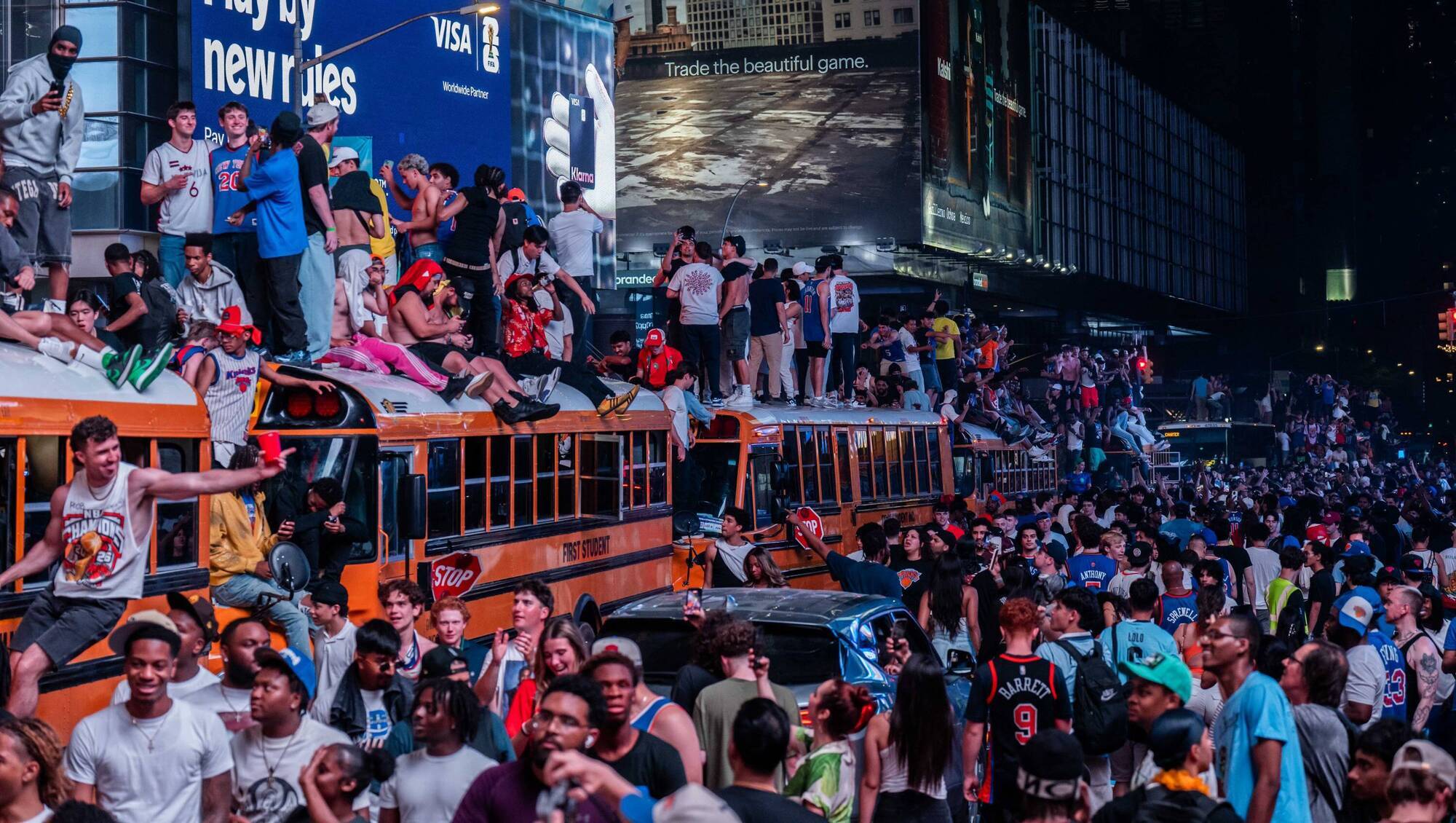
The New York Knicks ended a 53-year wait for an NBA title with victory over the San Antonio Spurs. Fans gathered in the city to celebrate. Pic: Adam Gray/Getty Images

The United States of America currently resembles a nation attempting to stage every sporting event in human history simultaneously. It is a feverish, high-decibel display of cultural excess.
The New York Knicks have finally broken their 53-year championship drought, bringing an end to over half a century of disappointment, delusion, false dawns, and tabloid humiliation. Somewhere in the five boroughs, a grandfather who remembers Willis Reed is now hugging a grandson who thought suffering was simply an inherent, inescapable part of being a Knicks fan. It is a generational bridge built on the back of a trophy, turning decades of misery into a singular, shared moment of catharsis.
While the city celebrates, the broader league looks toward a bizarre new frontier. Victor Wembanyama, a seven-foot-four Frenchman who appears to have been assembled in a laboratory specifically dedicated to disproving the laws of physics, waits to inherit the throne. He moves like a guard, shoots like a wing, and blocks shots like a medieval castle wall; watching him, the future of basketball feels less like the natural evolution of the sport and more like science fiction made flesh. Yet, even as the NBA finds its new messiah, the rest of the country’s sporting calendar remains claustrophobically packed. The Stanley Cup Finals rage on, the U.S. Open peeps above the parapet, and the World Cup lands like an anvil.
Amidst this, baseball — defying the constant eulogies of the sportswriters — is somehow alive and flourishing. It persists not just in the corporate machinery of major league ballparks, but in the places where the game has always held the most weight: the municipal parks where the sun-drenched grass meets the chain-link fences.
It lives in the quiet, intimate rituals that define it - a father teaching a son how to grip a curveball, or a son teaching a father how to navigate a digital scoring app on his phone. For all the clichés regarding American decline, there remains something undeniably moving about baseball’s refusal to die. It survives because, fundamentally, it was never really a sport. It was always a memory, a tether to a summer evening when there was still enough light to play one more inning.
Perhaps that is what fascinates sceptics like me most about America in 2026. For all its deep political division, its corrosive cultural fragmentation, and the suffocating weight of geopolitical uncertainty, sport remains one of the few things capable of gathering millions of people, regardless of origin, around a common story. It is not about consensus, nor is it about political unity; it is simply a shared narrative - a reason to care about something that exists entirely outside the self. In an age where every traditional institution appears under siege, sport increasingly functions as America’s last, and perhaps only, reliable civic religion.
This status explains why everything surrounding the games has become so profoundly absurd. Consider the spectacle unfolding this weekend: a study in jarring contradictions. On one hand, there are children playing baseball in municipal parks untouched since the 1950s.
On the other, a UFC event is taking place on the South Lawn of the White House - the seat of the most powerful political office on Earth transformed into a cage-fighting octagon, surrounded by floodlights, television cameras, and thousands of spectators. A federal judge was required to clear the path for the event, which is officially presented as a centerpiece of celebrations marking America’s 250th anniversary. While critics have questioned the symbolism and the appropriateness of staging cage fighting at the heart of the American government, the event feels strangely fitting. Modern America increasingly communicates through spectacle, where politics and entertainment dissolve into one another until the boundaries vanish entirely. The White House becomes a fight venue; the absurd becomes the new normal, and the normal becomes invisible.
Through it all, sport continues to function as both a mirror and an escape. Nowhere is that contradiction more obvious than in the manifestation of the World Cup. We will lament stadiums surrounded by sprawling parking lots, the exhausting distances between venues, the creeping corporate excess, and the inevitable cooling breaks. We hear the looming threats of commentators who will insist on telling us we have reached "the end of the first quarter" in a football match - a phrase that should, by all rights, result in immediate deportation proceedings.
But then, when the football begins, something shifts. Morocco run Brazil ragged; Argentina tango with Spain. A nation of five million people will terrify a global superpower. And in those ninety minutes, every criticism will evaporate.
Sport always wins in a way, and that is the secret buried beneath the noise. People do not watch because it is rational. They watch because it offers the one thing modern life has made increasingly scarce: belief. It offers the possibility that something impossible might happen. Whether it is a Knicks title, a giant French teenager changing the geometry of the court, or a cursed team finally winning a trophy, the details are mere window dressing. The mechanism remains the same: hope. That is the currency being traded - not tickets, not subscriptions, not merchandise.
America manufactures these myths at an industrial scale. It understands better than any country on earth how to harness the superstitions that convince entire fan bases that the universe has taken a personal interest in their misery. The stories are ridiculous - until they aren't. Until the buzzer sounds, until the trophy is lifted, until 53 years of accumulated disappointment vanishes in a single evening.
Perhaps that is why the rest of us, however suspicious, cannot look away. America often appears grotesque in its scale, excessive in its ambition, and exhausting in its presentation. It commercialises every pause and monetises every heartbeat. And yet, it remains uniquely capable of producing moments that feel larger than the games themselves. A father and son playing catch in the fading light; a city waiting half a century for redemption; a World Cup arriving amid global uncertainty. None of it should belong together, yet all of it somehow does. America remains the world’s great sporting contradiction - part carnival, part cathedral, part shopping mall, and part mythology. For better or worse, we are all still watching.
Last Sunday evening, Alexander Zverev lay flat on the red clay of Roland Garros, arms spread wide, tears in his eyes and 15,000 people rising to salute a champion. The scene was irresistible. A first Grand Slam title after years of near-misses, a career-threatening ankle injury suffered on the same court three years earlier, and finally the moment of fulfilment. Even Zverev framed it as redemption. Court Philippe-Chatrier, he said, had been the site of the lowest moment of his life. Now it was the scene of his greatest triumph. Sport loves a redemption story.
Broadcasters love it even more. The arc is neat, emotionally satisfying and easy to tell. Suffering, perseverance, reward. The problem is that Zverev's story has never been that simple. For years, allegations of domestic abuse have followed him. He has consistently denied wrongdoing. A legal case brought by a former partner in Germany was settled last year without a verdict or admission of guilt. Yet the allegations themselves, and the disturbing details that accompanied them, remain part of the public record. That does not mean every mention of Zverev must begin and end there. Nor does it mean his sporting achievement should be dismissed.
Winning the French Open is a magnificent accomplishment, one earned through talent, resilience and years of disappointment. But redemption is a loaded word. It asks us to believe that a chapter has closed and that an account has been settled. In Zverev's case, that is not something tennis can decide. His victory deserves applause. His perseverance deserves recognition. Yet the full story requires a degree of honesty that sport is often reluctant to embrace. The trophy may complete the tennis narrative. It does not erase the asterisk beside it. That is not unfair to Zverev. It is simply the reality of the story.
For a broadcaster that still holds itself out as the home of Gaelic games, RTÉ’s failure to provide any network highlights programme on a weekend of championship football is baffling. These were high-stakes summer fixtures, some effectively knockout contests. Yet viewers were left with no Saturday night review, no meaningful highlights package and no opportunity to relive the drama unless they sought clips elsewhere. This is becoming an annual own-goal. RTÉ appears unwilling to modernise its coverage, unwilling to rethink The Sunday Game, and increasingly disconnected from how supporters consume the championship it is supposed to showcase.
As the US Open returns to Shinnecock Hills, Shane Lowry faces a challenge that has little to do with technique. He has already secured what every golfer craves: A major championship and financial security beyond measure.
Lowry no longer needs to protect a reputation or chase a payday. He has earned the right to swing freely and compete without fear. Yet too often in recent majors he has flattered to deceive, lingering on leaderboards before drifting away dramatically on Sunday. The talent remains. What is required now is endurance, conviction, and four days of sustained belief. Lowry has nothing left to prove financially. He still has plenty to prove competitively.