D-day for FAI 'summer soccer' plan - outcome of vote will polarise
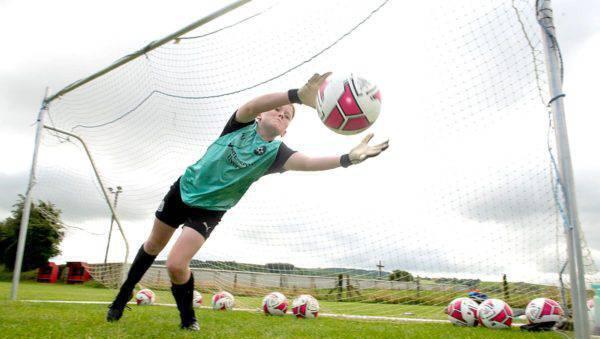
SUMMER SOCCER: Danny Conroy making this save at the T&S Utd FAI Summer Camp.

BALLOTS are in vogue, be it the General Election or GAA special congress, and Thursday is the turn of football folk to cast their votes.
This motion, ratifying the implementation of a calendar season across the entire game in Ireland on a phased basis by 2028, is being categorised in similar magnitude to the aforementioned pair.
According to FAI President Paul Cooke, all clubs and leagues leaving behind the traditional school year season of September to May is a "defining vote in relation to the future of Irish football."
The simplest description of the change is aligning every facet of the game to the League of Ireland format in place for the past 21 years.
That will entail the campaign kicking off in February, or March for mid-teens, and finishing in October.
If that seems straightforward and logical, well it hasn't proven so in practice.
First up is the question of who has jurisdiction to decree policy.
To some around the professional game at senior level, decision-time ought not to be tomorrow's forum of the General Assembly.
While this isn't the first time for the summer season concept to be broached, this iteration originated in Marc Canham's Football Pathways Plan (FPP), launched in February.
This, as the FAI stress, is only one of 11 actions arising from that long-term strategy but has dwarfed the rest during the intervening months.
General Assembly and annual general meetings have covered the thorny topic of implementation 2026 start date and the pace intensified once the FAI board approved the proposal on October 11.
That blessing, considering the 14-person board consists of directors across various affiliates, what interpreted as significant but not decisive.
Throughout the various stages the FAI trumpeted as consultation, those operating with teams, clubs and leagues in football from the youngest at eight years of age to adult amateur were assured of democracy.
It has translated into tomorrow being D-Day.
The General Assembly consists of 135 members sourced through three pillars - professional, amateur and national bodies. For explanation purposes, the first of these is predominantly national league clubs. Likewise, the latter is dominated by schoolboys/girls league.
Tomorrow's outcome rests in their hands. A simple 51% majority is required for a rule change.
75% is the waterline for constitutional amendments, a level controversially not reached 13 months ago for a board configuration ballot. A tweaked version was subsequently endorsed.
More work has gone into this campaign for acceptance.
Presentations from Canham, along with his assistant Shane Robinson and former league director Fran Gavin, have been delivered for months and, more specifically, the pitch ramped up in recent weeks during remote calls separately with the three pillars.
In essence, the FAI view this measure as essential to avoid slipping further behind European peers, particularly in the men's game.
Packie Bonner, a board member since 2021 who chairs the international and high-performance committee, has pleaded with delegates to synchronise the seasons, lamenting Ireland's status as an outlier.
He and his chief executive David Courell have pointed out that Ireland remains the sole country within Uefa's umbrella without a football pyramid .
On that comparative theme, reference has been made during the charm offensive of Ireland being one of 11 countries operating a summer season.
No specifics, other than a generality about Scandinavian nations dodging harsh weather, were provided but we detail them as Estonia, Faroe Islands, Finland, Iceland, Ireland, Kazakhstan, Latvia, Norway, Sweden and Moldova.
All of the other 80% - including the top 16 men's teams, as per the last Nations League A split - are wedded to the conventional schedule. This is the typical mainstream season for national bodies and European competitions, leaving space for international tournaments in the summer.
Some observers have pointed to a method behind the choosing of this winter date for a final judgement.
Granted, temperatures in early December are low but in a broader sense this season is hardly the one to declare as a template for change.
Mild weather so far has resulted in scant postponements, certainly none of the blanket cancellations by local authorities which enrage parents, coaches and players.
By this stage, most underage and amateur clubs have clocked up over a dozen games uninterrupted.
Amongst the arguments cited by the FAI is the 60% cancellation of fixtures between November and February, yet its been well established that games break from mid-December to the middle of January.
If anything, recent patterns have displayed the riskiest periods for adverse climate are the months of February and March – both part of the proposed concept.
Additionally, within the increased allocation of grant aid to football this year, all-weather pitches are central. These artificial surfaces are prominent too in the FAI's own wishlist for Government grants – a total of €75m funding a projected 176 pitches, both new and upgrades. The clue about their benefit is in the name.
That trend has been replicated in the senior game to the extent that half of next year's First Division's clubs will operate on astro.
Bray Wanderers became the latest to ditch natural grass, joining Dundalk, Athlone Town, Wexford and Kerry in believing the 12-month availability is the cost-effective method for their host of teams to train and play.
Like the political system, it will all come down to the numbers of who logs on remotely or attends the summit at a Dublin hotel.
It is widely expected that the outcome may hinge on a portion of votes among the underage leagues.
Whichever way it falls, a sizeable chunk will feel discontented beyond the winter.
HAD the best laid plans come to fruition, the FAI's third tier – of the National League – would have had its maiden winners by now.
Strategy documents belonging to the governing body are packed with unfulfilled promises like Jonathan Hill's blueprint of a division below the First Division arriving in 2023.
Initially pushed back to this year, Hill's departure as CEO coincided with the bluesky concept long-fingered until 2026 – contingent on 'expressions of interest'.
Those are soon to be sought, according to an email circulated to club secretaries yesterday. Amateur clubs, university sides and existing clubs entering reserve teams are all part of the target audience. Further details will be divulged to General Assembly members tomorrow followed by public release next week.
"We would like to introduce the FAI National League in August/September 2026 once the expression of interest and the application process has been completed," read their update.
As expected, costs around the operation of competing nationwide has been raised, especially by clubs already with massive running outlays. Talk of grants for bus hire have been percolating, succeeding in at least dissuading sceptics of turning entirely off the idea.
Rare is the sight of an Irish player facing Real Madrid, never mind coming within inches of scoring against the Champions League holders.
John-Joe Finn did just that on Sunday, marking his return to La Liga with Getafe by rifling a shot that struck both the crossbar and post.
Known as John-Joe, Finn's late father was born from Ballyhaunis in Mayo. He is also eligible for his native Spain, as well as England and his mother's birth county of Cameroon.
Back in 2021, Ireland and the precocious midfielder appeared set for a long and fruitful partnership. Senior boss Stephen Kenny, along with U21 chief Jim Crawford and U19 supremo Tom Mohan collectively held a remote call with the player and his mother, after which he made his debut for the latter in a friendly against Sweden.
That would be the height of his ascent, as injuries and instability at club level drifted him from contention. Now 21, and overage for the underage ranks, a run in the Spanish league either side of Christmas would be timely for his senior prospects. Still, Getafe are immersed in a relegation battle and his most immediate chance of a start is tomorrow's meeting with Orihuela.
That comes in the Copa del Rey, the only competition he's featured in this season within the first XI.
Email: john.fallon@examiner.ie