Peter Jackson's Six Nations talking points: Ireland on track for record-breaking championship
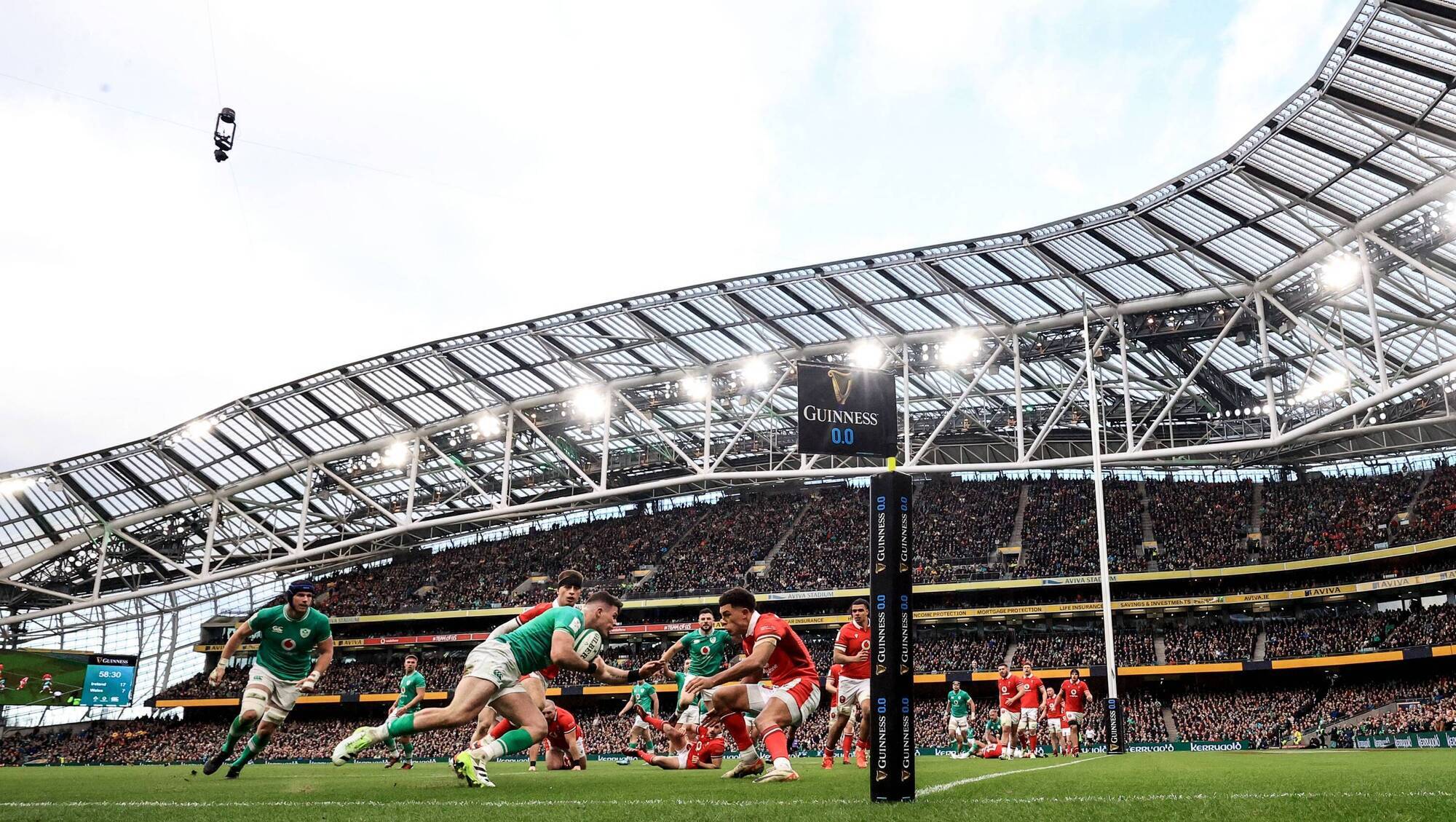
Ireland’s Calvin Nash with Rio Dyer of Wales. Picture: INPHO/Dan Sheridan

At the risk of annoying the one-game-at-a-time brigade, it can be said without fear of contradiction that Ireland are on track for the Grandest Slam of all.
There have been 13 of the Six Nations variety, none completed more stylishly than England’s at Lansdowne Road in 2003. At their current rate of progress, the defending champions will outscore the finest European team of the 21st century on all counts.
What ‘Johnno’ & Co achieved en route to beating the world in Australia a few months later added up to Grand Slam numbers on a scale that others could only dream of: 18 tries and 173 points from their five matches.
Successive Irish Slammers have out-tried England; the 2018 squad raising it to 20 under Rory Best, a figure equalled under Johnny Sexton last year. Maintaining their five-a-game average over the final two rounds under Peter O’Mahony would blast their own record into the stratosphere, likewise the points total, not only for the most gained but fewest conceded.
Ireland are so far ahead of the Six Nations game that they stand alone in every respect, not least as the only one country capable of dealing in try bonus points; in their case three which happens to be three more than Scotland, England, France and Italy have managed in 12 matches between them.

France’s grimly fortuitous draw in Lille made not a jot of difference to the fact that another five-pointer at Twickenham on Saturday week will confirm back-to-back Irish titles for the second time in 10 years. The untouchables will be uncatchable.
That would create not merely the perfect scenario of a home grand finale against Gregor Townsend’s enterprising Scots but one of potentially historic dimension. Since the introduction of the current scoring system seven years ago, no Grand Slam team has claimed the maximum 28 points (25 from the five matches plus three-point bonus).
Where Wales (23 in 2019) and France (25 in 2022) went close, Ireland has gone closer (26 in 2018, 27 last year). Now, thanks to Tadhg Beirne’s stoppage-time stampede, they are on course to clean up like nobody has cleaned up before.
These truly are momentous times.
The French implosion post-World Cup takes some believing; from beating the All Blacks in Paris to escaping the most shocking of home defeats amid a deafening silence in Lille.
Italy’s cruel misfortune at a last-kick penalty rebounding off an upright allowed the embarrassed hosts to snatch the luckiest of draws on top of the luckiest of wins at Murrayfield a fortnight earlier. Paolo Garbisi, Italy’s French-based stand-off, will spend the week wondering what he had done to offend the rugby gods.
As if the stoppage-time penalty wasn’t stressful enough, Garbisi then had to cope with the frightful spectre of the ball falling off the tee just as the shot-clock ticked dangerously close to single seconds. He put the accursed ball back in place, took two hasty steps back and watched it smack into the far upright.
Instead of going over, its ricochet to relative safety left Italy cursing their luck every bit as the Scots had cursed theirs over the no-try verdict which they will forever condemn as the French getting away with floodlit robbery.
Now the alarm bells will be ringing ever more loudly around head coach Fabien Galthié from a French public demanding an explanation for their slide from potential World Cup winners to the bottom half of the Six Nations.
What, for example, has happened to their discipline? Jonathan Danty’s red for a head-high hit following Paul Willemse’s for a similar offence against Ireland left the La Rochelle centre without a legal leg to stand on. It was his second sending-off of the season and the fourth of his career.
Antoine Dupont, on sabbatical in Vancouver with the French Olympic sevens squad, must find it hard to believe. When did a French half-back pair play as badly as Matthieu Jalibert and Maxime Lucu in Lille yesterday?
Welsh complaints about the legality of Andrew Porter’s scrummaging revolved around claims of the Leinster loosehead driving in at an angle towards the opposition hooker. It’s known in the trade as ‘boring’ and thereby hangs a tale.
Way back when scrum-halves really did as the lawbook requires and put the ball in straight, when hookers really hooked, Phil O’Callaghan from Cork began making a name for himself as a quick-witted Test tighthead.
In one of his early matches, believed to have been England at Twickenham in 1968, the referee, Meirion Joseph of Wales, penalised the Dolphin prop at one set-piece.
‘’You’re boring, O’Callaghan,’’ the referee told him.
To which ‘Philo’ replied: ‘’You’re not so -------- entertaining yourself…’’
In the course of beating England for the fourth time in a row, a streak they last achieved in the 19th century, Scotland relied on four players born in England, three in South Africa, three in Australia, one in Canada and one in Ireland.
Ben Healy, an unused sub during the first two rounds, finally got the chance to make a contribution, albeit one restricted to fewer than four second-half minutes as a temporary substitute for Cameron Redpath.
Had the gods decreed otherwise, the Munster man would not have been the only Irish émigré to find an alternative route into the championship. Tadhg Beirne might conceivably have been on the other side at the Aviva on Saturday afternoon had Wayne Pivac, then the Scarlets’ head coach, succeeded in persuading him to stay on their side of the Irish Sea.
"Wayne tried to encourage me to stay because the World Cup was then following year and I’d be qualified for Wales and all that,’’ he said. "I had a brilliant time over there but I wanted to be wearing green for the World Cup, not to be in red.’’
Released by Leinster and re-assembled in Llanelli, Beirne proved such a spectacular capture over two bountiful seasons that the Scarlets offered him a long-term deal which would have qualified him for Wales on the old three-year residential rule.
Unfortunately for Wales, Ireland, all too aware of the magnitude of their mistake in letting Beirne go, had taken steps to bring him home. Wales, consigned to a loser-take-all wooden spoon decider against Italy in Cardiff on March 16, can only wonder what might have been.
When the selling-platers in red dared to rattle the thoroughbreds into conceding a penalty try, Beirne shouldered the personal price, binned for the technical illegality of changing his bind. And when the Welsh threatened to slash the Irish lead with another try, Beirne emerged from the bin in the nick of time to stop them, then gallop over for the bonus-point.
Ireland still took the maximum despite being some way below their best for which a gutsy Wales deserve credit.
England, sent packing in disarray by their northern neighbours , returned to find headlines of screaming out of the back pages. Rather than confront their failures, they clung to the perennial cop-out of ‘taking the positives.’ Maybe some day, someone, somewhere, might break the mould and say: ‘We’ll take the negatives.’ England, beaten 3-2 on tries by Italy in the first round and hard pushed to squeeze past Wales at home in the second, continue to talk themselves up. Of course they are always capable of a big performance at Twickenham against stellar opposition but Ireland have nothing to fear.
Six Nations’ hat-tricks arrive on average at less than one a year, a rarity value which makes Duhan van der Merwe’s trio the most ecstatically acclaimed in the name of the rupee-encrusted Calcutta Cup.
It also happened to be the first hat-trick at England’s expense in the tournament since Maurice Richards, from Ystrad in the Rhondda Valley, ran in four at Cardiff Arms Park in April 1969 and promptly embarked on a glittering career in Rugby League.
Ireland have gone without a Six Nations hat-trick for seven years since two arrived in Rome on the same day, from Craig Gilroy and CJ Stander. Dublin last witnessed a home treble more than 20 years ago, from Brian O’Driscoll in a 43-22 win over Scotland. Time, perhaps, for history to repeat itself.
15 Blair Kinghorn (Scotland) 14 Tomasso Menoncello (Italy) 13 Huw Jones (Scotland) 12 Bundee Aki (Ireland) 11 Duhan van der Merwe (Scotland) 10 Finn Russell (Scotland) 9 Jamison Gibson-Park (Ireland) 1 Andrew Porter (Ireland) 2 Dan Sheehan (Ireland) 3 Zander Fagerson (Scotland) 4 Tadhg Beirne (Ireland) 5 Federico Ruzza (Italy) 6 Michele Lamaro (Italy) 7 Rory Darge (Scotland) 8 Aaron Wainwright (Wales)