Paul Rouse: How GAA helped the county become central to Irish identity
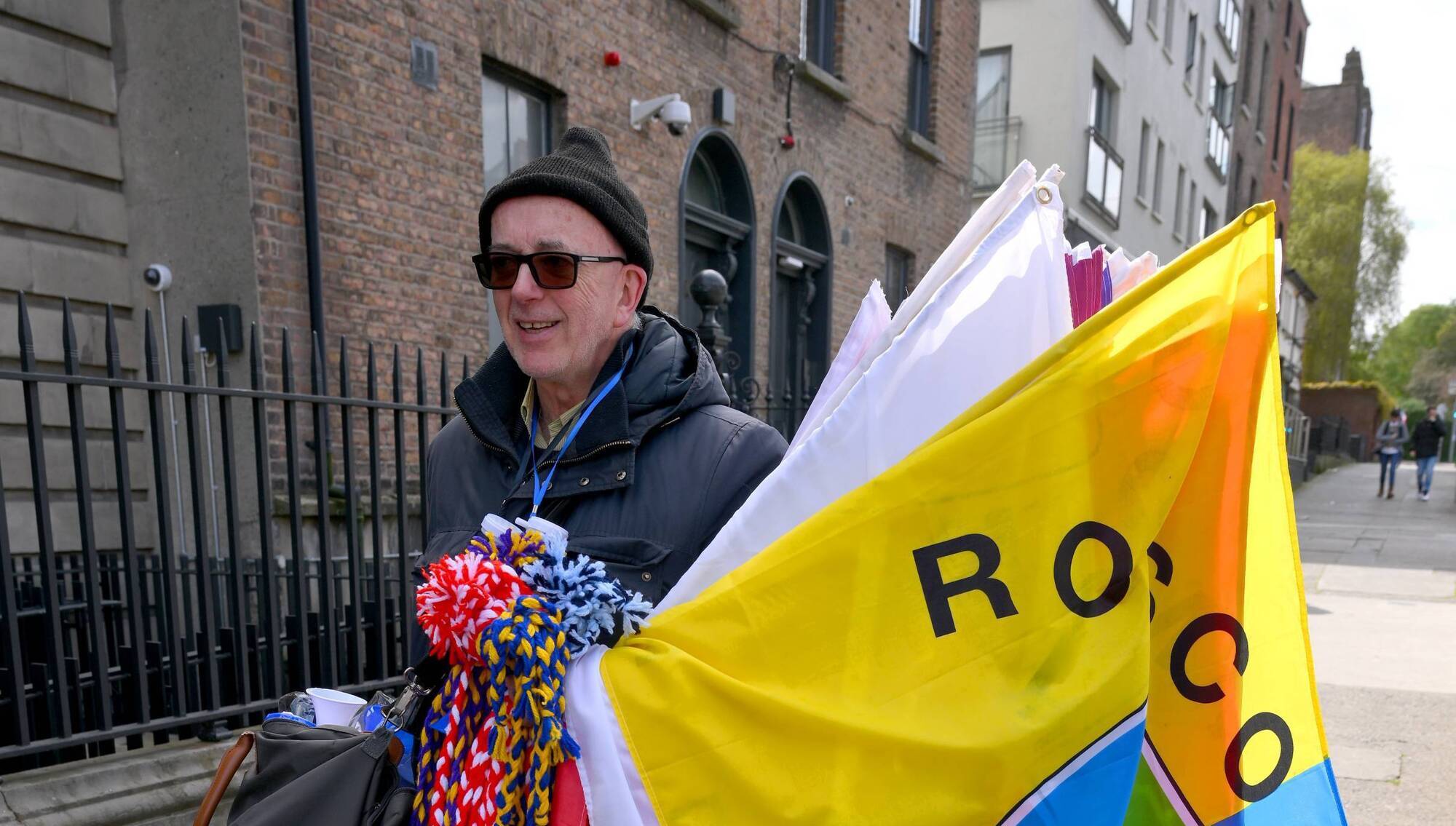
IRISH IDENTITY: A flag seller makes his way down Fitzgibbon Street before the Leinster GAA Hurling Senior Championship Round 3 match between Dublin and Wexford at Croke Park in Dublin. Pic: Ray McManus/Sportsfile
The publication of the Electoral Commission’s constituency review offers glorious insight on the importance of county boundaries in Irish life.
The review recommends an increase of 14 TDs in the next Dáil, and an increase in the number of constituencies by four from 39 to 43.
More dramatic change had been expected – but while greater change may have made sense in terms of geography and population, the boundaries between counties are sacred lines in Irish life.
The review makes this clear: “With a higher number of seats the Commission would not have been able to recommend the removal of a number of existing county boundary breaches. It would also have had to recommend a number of new breaches of county boundaries.”
The logic of this is set out: “Ireland’s historic county boundaries have a particular resonance in the electoral process. The preservation, insofar as is practicable, of the integrity of the county boundaries is an express statutory requirement. It is noteworthy that the preservation of county boundary integrity also stood head and shoulders above any other issue in the 541 public submissions received for the Dáil Review. The Commission is pleased to be in a position to recommend the removal of seven of the 10 existing breaches of county boundaries and to propose only three new county boundary breaches in the recommended constituency composition.”
Across more than eight centuries, the county system has been a feature of life on this island.
It was the Normans who began the evolution of the county system when they introduced an English system of shires and counties to the Irish landscape almost immediately after their arrival in Ireland at the end of the 12th century – boundaries (although many of these remained fluid for quite a time) were introduced and Ireland’s modern counties began to emerge.
By 1200AD, counties such as Cork, Kerry, Louth, Tipperary and Waterford had come into being in more or less their modern form. The basic process of making counties continued until Wicklow in 1606 became the last of the 32 counties of Ireland to be created.
A word of caution is needed, however: for most Irish people, the idea of any sense of county identity, prior to the 19th century, was most likely relatively weak – indeed, there was nothing inevitable about the triumph of county loyalties.
Increasingly, though, after 1800, the county functioned as an administrative unit for British colonisers. Bodies such as the Royal Irish Constabulary were established around county units of organisation and the census of population was collected on a county basis.
A further major shift in developing county affiliations took place between 1833 and 1846, when Ireland was mapped by the Ordnance Survey.
While the process of mapping was met by suspicion and even violence in certain parts, the reality of the maps was simple and powerful: people now knew with certainty in which county they lived, where the boundaries of that county were, and where next door began.
This was further reinforced when the counties began to be used as the unit of local government from 1888. These were practical ways in which county loyalties were formed as the apparatus of the modern state was constructed in Ireland.
As if to underline the extent to which the idea of the county was becoming more and more important during the nineteenth century, history books were written which chronicled the history of various counties.
But, of course, the idea of organising on a county basis was something that was also taken on by those who opposed (in various ways) British governance in Ireland.
For example, the campaign for Catholic Emancipation, the Land League and other movements were organised by county.
Nothing has done more to frame the importance of the county to people’s identity in Ireland than the GAA.
This was an accident. Initially, it had not been the intention of the men who established the GAA in 1884 to use the county structure of Ireland as a basis on which to develop their Association. In the beginning, it was simply decided to establish clubs across Ireland and these clubs were asked to affiliate to the central committee of the GAA.
The extraordinary and immediate growth in the number of GAA clubs left it impossible for the GAA to regulate matters at central level.
There was already a precedent within sporting organisations for responding to a rapid increase in the number of affiliated clubs. In England, the men who organised soccer, rugby and cricket used the English county structure as the basis for their own rapid spread.
It is, of course, impossible to know with certainty if the GAA consciously followed the model laid down by sporting bodies in England.
A critical factor in determining that the GAA should organise on county lines was the decision to establish All-Ireland hurling and football championships. The rules of this competition laid the basis on which the future primacy of the county was founded.
These rules stated that the All-Ireland Championship was open to all affiliated clubs of the GAA; that clubs in each county would first play off a championship between themselves on a knockout basis; and that then the winning club in each county would proceed to play off, again on a knockout basis, against the winning teams from the other counties until an All-Ireland champion emerged.
Critically, to facilitate the running of the championship it was decided that county committees (the forerunners of modern county boards) should be established in each county. It was to these county committees that so much power ultimately devolved within the GAA.
If the establishment of county committees was vital to the future, so too was the manner in which GAA people observed the rules – or, perhaps, failed to observe them. From that very first championship, a practice was established whereby the winning club in each county pulled in the best players from other clubs in the county upon entering the All-Ireland championship.
Quickly, it became apparent that the only way to police such a tendency towards illegality was to legislate for its acceptance. It was soon accepted that the winning club in each county would have the right to choose whichever hurlers it wished to play with it during the All-Ireland championships.
Over time, more and more players were brought in to supplement the county champions. Steadily, too, the selection of county teams became the preserve of the county committee, rather than the champion club – in some counties this happened shortly after 1900, in others it took several more decades.
Although there were occasional pleas that the county was not the appropriate structure for the proper organisation of the GAA, these were lost in a fervor of local patriotism.
This local patriotism has helped the political careers of successful GAA players. For example, Jack Lynch’s fame as a Cork All-Ireland winning captain was essential to his status in the county when he ran for election in the county in 1948 for Fianna Fáil.
Having GAA fame is no guarantee of political success, of course, but it allows for a starting point in terms of recognition that is hugely valuable.
That is fine when electoral boundaries match county ones; but it could have the opposite impact when that is not the case.
There was a dark time in the history of Offaly between 2016 and 2020 when a strip of North Tipperary (including Borrisokane and Lorrha and other villages) was part of a newly formed Offaly constituency. This appears to have been welcomed by very few people on either side of the border. The Tipp crowd (overwhelmed by coming into contact with a superior civilisation) left nobody in any doubt as to their resentment at their new-found Offaly citizenship.
And, from the opposite side of the dismantled fence, I think the politest way to put it is that it would have been quite the surprise if, say, a retired Tipp hurler had been elected as a TD in Offaly.
The basic point is that there is no rivalry quite as intense as the one between border rivals.
And for all that Ireland is changing, county patriotism remains largely undimmed.
As one submission to the Review put it: “One’s identity is not a movable feast nor is an age-old boundary which is intrinsically linked to identity”.