'15c or 25c does not appear enough to incentivise' people to use deposit return scheme
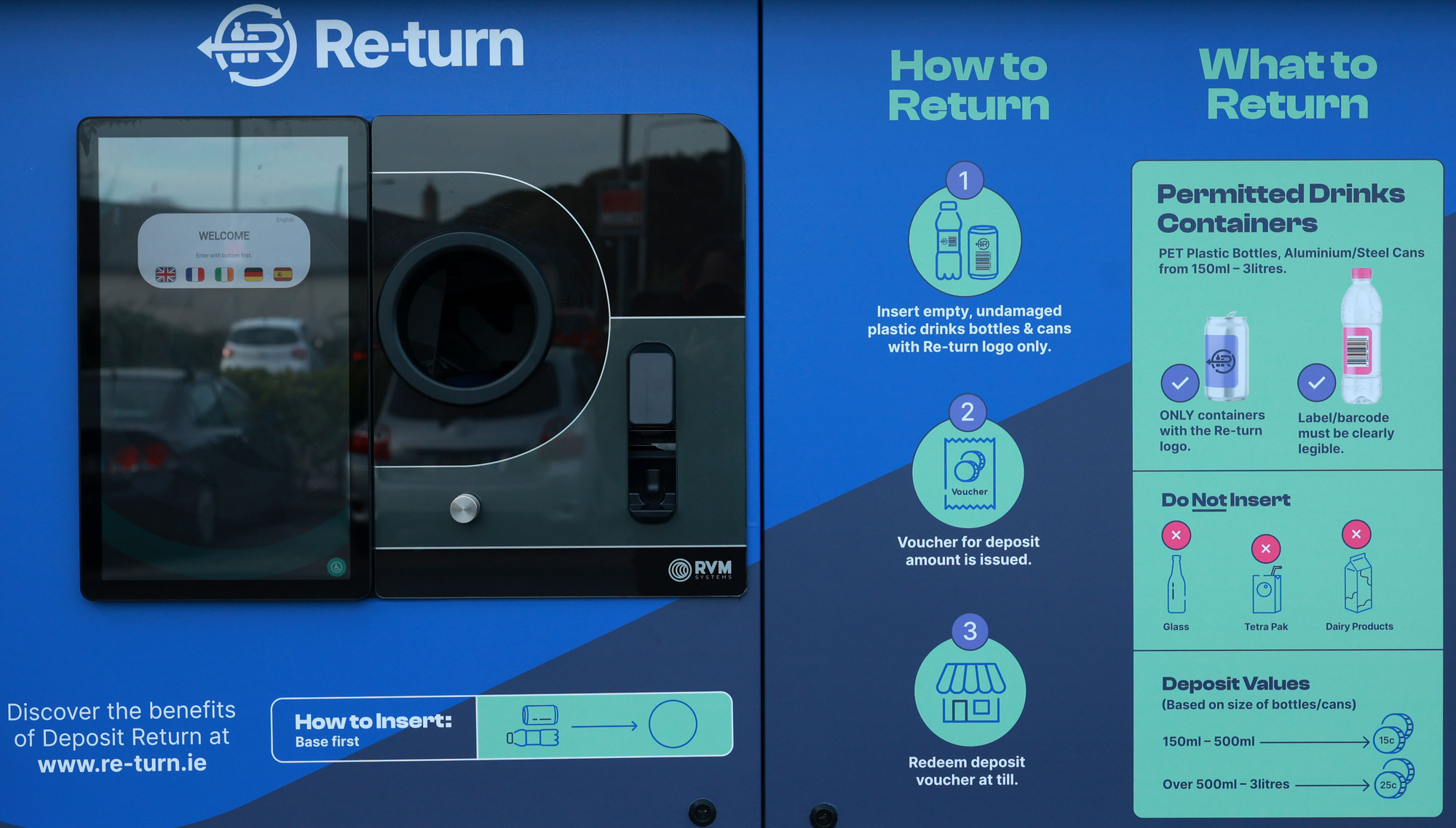
Conor Horgan, of Irish Business Against Litter, said that while the deposit return scheme’s impact on overall cleanliness levels was beyond dispute, hopes that the scheme would completely eradicate such litter are misplaced. Picture: Sam Boal / © RollingNews.ie
While there are fewer littered areas in the country than at any time in the past 25 years, plastic bottle and can litter remains an issue despite the introduction of the deposit return scheme.
That is according to Irish Business Against Litter, whose latest litter survey shows that, although such litter has decreased by more than half since the scheme was introduced in February 2024, plastic bottles were found in 19% of sites surveyed and cans in 22% — the highest levels since the scheme began.
Conor Horgan, of Irish Business Against Litter, said that while the scheme’s impact on overall cleanliness levels was beyond dispute, hopes that the scheme would completely eradicate such litter are misplaced.
“15c or 25c does not appear enough to incentivise some people to return a bottle or can,” he said.
Separately, disposable coffee cup litter was at its highest level since 2023, making it one of the main sources of litter on Irish streets, behind sweet papers, fast food wrappers, plastic bags and cigarette butts.
“Talk of a ‘latte levy’ has all but vanished, yet coffee cup litter clearly has not. The government inaction on this persistent problem is baffling,” Mr Horgan said.
Read More
The study also revealed a significant increase in cigarette butt litter compared to 2025. Mr Horgan noted that butts are not only unsightly, but also constitute a toxic single-use plastic that can contaminate the marine and land environment.
Established in 1996, Irish Business Against Litter is an alliance of companies promoting a credo that says continued economic prosperity — notably in areas such as tourism, food, and direct foreign investment — is contingent on a clean, litter-free environment.
As part of the alliance's anti-litter league, independent environmental charity An Taisce monitors towns independently and in accordance with international grading standards.
The latest Irish Business Against Litter survey shows progress in urban areas which were previously litter blackspots, with Dublin’s north inner city and Cork’s northside both improving their designation to ‘moderately littered’.
This continues a recent trend, with the majority of socially disadvantaged urban areas improving year-on-year. Dublin’s north inner city, Ballymun, Cork’s northside, and Galway’s Ballybane all progressed from ‘littered’ to moderately littered’.
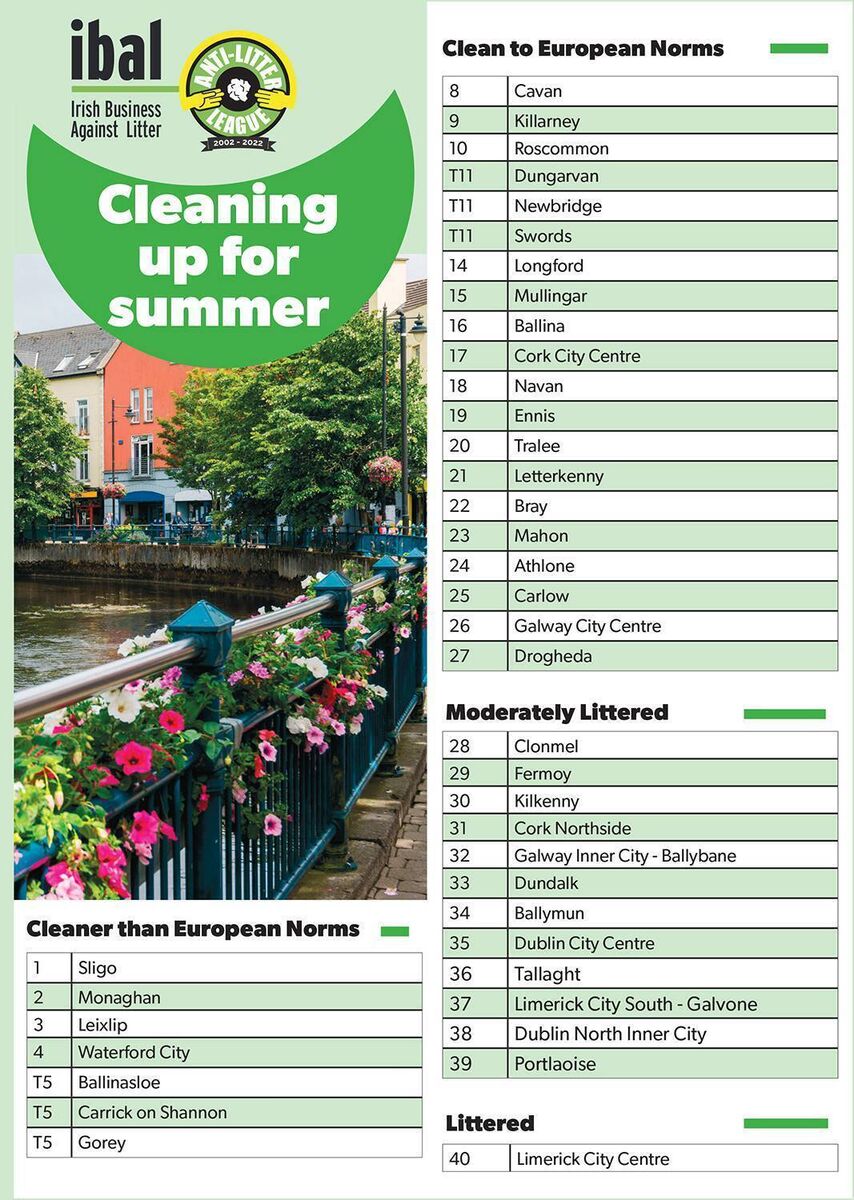
For the first time, only one of the 40 cities and towns surveyed — Limerick city centre — was branded as littered. Sligo again topped the ranking.
No town or city occupied the "seriously littered" or "litter blackspot" categories at the bottom of the league table, and overall litter levels were on a par with last year, with 27 towns judged to be clean.
Behind Sligo were Monaghan and Leixlip, with Waterford — once again judged Ireland’s cleanest city — coming in fourth place. Navan, Carlow, and Athlone all showed significant improvements.
An Taisce had particular praise for Sligo for its top-ranking approach roads, “exceptionally freshly presented” retail park, and the “complete absence of litter” throughout the Great War Memorial Garden.
However, inspectors said Limerick city centre had disappointed, dropping to "littered" status.
An Taisce lamented a dearth of clean areas within the city centre, as well as the number of sites that it said are heavily littered on a consistent basis.
Those included Mount Kenneth Place and the entrance to Henry St carpark, the residential area of Grattan Court, the recycle facility on Dock Rd, and the laneway at Cruises St carpark.
In Cork City, An Taisce had praise for several parts of the northside, including Patrick’s Hill, Pope’s Quay, Shandon St, Middle Glanmire Rd, and Old Youghal Rd.
The Mayfield and Hollymount industrial estates came in for criticism, as did the waste ground at Fairfield Meadows, where levels of dumping were described as “monumental”.
In Cork city centre, inspectors praised the Lapp’s Quay and Horgan’s Quay as “lovely riverside environments which were very much deserving of the top litter grade”. St Patrick Street also received top ranking.
The ongoing scourge of graffiti in Cork City was noted, and “by far the most heavily littered site” was Anderson’s Quay, while Bishop Lucey Park and Liberty St were also littered.
In its report on Mahon, An Taisce praised an “excellent result”, with Avenue de Rennes and Skehard Approach Rd described as deserving of the top litter grade, while Loughmahon Park came close.
In the county, past winner Fermoy has improved slightly to 29th place from last June’s 32nd pace, but is still deemed "moderately littered", something which is likely to be a bitter blow for the town’s dedicated Tidy Towns volunteers.
An Taisce said many sites in Fermoy had just missed the top litter grade, while by far the most heavily littered site in the town was the public carpark and recycle facility, which it said had suffered both abuse and neglect.
Mr Horgan said that with the peak season for tourist visitors approaching, there were fewer littered areas in the country than at any time over the past 25 years.
The study showed, he said, a low number of very heavily littered sites among the 500-plus sites surveyed, compared to previous years.
“The job’s not done but, across the country, local authorities appear to have upped their game when it comes to tackling persistently littered sites and dumping in our towns and cities,” Mr Horgan said.
He added that after 15 years of monitoring disadvantaged areas of Dublin and Cork, "for the first time we’re seeing evidence of sustained improvement as a result of greater investment from Dublin and Cork City councils".
"If plans in Dublin for the elimination of domestic waste collection in bags across the inner city are realised, we will have a much cleaner capital city," he said.

CONNECT WITH US TODAY



Be the first to know the latest news and updates