John Riordan: New documentary serves up a reflection on McEnroe and his meltdowns
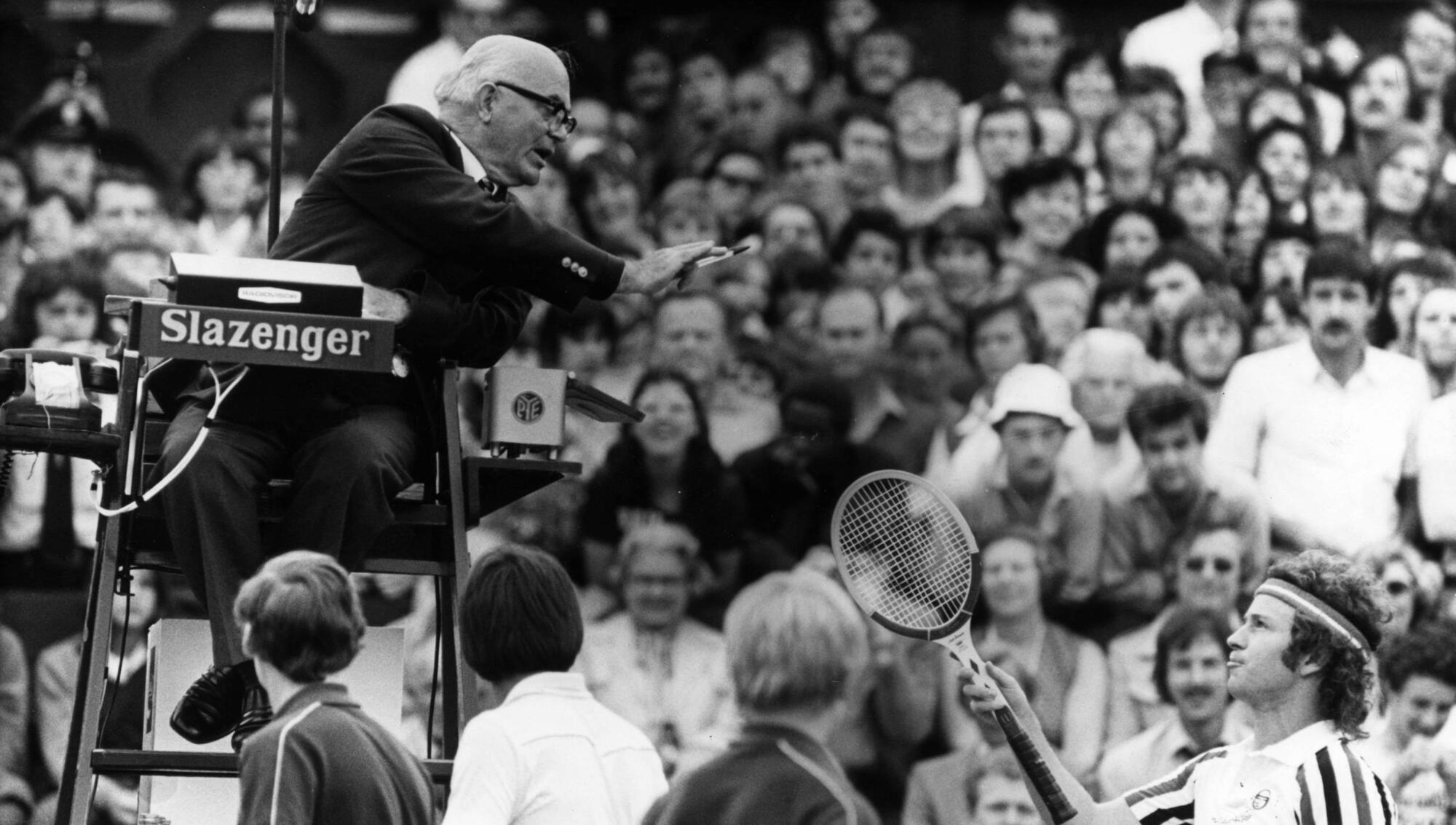
Putting on a show: American tennis player John McEnroe argues with the umpire during his Wimbledon semi-final match against Jimmy Connors. McEnroe won 6-3, 3-6, 6-3, 6-4. Pic: Central Press/Getty Images)
A new John McEnroe documentary got the big screen treatment last week at Robert De Niro's TriBeCa Film Festival in Manhattan, the natural habitat of one of the most Manhattan people ever.
This Barney Douglas-directed film comes to Ireland next month and If, like me, you wanted to understand the tennis legend a bit more or maybe even a lot more, you should definitely try to catch it.
Anyone I told that I was planning on going to see it replied with "oh the anger issues guy". Well, yes, but clearly that misses the tennis part and obviously reduces the significance of his supernova 1979-84 period to ashes with a single sneering smashed volley.
Iâm included in that unenlightened sphere; as someone born a few months after his famous first US Open win, I also needed to be sat down and forced to fully appreciate that stunning chapter of tennis history which lit up the early 80s.
The brash and braggy 20-year-old from Queens who made his Grand Slam breakthrough in 1979 went onto establish a tennis legacy which extends way beyond those entertaining blasts of rage. I wonât try to claim that our modern era trio of Federer, Nadal and Djokovic are anything but the greatest of all time but McEnroe can lay claim to being the record holder of the the menâs gameâs highest combined singles and doubles titles. Admittedly itâs a roughly half-and-half split that gets him to 155 victories but itâll surely never be overtaken.
"I only remember knowing how to play," he tells us as he walks moodily around nighttime Douglaston, the Queens neighbourhood in which he spent his formative years under the very watchful eye of Irish-American parents.
The elder John of the family is a particularly significant protagonist in this often intriguing psychological study of what made John Jnr tick. There is a great though sad clip of the old and fading patriarch reprimanding a television producer for referring to him as âJohn McEnroe Snrâ instead of being acknowledged as the original; one of the most famous tennis players of all time should be the afterthought, the junior.
Itâs a moment late in his life, not long before he passed away in 2017 and, appropriately given the family inclination towards drama, funeral donations were directed towards the Irish Repertory Theater in the Chelsea district of Manhattan. Itâs also a moment which strongly echoes footage of McEnroe during his youthful peak, filming a promo for the newly formed MTV. Sick of being asked to do repeated takes to camera, he stops cooperating and the producer experiences a brief moment of what itâs like to be in the umpireâs seat during a McEnroe meltdown. What they have is good enough. Off is ripped the microphone.
His father was his agent until the wheels fell off in 1986. Distracted by partying, drugs and a failing marriage to Tatum OâNeal, McEnroe dropped to 16th in the world and he never managed to emulate the dizzying heights of his early 20s.
But itâs very interesting to see how much of a career he squeezed into just over half a decade and the documentary is brilliant at charting that rise and fall. And he is more than willing to open up and help us understand what drove him in between shots of him walking alone around the empty streets of pre-dawn Manhattan, passed and recognised only once on Mott St in Chinatown by someone who shouts âHey Johnâ across the street.
At Wimbledon in 1977, a rabidly aloof Jimmy Connors goes out of his way to ignore the young prodigy he is about to beat ("Why is he such an asshole?") and suddenly McEnroe sees the level of intensity he needs to reach in order to achieve his goals.
There is brilliant footage from the 1978 Davis Cup and an early 1979 duel with Connors who quits while behind due to an injury, the authenticity of which McEnroe is clearly still suspicious four decades later. "I did learn from him ... you gotta learn to be a bit of a prick out there."
And then the breakthrough arrives at the US Open later that summer, two breakthroughs in fact. "Two kids from Queens" in the final and the vanquished Vitas Gerulaitis utters the fateful words to the new star: "What are you doing later?"
He lands in London the following summer like a nuclear bomb. The American "Super Brat", the tabloids blast in their headlines; the player England loves to hate. Current McEnroe berates the footage and the memory of his younger self. Whereas back then he was shouting at umpires about wrong or missed calls, now he's barking at himself "What are you? A stupid fucking moron?"

The 1980 final against Björn Borg pits together two of the coolest people alive. The footage of their antics, wowing crowds in different ways, is worth the admission fee alone. The Beebâs John Barrett informs us in his understated way that McEnroe is "not the most popular of players" but their fourth set battle - an epic tiebreaker won by the American - goes some way towards rehabilitating the reputation of the young pretender.
It's fascinating to watch McEnroe recollect his misguided belief at that moment that Borg will fold in the fifth. "Within a couple of games," McEnroe recalls realising: "on no... I don't got him."
Borg wraps it up, playing the decisive set like nothing happened, and McEnroe leaves London with a valuable lesson learned, beating the Swede less than two months later in Queens for his second US Open in a row.
By the time Wimbledon '81 rolls around, "you cannot be serious" starts to feel staged. But the footage does seem to back him up; chalk flew up, what else can you say? "I would end up saying the asshole thing," he laments now in a low lit studio.
He finally makes the Wimbledon breakthrough in 1981, beating Borg and achieving what he needed as much as a title: to be able to tell the powers-that-be what they should do with their lifetime membership: "I had to prove that I could win it and I could really tell them to go fuck themselves"
The retirement of Borg hits McEnroe hard and the documentary seems to argue that this is the beginning of the slide to his own demise. The Scandinavian walks out of the US Open and the American remembers thinking of it as a travesty.
"Someday you will understand," the 26-year-old tells his rival who subsequently hits his peak in 1984 with another pair of Slams in London and New York.
"Why does it feel not that amazing?" McEnroe remembers wondering. Borg leaves a void and the meltdowns become more prevalent, most noticeably a protracted hissy fit that dominates a defeat to Ivan Lendl in the French decider.
By the end of the 90s, McEnroe was well on his way to a new lease of life through his television work; he has been a long-time proponent of the self-deferential and the market has held up for that. But heâs also spun that off into a hit TV series on which he is the narrator for a high school comedy series on Netflix created and produced by Mindy Kaling, âNever Have I Everâ. The main character is the Indian-American daughter of immigrants who has a propensity towards angrily lashing out, just like the tennis star doing the showâs voiceover as himself.
McEnroe is being introduced to a whole new generation of young people for the same reason we were when he was serving out his last games, sets and matches as a singles player at Wimbledon in 1992. But it's good to be able to be reminded of or be educated on his relatively brief brilliance.
Speaking of younger generations I don't understand, the youngest Riordan, Louise, has a shot at glory in her own tennis final in Sunday's Well tomorrow evening. She last won this trophy in 2019 so she's hoping to reclaim the crown. And the rest of us are hoping the incident with the umpire which marred that final three years ago isn't repeated. Good luck, sis!