How did Irish football end up in Delaneyland?
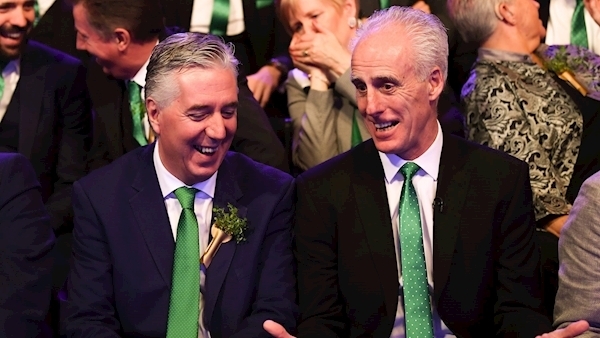
If a thirst for public profile not in keeping with his station has been a key characteristic of John Delaney’s public life, then he can’t ask for much more than this. For the last week-and-a-half the content of every newspaper, online outlet, TV and radio show in the country has been largely about him.

How did Irish football end up in Delaneyland?

If a thirst for public profile not in keeping with his station has been a key characteristic of John Delaney’s public life, then he can’t ask for much more than this. For the last week-and-a-half the content of every newspaper, online outlet, TV and radio show in the country has been largely about him.

Yes, almost all of them have called for his head on a spike, but, you know, if there’s one thing worse than being talked about, it’s not being talked about, right?


The cult of personality around Irish football’s top man, largely cultivated by Irish football’s top man, has reached its apex, a glorious moment when we are all, to borrow a term the sportswriter Kieran Cunningham used on Off The Ball the other night, living in Delaneyland.

Each new day has brought more front page revelations and thundering denouncements from Irish football elders. In editorial pages and on panel shows there have been calls for Something To Be Done, Conversations To Be Had and Questions To Be Answered. Most of us rounded off Tuesday night playing a phone game which involved throwing tennis balls at John Delaney’s head.

But if Irish football has been too much in thrall to the personality of one man, so too has its critique. Everyone suddenly now wants to be tough on John Delaney; fewer are being tough on the causes of John Delaney.

The current bloodlust suggests that removing Delaney will allow Irish football to skip gaily toward a bright new dawn. But nobody seems to be asking how one of our biggest national sporting bodies could become what has been described as the ‘personal fiefdom’ of a Waterford accountant with little pedigree playing the game and a penchant for rebel ballads?

Did John Delaney just happen to Irish football, or was Irish football on a special path that left it exposed to one man’s ambition?

There have been powerful GAA administrators who have had major influence across lengthy careers, but it’s impossible to imagine one having comparable all-powerful status over its labyrinthine structures as that enjoyed by soccer’s kingpin. Rugby too has its share of blazered blowhards, but its modern image as a model of precision corporate engineering is one soccer has never enjoyed.

To borrow the term Delaney once infamously used to describe the League of Ireland, in the Irish sporting family, soccer appears to be the difficult child. Did the special historical path it endured leave its institutions weak and underdeveloped?

The status of the sport in Ireland in the early years of the state is well documented. The GAA ‘ban’ saw it positioned as the very antithesis of what it should mean to be Irish. It was played by the urban working classes; to be Irish was to be dancing at the crossroads, not kicking a ball on cobbled city streets.

Rugby had its private school system and GAA had its colleges, both aspirational destinations for two upwardly mobile strands of Irish life. Rugby was championed by the professional classes, GAA knitted into the very fabric of every community. Soccer scrapped and scraped for status, its best protagonists sent away to England, its domestic fortunes rising and falling with the tide.

These were the insecure foundations on which the FAI was built, the organisation that would become a byword for shambling amateurism and bitter committee room bloodletting.

When Saipan saw the jerry-built edifice burn to the ground, enter Delaney.

Today when I talk to other parents of young kids about our children’s sporting lives, it’s clear many of the old prejudices about soccer remain. When people bring their kids to GAA, they talk about the community and identity. When they bring their kids to rugby, they talk about values and ethos.

With soccer, they don’t really say anything, other than the kid seems to enjoy it and likes playing with their mates. There’s a purity to that, the love of the game and whatnot, but it’s why soccer, for all that it is the country’s most played sport, is institutionally its weakest. The health of soccer was never important to those who mattered, its bungles and scandals were its own oddball business, and not of serious import to the moral fibre of the nation.

But now the organs of Official Ireland are finally taking note; editorials are being written and words like governance, Oireachtas committee, and public funding are being gravely intoned. Maybe the difficult child is finally getting a little bit of love.

Hell, they’re even talking about the League of Ireland as being something to be championed, rather than laughed at. Wouldn’t it be the ultimate irony if the difficult child’s own difficult child were to be the ultimate winner once the supernova of Delaney’s preeminence finally burns out?

More in this section

Sport

Newsletter

Sign up to our daily sports bulletin, delivered straight to your inbox at 5pm. Subscribers also receive an exclusive email from our sports desk editors every Friday evening looking forward to the weekend's sporting action.

Cookie Policy Privacy Policy Brand Safety FAQ Help Contact Us Terms and Conditions

© Examiner Echo Group Limited