Tiger Woods and Phil Mickelson merely helping us open our eyes
Do you know what movie is available to watch if you have On Demand from Virgin Media? They Live.
John Carpenter made They Live 30 years ago and quite apart from the casting of Rowdy Roddy Piper in the lead, it holds up when you revisit it now.

The plot centres on Piper finding special dark glasses which reveal the reality of life: they reveal to him the subliminal messages on television screens and in magazine pictures, messages telling people to MARRY AND REPRODUCE when they see an ad with a girl in a bikini. A picture of cash tells them THIS IS YOUR GOD and the magazines say OBEY and CONSUME.
The movie was decades ahead of its time given that we all now carry machines of our own telling us to CONSUME and OBEY all the time, but this week I felt a little more like Rowdy Roddy myself when the Phil Mickelson-Tiger Woods golf game popped into my consciousness.
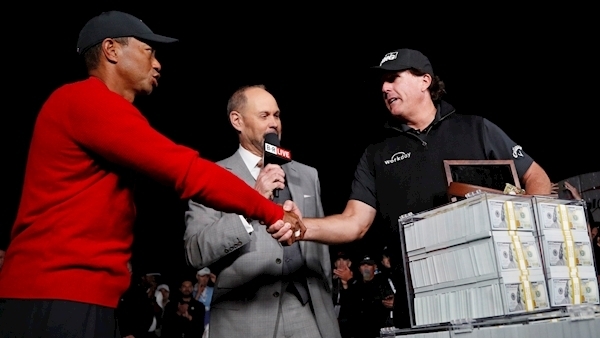
What caught my eye were widely-circulated photographs of the two of them with a big pile of banknotes, photographs which drew the ire of many on the basis of . . . vulgarity? Inappropriateness?
First of all, that’s entirely the wrong attitude. Not because we live in a post-vulgarity age, one in which appropriateness does not exist - though we do - but because the two golfers’ mugging for the camera throws something into sharp focus.
Namely, that professional sport is about money. Mickelson and Woods did everybody a favour because they identified and articulated the purpose of sport at that level: to generate money.
Why the clutching of pearls at the sight of that money? Is it okay to think of the vast sums earned by elite professionals in the abstract, but somehow distasteful to see the actuality? Can you comfort yourself, if the cash is invisible, that the lads would be happy to play away?
Unless ... are Phil and Tiger working as Rowdy Roddy Piper substitutes? Are they trying to signal to us that it’s all a con, that the whole military-sports-commercial complex is one big superstructure designed to make you passive and malleable, to drive you to CONSUME and OBEY?
Because it just so happens that I stumbled across some research from sociologists in the US who worked out there was a dramatic fall in the amount of crime committed in Chicago during big sports events - significant games involving the local teams, the Super Bowl, those kinds of stand-out occasions.
Now the sociologists did a lot of theorising about opportunistic crimes, and there were some interesting sideshows about the amount of crimes committed when super-popular movies were released. But the study kicked off in the first place following a throwaway remark by the NFL’s Ray Lewis during a player strike: “If we don’t have a season, watch how much evil, which we call crime, watch how much crime picks up if you take away our game ... [People have] nothing else to do.”
This is probably the appropriate place to point out Lewis himself faced murder charges in 2000 that were later dismissed after he agreed to plead guilty to misdemeanour obstruction of justice charges, though it could also be argued that it underlines his authority on the subject.
But sport as a weapon of social control? Seriously?
I discovered this study the same week a mail pinged on my screen telling me that “Ireland’s win over New Zealand drew an average of 883,700 viewers to RTÉ 2, peaking at over 1 million at the end of the game. 57% of those watching TV at the time were tuned-in.” They Live, man. They Live.
Weeshie had a real touch of class

Late to the party though I am, I have to mention the late Weeshie Fogarty, though plenty of people who knew the Radio Kerry broadcaster better than I did have already paid eloquent tribute to him.
In my limited dealings with Weeshie, I found him as decent, helpful, and thoughtful, as everyone else has said. I wrote a piece about high fielding for this paper some years back and arrived into the office soon afterwards to a package from Weeshie which included the great shot of Sean Walsh soaring over Brian Mullins, among others. We had a few lengthy phone conversations about games and players, during which Weeshie was both frank and generous, which is not a combination that everyone can pull off.
When I was on the publicity trail with a book, he invited me down for a chat, and asked me to bring two or three bits of music to break up the hour.
In a flash of pretentiousness I took a Caetano Veloso number from the Talk To Her soundtrack.
During the show Weeshie gave the nod to the producer and, as relief from the GAA talk, this Brazilian singer gave us a Mexican folk song, backed by a single cello. Then we went back to talking about Cork and Kerry.
After the show I asked why he’d left the song play in its entirety (it’s almost five minutes long). “It was unusual,” he said. “A real touch of class. I wanted to hear how it ended.”
No, Weesh. “A touch of class” was our line.
Hatters’ gambling summation not so mad
It’s not so much that Luton Town have rejected gambling money, laudable though that is, in a world where gambling has become amazingly normalised.
What I warmed to was chief executive Gary Sweet’s comments: “We don’t feel comfortable with advertising or carrying a sponsorship of a gambling brand.” Sweet didn’t get any more detailed than that, which I found endearing. He didn’t go on a long, meandering breakdown of his philosophy or offer a terse refusal to expand, he summed it up the way a lot of us feel: gambling is an individual choice and often harmless, but one can also feel less than relaxed about its prominence. Uncomfortable is just the word. Mind you, I didn’t see quite as much focus on how Sweet finished his comments about not carrying gambling sponsorship: “Unless we are forced to do so obviously.”
We’ll come back to this one.
Cast an ear to the Hernandez podcast
I usually recommend a book here, but can I break with tradition and offer something slightly different?
‘Gladiator: Aaron Hernandez and Football Inc’ is a podcast about the American football star who ended up killing himself in prison.
It details the player’s descent, which included a conviction for murder, and asks some searching questions of the professional sport he played.
Context? The podcast was made by the same Boston Globe department made famous in the movie Spotlight.