A Bronx tale: How GAA took hold in New York
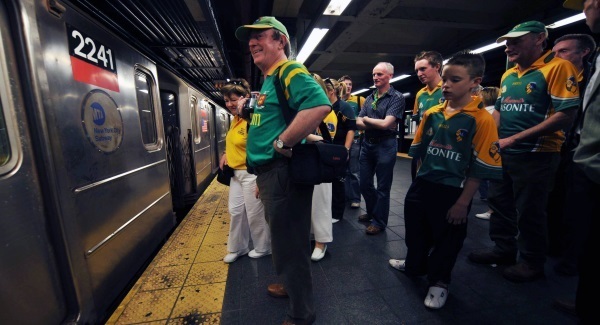
On Sunday afternoon in the Bronx, New York will host Sligo in the preliminary round of the Connacht championship. There is nothing quite like this day of days for the GAA in New York. Fergus Hanna traces the unique history of Gaelic games in The city in his lovely book, The History of the GAA in New York, published in 2014.
Scenes from New York:
It’s winter and Collect Pond, a body of fresh water in New York city, has frozen over. The people of the city have turned it into a popular skating rink. The ice is alive with skaters shooting in every direction. Among them are Irishmen. They, too, are skating, but in their hands they also have hurleys and they have recreated on the ice the hurling matches they play on grass in New York through the rest of the year. Hurleys and balls have been imported from Ireland and the game is played with a ferocious devotion.
Twenty-two clubs of footballers and hurlers have come together to found the Gaelic Athletic Association of America. The delegates are from all across New York and New Jersey. They elect a central council, pick the officers who will lead them and establish a championship with gold medals and a gold cup for the winners. This Association will prove to be only a limited success and it will only be in 1914 that the GAA will develop an enduring formal structure in New York. But a start has been made and everything needs a start.
There’s a field at the corner of 2nd Avenue and 34th Street. It’s Sunday afternoon and a group of hurlers are playing away. Their game is stopped when other men walk onto the field carrying baseball bats. They demand that the hurlers leave and that the field be cleared for a baseball match. The hurlers decline the demand. Push and shove become punch and swing. There’s ash flying and blood flowing and eventually the baseball players run for the gates. But the day isn’t done. The police are notified and six hurlers are arrested. This is New York, though. There are too many Irish ward politicians and too many Irish policemen for the men to lose their liberty for long. William Heffernan, an alderman from South Brooklyn, secures the hurlers their freedom. They are all home for tea. And they will have to endure no further interruptions on the Sunday afternoons that follow.
It’s a Sunday in late July and 7,000 people are in Celtic Park — the GAA’s pitch in New York — to watch football and hurling matches. Two men are sitting on the terrace that has been built beside the pitch. They pass a bottle between them. They are being watched by two detectives who suspect the men are drinking alcohol. This is the age of prohibition and the detectives move to seize the bottle. The men resist. A detective is struck with a bottle and one of the drinkers sprints towards the Irish dancehall that has been built at the end of Celtic Park. Mounted police arrive in the pitch. Pandemonium ensues. More bottles fly. People are arrested and six people are brought to hospital, including two young girls. The police are condemned for being heavy handed.

It’s Tipperary Field Day – the day when Tipperary people from all across the north-east corner of America head for Celtic Park to watch football and hurling and meet each other and do whatever happens when people come together. There is meant to be a match between the footballers of Sligo and the footballers of Tipperary. The Sligo team are on the field and so is the referee. They wait and wait and finally the Tipperary team arrive. Many of the Tipperary players are distraught. They have just heard that one of their team has been shot dead. He was working the previous day behind the counter in Butlers’ Store on 119th Street when there was a hold-up. The Tipperary players eventually decide to play the game out of respect to all the Tipperary people who have travelled to Celtic Park. They lose. In fact, they don’t even manage to score.
The clubs of New York have a new pitch to play in: Innisfail Park in the Bronx. In time, they will change the name to Gaelic Park and it will become the great home of Gaelic games in New York. The tides of Irish emigrants to New York mean that GAA clubs are flourishing. There are now 50 affiliated clubs. Every Sunday that spring and summer, Innisfail Park hosts match after match. There’s a ballroom at the end of the pitch and Irish music drifts out into the evening air. Home has been remade.
The Cork hurler Tom Fitzgerald is home to New York from the Second World War. He fought in France for the U.S. Army with such bravery that the French government has awarded him the Croix de Guerre.
Relations between the GAA hierarchy and the GAA in New York are at an all-time low. Things are so bad that New York is not even officially affiliated to the GAA. But the championships in that city are thriving and the New York Board has narrowly voted to allow its clubs bring in an unlimited number of Irish-based players for its matches. The economy in Ireland is mired in a brutal recession and the flow of weekend and summer players across the Atlantic is greater by the week. There’s anger at home in Ireland at the way it is perceived the GAA in New York is being run. Stories make the papers about the amount of money that it is said to change hands. It is said that one player who arrived at JFK Airport was met by clubs who entered an auction for his allegiance.
It’s 2014 and the GAA in New York is celebrating the centenary of its formal organisation. Post-Celtic Tiger economic collapse has brought renewed vigour to Gaelic games in the city.

There are now 29 teams playing Gaelic football, nine playing hurling and five playing Ladies Gaelic Football. Every Sunday, Gaelic Park is alive and familiar.
The games are good — sometimes very good. But the games are only part of the story and have only ever been part of the story.
The success of the GAA in New York is a triumph of pride and commitment. And it is a triumph that stretches out towards an unending future.