Battle scars all too apparent in clubhouses long after 1916
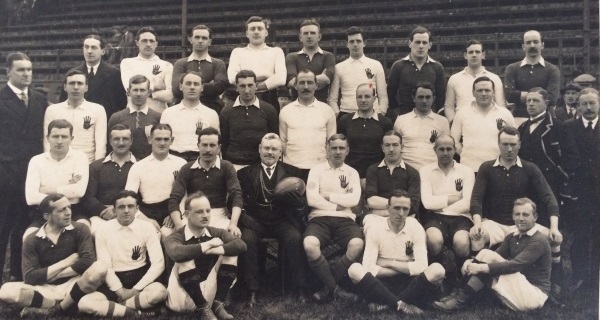
A huge crowd has gathered at Lansdowne Road for a match between Ulster and Leinster.
This is no normal game, however. The Great War is continuing to produce slaughter on an industrial scale and the normal rugby calendar has been suspended. In its place is a series of charity matches to raise money for injured soldiers, or the dependants of dead ones. Or to send things to the Western Front to make the lives of soldiers in the trenches more bearable.
The match in Lansdowne Road is billed as a ‘Crock’s Match’ — veteran players line out to represent Ulster and Leinster. A huge crowd turn out to see “the best game we have seen since the war broke out”.
Among the players are 19 former Irish internationals, some of whom played for Ireland back in the 19th century. Others are soldiers who are actually home for Easter, on leave from service in the British army, and they include at least one serving major.
The players gather together and pose for a photograph before the game — just as teams always do — in front of the Main Stand.
Behind the moustaches and the slicked hair and the starched shirts, there is an obvious pride in the prospect of once more representing their province at Lansdowne Road. The men are clearly ageing, yet they mostly carry it well — filling the jerseys, but not overfilling them.
Over to the extreme right of the photograph sits Frank Browning. Browning is wearing a buttoned-up white shirt and a tie and a solid moustache and a mid-parting in his hair that is under a little bit of pressure.
This is the last rugby match that Frank Browning will ever organise: two days later — on Easter Monday — he will be shot dead by members of the Irish Volunteers on a street just around the corner from Lansdowne Road.
How did this happen?
In the weeks after the Great War began, the Irish Rugby Football Union Volunteer Corps had been founded by Frank Browning. He had called on the players and officials of Dublin’s rugby clubs “to do their bit” and to join the war effort (just as the leader of Irish nationalism, John Redmond, also did).
This Corps mirrored similar sporting battalions in Britain, where sporting clubs enlisted almost en bloc.
Ultimately, more than 300 men joined the Irish Rugby Football Union Volunteer Corps, formally constituted as ‘D’ Company of the 7th Royal Dublin Fusiliers.
Men who were deemed too old to fight in the regular army formed a home battalion and — dressed in green uniforms — took on duties in support of the regular British army in Dublin.
This battalion — led by Browning — were returning to Dublin from routine manoeuvres in Wicklow on Easter Monday 1916 when they headed straight into the rebellion which had begun in their absence.
Led by Patrick Pearse and Tom Clarke, a small group of Irish nationalists were determined to use the war to assert Irish independence and, joined by members of James Connolly’s Irish Citizen Army, had secretly planned for rebellion.
Close to Beggars’ Bush Military Barracks, Frank Browning and six other members of his Corps were shot dead in an ambush.
A man who two days previously stood to get his photograph taken with a rugby team lay dying in a pool of blood.
The great certainty of war is death. And the year 1916 brought war and death on a scale that was unprecedented in modern times in Ireland.
By the spring of that year, the roll-call of the dead, the dying and the injured mounted day after day, month after month as the Great War lurched disastrously onwards.
The scale of that war — and the sense that no end to it was in sight — presented both the backdrop and the opportunity for another war.
This second war — known to history as the Easter Rising — transformed the city of Dublin during Easter 1916 into a battleground of death and destruction, and ultimately transformed the politics of Ireland.
As both these wars recede into history, there is a tendency to look at them increasingly in the abstract, as things that are remote from modern life. This tendency draws people to regard them as being as distant in their own way as the French Revolution or the Napoleonic Wars.
They become, in this respect, understood by counting the numbers of those who fought and died, or in the way they redrew maps, nationally and internationally.
Or in one-dimensional heroic tributes to ‘patriotism’ (or equally one-dimensional condemnation of such ‘patriotism’), often paid by those seeking to make modern political capital by rattling the bones of the dead for their own ends.
But the real meaning of these wars lies in the individual stories of the people who were lost, and the people who were left behind.
And it is here that the true horror of both wars reveal themselves.
In the course of the Great War, at least 14 Irish rugby internationals died, while others were permanently disabled.
Many more club rugby players were also killed. These included, to give just one example from 1916, the Shannon junior rugby player Timothy Carroll who was killed in France. Numerous other rugby players also died in 1916, including many who fought in the Battle of the Somme. Whether they were unionist or nationalist in their allegiances mattered nothing in the churn of blood and flesh of northern France.
The Somme is a battle which has passed into memory as human tragedy on a grand scale.
After the initial German advance into France had been halted in 1914, there was deadlock. Trenches were built along 450 miles of the Western Front which stretched from Belgium, through France and into the Swiss Alps. On July 1, 1916, the Allied forces sought to break the deadlock and launched a major offensive along a 40km front at the River Somme.
The offensive was confronted by strong German fortifications and the ensuing battle was devastating. The first day of the Battle of the Somme was the worst day in British military history. Some 20,000 men were killed and among the dead were thousands of Irishmen, mostly serving with the 36th (Ulster) Division. During the first two days of battle alone, the 36th (Ulster) Division — Carson’s Men — lost 5,500 out of 15,000 men to death or injury at Thiepval.
The Somme offensive continued through the summer and autumn, and in September, the 16th (Irish) Division joined the action as they fought in battle at Guillemont and Ginchy. Again, there were heavy losses and amongst those who fell were Tom Kettle, the former Nationalist MP and university professor.
The Battle of the Somme lasted until November 18, 1916 and resulted in the allies advancing five miles.
By then, the bloodiest battle in world history had brought more than a million casualties — 420,000 from the British army, 195,000 French and 650,000 Germans.
The bodies of many of those who died were never found.
From the streets of Dublin to the fields of France, the brutal impact of war was apparent for all to see in 1916.
The abstract notion of ‘blood sacrifice’ — in the service of empire or of nation — was made real in old team photographs and in teamlists that now contained names and faces of rugby players and officials who were no longer alive.
And when rugby began again to be played across Ireland in the aftermath of the Great War, the scars of war were all too apparent in the memory of those were no longer present in clubhouses and dressing rooms.
This is, when it comes down to it, the cruel truth of the wars fought in 1916.