Why you can’t bring flakiness to the Six Nations table
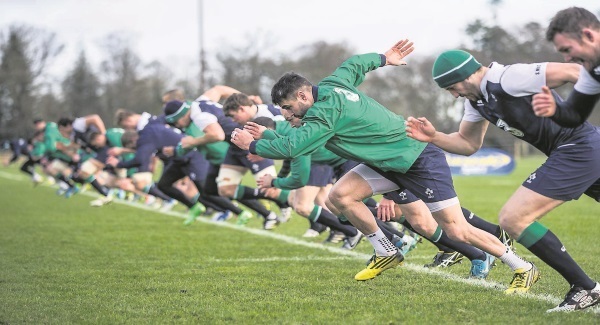
The Six Nations championship is a three-horse race that will be decided on the first three weekends - starting on Sunday in Dublin, writes Ronan O’Gara
Why you can’t bring flakiness to the Six Nations table

he Six Nations championship is a three-horse race that will be decided on the first three weekends — starting on Sunday in Dublin.

Even from the other side of the world, the Six Nations championship ground rules look and feel the same. The first one? Don’t bring flakiness to the table.


It’s why Wales are perennial contenders, why the French sometimes appear comme çi, comme ça.

They’re not of course. They bring as much emotion to the table as Warren Gatland’s Wales. They are interested. But they don’t dig in. If things fall neatly for them, they are dangerous, but allegations of flakiness hang around their neck and grow bigger and bigger in the blue jersey. You hang in there with the French, you’ve always got a chance.

In Guy Noves, they’ve a coach with vast experience, but the playing group — and likely 15 for tomorrow’s opener against Italy — is pockmarked with inexperience. A new captain in Guilheim Guarado of Toulon, Hugo Bonneval on one wing, Sevens star and former Racing 92 player Virimi Vakatawa on the other, and a barely tried half-back partnership of Sebastien Bezy and Jules Plisson; it could click but sorry, I don’t see it happening.

Wales, meanwhile, have that priceless, uncanny knack of hanging in there in tight games. What they did to England in the World Cup may haunt the Twickenham suits but it will feed the perception that Gatland’s men are never done.

Then look at the Irish dressing room. They may have lost The Man Who Can’t Be Replaced, but every Irish team meeting I can remember, Rory Best was there. My admiration for him is well known, he’s the sort of leader I’d have wanted to go the extra mile for all day long.

Johnny Sexton is a more recent vintage but like Heaslip, Conor Murray, Sean O’Brien, and Rob Kearney, he’s a frontline performer. I’ll repeat myself — there are a lot of leaders in the Irish game. A lot of fellas who don’t do flakiness.

The World Cup was lovely for a while, a jamboree, but Six Nations is our passion. Our dinner and our supper. England 2015 was about New Zealand and Dan Carter, about Japan for 80 minutes. Everyone else went straight back to work. The best team for the last four years proved themselves just that again in a mini-cycle. Now let’s see where the Northern Hemisphere has taken itself for the spring classic. Let’s see where the level of the games are at, how long the ball will be in play, because SANZAR goes from strength to strength. We only need to look at Ireland’s last World Cup game to see that.

It’s a big Six Nations for Sexton. Sorry, it’s a big Six Nations for every 9-10 partnership, but Johnny has his own motivations. He’d be very frustrated with his World Cup. He didn’t get the good feeling of the French game and couldn’t put his oar into the Argentina struggle.

You know what no Irish supporter needs these next two months? To see who Sexton’s back-up is, and how he does. We need to see five strong 80-minute games with Sexton in the hot seat. The first three especially. When last did the schedule throw up a Wales-France-England start to the tournament for Ireland?

The players will know it’s a long tournament if they lose at home to the Welsh Sunday. But they know and trust their coach. The lack of a bounce from the provinces means, for the first time I can remember, that players are coming in to camp with brittle confidence.

Their last big victory was against France last October. The flip side is they are arriving into a coaching set-up they thrive under. When Joe says jump, the Irish players still ask how high. If they get over Sunday, the Stade de France will hold no fears. The target of a third championship in a row is a remarkable incentive, but the statistic that jumped out at me on the flight over here was ONE Grand Slam since 1948.

Wales will always fancy their chances of getting the result, and they bring a familiar, settled backline. Looking to do damage with North, Davies, Roberts, all masterminded by Biggar. If their half-backs can bring their autumn form into spring, they’re a formidable proposition.

But the Six Nations demands a very specific set of attacking skills. Game flexibility is fundamental. You’re going to have the wet and biting chill of the start of February compared to the spring conditions at the end of March.

That tests the players’ skill in every capacity, but nowhere more than at half-back. When you play in dry, warm conditions, you don’t have to concern yourself with catching and passing the ball. But if the ball is wet or difficult to handle, you’re playing more field or putting faith in your players to hold the ball for longer periods of time. The first thing that happens in that scenario is the line speed will be ramped up against you. Then you are compromised in your ability to put that extra two metres on every pass. Everything tightens up, including you.

That’s where Six Nations past experience is so critical. While the combination of Toulouse’s Bezy and Stade’s Plisson might get away with this weekend against Italy, they will struggle thereafter. The 10 doesn’t start games for Stade, so when the intensity and pressure cranks up after 60 minutes, does Plisson really have the facility to deal with that?

I do respect the quality of player France have, but knitting the pieces together seems to be beyond them. Maybe it’s the vastness of their player pool, the fact that if 15 different experts sat down to pick a French team, no two would select the same personnel. They struggle to understand the notion that by playing together more often, you develop a relationship — and a team.

If Ireland can go to Paris on Valentine’s weekend with a win against Wales under their belt, it’s almost a freebie. All the pressure will be on France. Suffocating pressure. And we suspect how that will turn out.

Hence, there are three championship contenders — the two sides at the Aviva on Sunday, and England. Scotland’s impact will be intriguing, not least with an opener against England coming on the back of a promising end to their World Cup.

But the difference between what did happen against Australia and what could have happened had they made a semi-final is vast. Even though progress under Vern Cotter is self-evident, it all comes back to control at half-back, and they are not in the same league as Ireland and Wales in that regard.

It will be fascinating to see how England go under Eddie Jones. The same players with a different spin. Paul Gustard has done outstanding defensive work with Saracens, and if he can bring that into test arena, England will be especially difficult to score against. I would have thought it was one or the other between Owen Farrell and George Ford, with the Saracen playing better rugby at this moment. But what do I know?

Historically, beating England had the feel of a scalp about it, one for the old country. That has dissipated, thankfully. I look at Wales, whom we feel we are at least as good as, and possibly better. They’ve three Grand Slams since 2000. Ireland might have five Heineken Cups, but the Slams trump that. Our return is not good enough.

When we met them at the 2011 World Cup, we talked ourselves up and didn’t produce. They are Ireland’s biggest obstacle, from a rugby and a psychological point of view, to a potential hat-trick of championships. Hopefully that breeds fear and desperation. Because they may be Ireland’s trump cards this weekend.

More in this section

Sport

Newsletter

Sign up to our daily sports bulletin, delivered straight to your inbox at 5pm. Subscribers also receive an exclusive email from our sports desk editors every Friday evening looking forward to the weekend's sporting action.

Cookie Policy Privacy Policy Brand Safety FAQ Help Contact Us Terms and Conditions

© Examiner Echo Group Limited