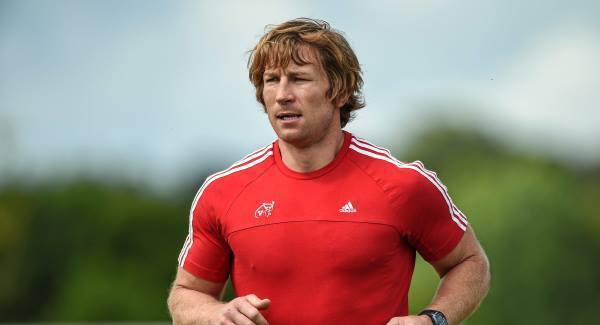
The many hats of Jerry Flannery
The Michael Moynihan Interview.

The many hats of Jerry Flannery

From top player to conditioning coach at Arsenal, where they talk salary in telephone numbers, and back to Munster. It’s been an energising journey thus far for Jerry Flannery — and an informative one.

Success is a journey, not a neat storyline: “It’s down to the grind, the getting up to get a little bit better every day. You get a degree and it’s not down to one paper you wrote in second year. It’s the continuous effort.”


The Tweeter

You virtually know Jerry Flannery, or maybe you know him virtually.

On Twitter the former Ireland and Munster hooker has 70,000 followers hanging on his bons mots. In between lacerating former team-mates and championing his own body parts, Flannery often tweets pictures of food: take the dazzling cheesecake he shared online.

“I was in London on my own for a while, and I was always into the habit of eating healthily from playing, I had time on my hands — I know it can be a bit off putting stuff up on Twitter, though.

“You’re walking a fine line between looking for attention but I put stuff up if I’m genuinely excited by it. And that cheesecake looked good.”

Yes, the low-fat cheesecake put up by the big man looked enticing. However . . .

“Looked impressive, didn’t it? It tasted manky enough, though. I didn’t bother making it again. It’s good to get feedback on it, though. I met Derval O’Rourke recently and I had some protein truffles that I’d made that I showed her. I like cooking, it’s something I get into more the older I get.”

It’s a change from his playing days.

“When I played I had to eat so much all the time I had no great grá for food. You’re always eating out, just getting it down. Nowadays if I eat out I enjoy it, with my girlfriend or my family, I’ll have a steak, or dessert. I’ll enjoy it.

“Because I was injured for a long time I had a long time to think about what I was going to miss about the job, and what I wouldn’t miss. I knew that something like playing in Croke Park in front of 80,000 people – that ends. It ends for everyone, so you just say, ‘that was great’ and you move on.”

The retired player

A recurring calf injury ended Flannery’s career a couple of years early. He made his peace with retirement, however.

“What I don’t miss is injury, and the calf injury in particular. But the fact that my happiness doesn’t depend on that any more is a help.

“If you play poorly in a game there’s always another week. You may not be selected for the following game, but you can put in the work and say to yourself at the end of the week’s training, ‘I got better’.

“I look at lads now with Munster with long-term injuries and I’m gutted for them, because I know the helplessness of it. That’s the biggest thing for me — the minute I retired I felt, ‘my life is no longer dictated by whether my calf can respond to treatment’.” The fact that he can still train helps: “I’ve seen lads come out of it who can’t train any more because they have bad injuries. I can, and I enjoy training, and it anchors the day for me. As a career, rugby shows you your successes very clearly. Your result on Saturday, your performance on Saturday, that lets you know how well your week went. And if you don’t go well you can think, ‘was I sloppy there during the week, was I off with the diet’.

“So there’s a lot of stuff I brought into retirement from rugby, and the other stuff, I just said to myself, ‘that was great for a period’.”

A good mental attitude was part of that stuff. Accommodating the pressure of professional sport was a big part of that, he says.

“The pressure I enjoyed, though it took me a long time to get my head around this when I was playing, and when I did I started to kick on. I got the attitude that I’m going to try my best whatever I do, so if I try my best I’ll embrace the fact that the odds are even higher: that I can win even more, or lose even more, but by trying your best there’s no shame because you can’t do any more.”

The new coach

He’s working with Anthony Foley at Munster now, but he acknowledges he’s “still green”.

“It’s massively fulfilling to see them follow through on something we’ve done, but I’m just starting.

“You learn things like how the week goes: as a player when you finish the game on the Saturday then the next 24 hours are for you to relax. For a coach that’s when the work starts — you re-watch the game, do analysis and so on.

“I enjoy working with the players because I see how hard they work and I want them to do well, I’m there to facilitate them in that. The fact that Munster is something that’s close to me, to my family and friends, is a help.”

Did it help to go away rather than segueing from player to coach with Munster?

“I don’t think you have to do it, Axel (Anthony Foley) hasn’t done it, but it was definitely beneficial for me even to live somewhere different. A lot of my mates would have emigrated to Vancouver or Australia or London, and the odd time you might think ‘it’d be class to be in London’ or whatever. But when I visited the lads and the grass isn’t always greener.

“I planned to do another year with Arsenal, and to throw myself into London, because I was living out in St Albans, which is a good bit out, but then I joined Munster.”

The Arsenal man

Flannery’s year working in strength and conditioning at Arsenal changed his mind about soccer, on the field and off.

“I saw how different an industry it is to rugby, and how the element of luck is important.

“I don’t begrudge the lads who make it, because so many of them are on the scrap heap. When I was at Arsenal Steve Bould and a few of the first-team coaches were really sound to me: strength and conditioning doesn’t have the same value at present in soccer that it does in rugby, where lads have to reach a certain condition to get on the field without being broken up.

“But Bould and some of those guys really made me feel at home, they’d ask about rugby.”

Flannery says the tactical knowledge the coaches shared was an eye-opener: “My thing was, ‘sure you just put out your best players, hit the ball around’, and they were, ‘nah . . .’

“They explained the pressing game, how they try to create space pulling guys wide, letting the opponents’ last forward free to have someone spare. That was stuff I hadn’t a clue about. I always liked to see guys dribbling with the ball, but their point was if someone dribbles then the opponents know where the ball is and can pick up the men that player will eventually try to pass the ball to. They showed me how important it is for teams to move the ball quickly through the first two-thirds of the field so they don’t get caught in possession.

He fell in for a few five a sides (“A different level altogether, sure, you were just chasing shadows around without ever touching the ball”).

The cultural connoisseur

Flannery is in a good position to compare the sporting culture of professional rugby and soccer, and he offers some telling points about the differences between the two sports. Take the resources available to them.

“When I went over first to see the facilities I was surprised by how poor the gym was, but they were on the point of putting an 18 million investment into the club.

“The money’s huge, but the early specialisation, to me, is the tricky thing. You’re taking in kids at 15 or so and they’re not really men but they’re going into an environment where you’re treated like an adult insofar as you can have your contract cut at 18 and you’re gone. At least in rugby, by and large lads go through school and academy, and they’ll know if they have a career in front of them as a pro rugby player by twenty or so.

“If not they’re not on the scrap heap, they have some kind of grounding, but in football they sign a contract at nine or ten, as they get older their mates are being culled, they’re being told how brilliant they are, and how focused is a 14-year-old going to be on school when he’s hearing that, or when he’s training near the first team, seeing their cars . . . it’s an unrealistic view of the world.”

Flannery recalls players talking about whether they’d prefer “Madrid for 70k a week to sit on the bench or playing for Villa for 35K a week’”, and shakes his head at the figures.

That’s not the only difference in mindset, however — he points out that a kid who succeeds in soccer must abandon the principles which brought him to the first team, for instance, if he’s to remain with the first team.

“Intrinsically they’re all good lads but it’s a cut-throat sport and lads become cut-throat. On their underage teams they’ll try to stand out, to impress, but when they break into the first team they’ve got to play totally differently – to be unselfish for the team.

“But being selfish has gotten them to that spot in the first place. That’s asking them to be a different person and that’s a tricky thing. Kids from smaller clubs have a better chance. I spoke to a guy at Arsenal who was with Southampton, and he said that if they felt a kid was good enough for the first team they just put him in the first team, and he either sank or swam, but he got that opportunity.

“But in Arsenal the level is higher – if the centre-half gets injured they have the money to throw at that problem, to buy someone in, so the incentive to develop someone and bring them through is probably less than at Southampton. There were so many areas where things could go wrong. If you were dropping your kid at Southend or somewhere you’d be wondering if they’d make it, while if you were dropping them at Arsenal you’d probably think ‘he’s being looked after here’. But their chances at a big club are so much smaller.”

The club culture manifests itself in other, more subtle ways.

“If the first team loses you don’t want to be walking around beaming and having a great laugh, certainly,” says Flannery.

“By comparison, I think there can be a culture of accountability in rugby, that if a guy makes a mistake he’ll hold his hand up and say so, while in football there can be a blame culture, whose fault was that?

“I think the culture of accountability versus the blame . . . it was weird. It’s like the natural progression for the psyche of the young footballer, they’re on a pedestal, they have money, they’re known, they’re immature, and you mix in the fact that they know they could be gone in the morning.

“There isn’t a sense that ‘we’ll all be here in five years’. I think that togetherness among rugby players is stronger, particularly here in Ireland, I know it is in Munster and in the provinces. When Denis Fogarty went to France he found it was less of a goldfish bowl, while here he was always a Munster player: I see that as a positive pressure, that everyone on the team holds themselves to a standard together.”

The believer in data

Flannery acknowledges the new drive in team preparation for data and analytics, though he feels there’s still a place for the coach’s eye and opinion.

“I think the processes of coaching have been refined, but people still coach. It’s about your eye and your ability. Now you have the added bonus of all those stats, and if you’re seeing something that’s contradicted by all the data, then you have to consider that you might be wrong yourself.

“It works the other way too, though, that the information will back up what you think about a situation or a player. It helps, certainly.

“The more you can quantify performance, within reason, the easier it is to have conversations with players about how they’re doing – ‘when we do this well, these are the outcomes’, and they can see it in black and white.

“If it were just figures . . . it’s getting across to the player what’ll generate the greatest return for them. There’s so much information coming at them – and I’m lucky we have good people around us in Munster and the IRFU – and it’s trying to get across the simplest points to get the greatest return for the team.

“It’s no good me having knowledge in my head, I’ve got to get it across. The better you can do that, the better you coach.”

Is he a good communicator?

“Reasonably good – I’m reasonably articulate, but it’s about refining it down to a point where it’s a case of ‘if I can get them to do this it’ll get a good return’.

“I loved that as a player, when a coach simplified things down to say, ‘concentrate on this’.

“The message can’t be that complicated if a guy who’s exhausted in the 76th minute is going to act on it. I suppose a lot of it is listening to what people say and being measured in what you say. My default when I was in the squad was to chat away to everybody all the time. But I didn’t get judged on what I said – if I talked rubbish but did it on the field, that was what counted.

“As a coach, though, I don’t have that luxury. You’ve got to be measured and to select the right thing to get across at the right thing. And you can’t be perfect in that all the time either, because the game evolves the whole time as well.”

The coaching fan

Pressed for a coaching hero, Flannery goes Stateside.

“From what I’ve read, basketball coach John Wooden’s approach seemed to be about controlling what you can control rather than whether you win or lose.

“Winning or losing will happen either way, but if you can control what you can control, that puts you in charge of your destiny. That comes back to confidence, too. If you’ve done everything you can, then there’s no fear of losing because you’ve done everything you can. You walk on the field with full confidence.”

He’s dubious about sports narratives which strain for a turning point: “I think whenever a team has success people always look for the USP, that one special thing . . . when the Seahawks won the Super Bowl it was all about Mike Gervais and his approach towards dealing with the players.

“Next year it’ll be different, though. When we won the Grand Slam everybody put it down to Deccie (Kidney) getting us in a room and Rob Kearney addressing the Munster-Leinster thing. Reducing the narrative to one thing.”

Flannery says success is a continual process, not an easy plot development.

“It’s (success) down to the grind, the getting up to get a little bit better every day. You get a degree and it’s not down to one paper you wrote in second year. It’s the continuous effort.

“When we won the Heineken Cup in 2006 people said we all grew ten feet tall when Limerick flashed up on the screen in the stadium, and it was a nice moment, but it was won over months and years of practice and training. Preparing properly is everything. You’re nervous about public speaking? You prepare to the very best of your ability and whether it’s good or not, then for the time and place where you are when you speak, that’s the best you are.”

Preparing to be the best. Jerry Flannery always did that.

x

More in this section

Sport

Newsletter

Sign up to our daily sports bulletin, delivered straight to your inbox at 5pm. Subscribers also receive an exclusive email from our sports desk editors every Friday evening looking forward to the weekend's sporting action.

Cookie Policy Privacy Policy Brand Safety FAQ Help Contact Us Terms and Conditions

© Examiner Echo Group Limited