Shane Curran: Tea and a slice of cake
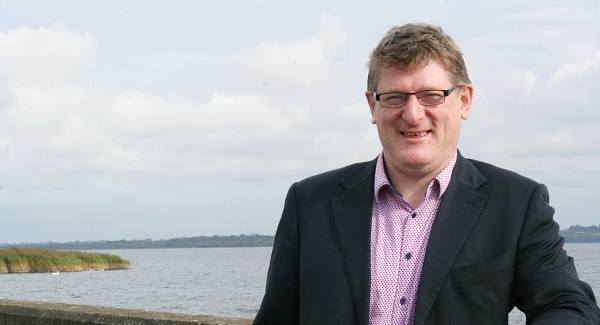

As much as the mention of Shane Curran invariably conjures up an image of him laughing, there’s hardly a minute when that beautiful mind of his isn’t ticking, calculating, formulating something.
Some of his ideas have been simply ingenious: coming up the field long before Stephen Cluxton ever did to take a last-minute free and indeed a penalty in the vital closing moments of a championship game; coming up with a goalkeeping tee with bristles to help minimise resistance and injuries; and then, at a time when he was almost broke, coming up with a flooding defence system that is now used around the world and has him on his way to making a very comfortable living.
Other lightbulb moments have been risky but ultimately worked out for the best, most famously with that well-documented last-minute penalty in the 1989 Connacht minor final, when he declared both mayhem and himself onto the national stage.
And then there have been other brainwaves — “Well, I thought they were brainwaves at the time” — he’ll admit and laugh that just simply haven’t come off.
Take the first round of the 2003 Connacht championship. Roscommon at the time had a handy team but Galway had an even better one, having played in three of the previous five All-Ireland finals. “And sometimes when there’s an ability deficit between your team and your opponents,” Curran writes in his wonderful new autobiography Cake, “the onus is on you, the underdog, to try and think of something that might create a swing of one or 2%.”
So, before that game, he elected to slap some Vaseline on one pair of gloves, clasp hands with his opposite number, Alan Keane “with great sincerity altogether” in the pre-match handshakes before then slipping on a second pair of gloves. Ideally Keane wouldn’t have noticed what had transpired, there might be a high ball into his square and...
But before the ball was thrown in, Curran could spot some commotion down at the other goals. Galway had copped his latest trick and Keane would summon a second pair of gloves.
“And ever since that day, goalies won’t shake my hand,” Curran smiles over a cup of tea in the Hodson Bay Hotel, the well-known lakeside hotel that sponsor his club, St Brigid’s. “The following year I’d go to Stephen Cluxton and he’d say ‘I can’t shake your hand, man!’ It’s been all tentative fist bumps instead. I let the cat out of the bag against Galway. John O’Mahony wasn’t happy with me at all that day. Look, it wasn’t the right thing to do, but sure what about it?”
For one, himself and Keane’s parents who he sold slates had a right laugh about it when they met soon after. Plus, the Vaseline was better than the other brainwave he came up for that game.
Curran was team captain that year. That involved making the odd team speech, including at half-time. So he’d wondered, what if the team were in a bit of bother at the break? What angle could he take to rally the troops? He’d just the plan.
A few days before the game, he visited his local GP and asked him to take a pint of his blood. Curran took it home in a sealed plastic bag, put in the freezer, only then to put it in his gear bag when Sunday came around. At half-time, he reached for it. Roscommon were six points down. Time for the captain’s speech of all captain’s speeches. “Lads, this is Roscommon blood. And we’re going to have to fucking spill blood now to win this match.” On his spiel went, and as it reached a crescendo he fired the bag off the floor, expecting it burst and blood to go everywhere. Only it didn’t.
“It just sat there on the ground,” he writes in his book. “The lads looked at it and looked at me and looked at it again, not knowing what to make of it all. I have to admit, it didn’t quite come off as I’d envisaged it.”
Roscommon, you might have guessed, didn’t win that day, but at least they didn’t have a health hazard in their dressing room; the team doctor would tell Curran afterwards he nearly had a heart attack when he saw him producing the blood. Mind you, they would at least win the second half. And later that summer they would knock Cork out of the championship and reach an All-Ireland quarter-final, with Curran’s heroics along the way earning him an All Star nomination. At times he might come across as a bit of an eejit but the reality is there isn’t a smarter or more successful one about. He might constantly be laughing but at no one more than himself. And that self-depreciating humour and self-awareness is partly why he’s also laughing all the way to the bank. Wherever he goes, he seems to laugh, especially to and from a dressing room.
He even brought the same joie de vivre to school, though he had little interest in the books. As early as fifth class of primary school, he made the calculation that school was more a place to socialise and connect with others rather than be educated along conventional lines. He didn’t know it at the time, that he had dyslexia but it took a real intelligence to accept that other forms of intelligence weren’t for him.
“I’m very lucky that I just don’t do stress and maybe it’s being dyslexic,” he says. “It allows you to look at things a bit different and I realised that most things aren’t that serious anyway. As long as you have your health, and are able to get out of the bed in the morning, you’ve so much to be happy about. And in school we were such a happy bunch. I can honestly tell you for the five years I had in the Tech in Castlerea, I didn’t miss a day. And there wasn’t a day I didn’t learn something either. But it was learning in a different way.
“We weren’t troublemakers. For sure there was a bit of devilment. We blew up the science lab that time. Another time I snuck up and tied a teacher’s shoelace to a chair. When she got up sure she brought the table with her! But I’ve met a lot of our teachers since and they’ll say that we were among the nicest fellas they ever taught.
“It was only when our youngest daughter was diagnosed with dyslexia that I realised I was chronically dyslexic myself. Thankfully she has great teachers to help her. In our time, our teachers didn’t know. And you can hardly blame them for that. Sure they just thought we were lovely thick feckers who only wanted the craic!”
One of the reasons he was so willing to accept himself was because he was so well versed in tolerating, accepting and appreciating others. As a kid growing up in Castlerea, he’d regularly spent time up in the local psychiatric hospital where both his parents worked, his mother Pauline in the kitchen, his father Tommy in the powerhouse. People that society had warded and written off, the Currans welcomed with open arms.
“My parents would bring them out to the bog with us where they’d have a cup of tea, a bit of porter, eat sandwiches with the rest of us. Why? Because they had a real good nature. Besides, we got the turf in a lot quicker. I remember one of them was called Mick and he was one of the most knowledgeable and decent men I’ve ever known. And I remember sitting down as a child talking to him and wondering why is he institutionalised? We’d go up the hospital and football field and play and talk and you were just surrounded by really humane, intelligent people. And that’s probably where I got my education.”
He’d bring that gift of the gab to work. Over the years Curran would change careers but the one constant was every job involved dealing and yapping with people. As a kid, he’d work on a milk round and sell shoes. From the outset, he was a terrific salesman, primarily because he was first and foremost a people’s person.
“I understood intuitively that selling was all about talking, making a connection,” he writes. “With the men, it was often football; with the women it was often flattery; you told them how well the pair of shoes they were trying on suited them.”
After school he worked in a big home supplies store. He’d sell frying pans (“That’s the one that Darina uses on the telly,” he’d tell prospective customers, “it’s a mighty frying pan altogether”). He’d sell beds, telling customers they’d spend a third of their lives in bed, a bit more if a young married couple were a bit of craic.
“I knocked outrageous craic out of selling beds. You’d know the couples that would be on for a bit of banter about the sex. You’d show them a bad bed, then a good one, then an expensive one. You could say I played an important part in the love life of many a couple over many years.”
During the boom, he’d move into the construction industry, selling slates, then setting up a builders providers company. Then came the bust, and his company went the same way. He was out of pocket and seemingly out of luck, but again his positive disposition served him well.
“Liquidating a company is not a simple process. You’re dealing with solicitors, accountants, bloody banks, creditors and the lot. But that’s where sport helps you. If you’re the underdog, like we are here in Roscommon, you develop an attitude that you have to fight for every little crumb that you get. You understand every bit of success takes so long. So I calculated very early in the process that having to close a business is like a football match that’s been lost. I had to move on from it and get onto the next match.”
He’s been winning ever since. When a friend’s house was surrounded by water during the notorious November floods of 2009, he and his business partner Ger Brennan came up with a brilliant flooding device which was far more effective than the traditional solution of sandbags. Since then, it’s brought him all over the world: the Middle East, the States, Africa. The product is manufactured in Germany, used by the UN and Concern in camps in places like Somalia where he visited and survived last summer. Sweating bullets over there made him yearn for the quiet, more mundane football fields of Roscommon.
Mind you, there was a time they were killing fields too. We all know Curran primarily as the maverick Roscommon goalkeeper of the noughties and still winning and playing with St Brigid’s in his 40s, but back in the early ’90s, he was one of the best corner forwards in his county. Unfortunately that meant he was one of the most targeted and abused. Twice in two months, he was sent off for retaliation. He saw a team-mate have his teeth and jaw cracked and never play again. When umpires were blind, you took the law into your own hands, because otherwise it was completely lawless.
“It was a time when managers and clubs were almost delighting that they were skinning the good fellas. ‘Ah, I heard Curran got an awful doing up in Strokestown’. ‘I heard Luke Dolan got an awful skinning in Tulsk’. ‘I heard Frankie Dolan got done something serious in Frenchpark’. That was the culture. I can remember a game against Shannon Gaels well and I was fecking delighted that I was getting out of here and going to the States for the summer because I could not stand the sheer thuggery and lack of protection anymore. I was thinking ‘Either I’m going to give this thing up or I’m going to kill someone on a pitch.’
“That’s why I don’t understand the critique of the game these days. I understand that there’ll be a bad game, fine, but the way the likes of [Joe] Brolly, [Pat] Spillane and even [Colm] O’Rourke are constantly rubbishing the modern game when it’s so much better to when they were playing. It’s so much faster. I hear people giving out that nowadays there are too many athletes, not enough footballers. At least now they’re either athletes or footballers, often both. Back when those boys were playing, there were fellas that were neither, they were thugs, hatchet men. You look at corner backs playing today: Paul Murphy, Keith Higgins, Johnny Cooper. They’re not depending on acting the maggot.”
Other things are better now. For one, you’re guaranteed more than one championship game. “Back in the ’90s, if you lost your first game, you were gone for the year. I played in the ’92 championship for Roscommon. ’94. ’97 again. One game each time. It was no way to develop a team. You’d spend large chunks of your career waiting a year for your next championship game. A lot of players lost careers and then would go back to the mundane club championships. You’d wonder at times why you’d spend half your life chasing a ball around the place.”
And yet at 43 years of age, he’s still doing it. Switching to goalkeeper helped. The backdoor and the emergence of a handy Roscommon team in the early half of the noughties helped too. The emergence and prominence of St Brigid’s has helped too. 18 months ago they won the club All-Ireland. Win next week, and they’ve won a fifth consecutive county title. That sustains him as well.
Above all the dressing room sustains him. Very few Irish sportsbooks have captured so vividly the smell and the sense and the charms of those four walls as Curran’s has. And while it’s a place he knows he’ll be leaving — only as a player — when Brigid’s current campaign comes to a close, it continues to intrigue and energise him.
“It’s not just a dressing room of players, we have a whole cohort of mentors around us. One of our sponsors, Eamonn O’Rourke, who has fireplaces in Glasson, will come in every night and see how we are. Before the [2013] All-Ireland semi-final, my quad was in trouble. It was touch and go if I’d play, it required around-the-clock treatment. So Eamonn comes in and he starts praying over it. So the heat is coming and this prayer is going ‘God, make this man’s leg be fine...’ And at the end he goes, ‘This man’s leg will be fine! Praise be to Jesus!’ And Jesus, right enough, my leg is fine! Last week my back as giving me a bit of bother and again he prayed over it. And again it did the job.
“So we’ve got prayer, we’ve got craic and above all we’ve good lads. I see the younger boys, fellas like Niall McInerney, Ronan Stack, Padraig Kelly, Eddie Egan, Sean Mannion who’ll be coming in after me, and they’ve taken the team to another level, they’ve become men in front of our eyes.”
It’ll be a quieter place for his leaving, but all so much the better for him being there at all.