Banner football’s Special K
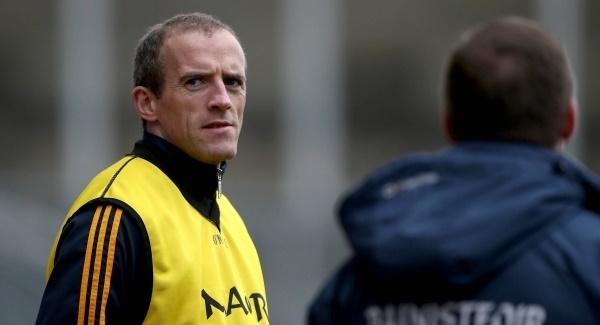
At 27, Paudie Kissane still hadn’t played Championship football for Cork. But he retired with one All-Ireland title, two Munster crowns, three National Leagues and an All Star award. And now he’s plotting Kerry’s downfall.

Banner football’s Special K

This is not Broadway. But it is an apprenticeship.

A league game in Cusack Park, Ennis, on the last Sunday of March and, on the sideline, two familiar, trim figures don bibs over their tracksuits.

Anthony Rainbow is Carlow’s Bainisteoir. At the moment Carlow are the weakest team in Leinster, probably the entire country. Mick O’Dwyer used to say the same about Kildare when he inherited them in the winter of 1990 and found a strapping raw teenaged Rainbow looking back at him but eight years later they would be the best in Leinster and one of the best in all Ireland.

As promising and earnest a young coach as Rainbow is, Carlow aren’t going to undergo a similar transformation. As the game here enters injury time, his side trail by 13 points. While Clare seem on course for promotion, Carlow look set for relegation, if in the basement of Division Four there was such a thing as relegation.

Further up the line Paudie Kissane sports a yellow bib printed Maor Foirne. Clare’s runner.

There was a time he could run all day for Cork as well and he played football for them too, as recently as last August in Croke Park against the Dubs. Seventy thousand people were at that game. Barely a thousand are in Cusack Park here. You could say it’s some comedown, but the way he and probably Rainbow see it, they’re slowly climbing up.

“You could have looked at it two ways,” Kissane says when reflecting upon Colm Collins’ invite last winter to go straight from hanging up his boots to throwing on that bib and whistle to become coach to Clare.

“One was to think, ‘Ah sure they’re only a Division Four team, they’ll go nowhere.’

“But the way I looked at it was there are loads of excellent coaches that I know of who’ll never get the chance to coach at intercounty level because they wouldn’t have had the playing career and profile I had.

“So I’m very grateful for this chance. But at the same time I wouldn’t be happy with just this either. Does that make sense?”

It does, perfectly, for anyone who knows Kissane. His humility is only matched by his ambition.

As he admits himself, “I’d be very ambitious.” Put it this way: At 27 he still hadn’t played championship for Cork. Anyone else at that age would have given up on the dream. But he kept dreaming and more importantly kept planning and plugging away. At 28 he would make that debut. And at 30 he would start with them for a second time and win an All Star and an All-Ireland while he was at it. If his career shows anything it’s that nothing is below him and nothing is beyond him.

This actually isn’t the first time he’s helped out a Division Four team. In 2008 he was the trainer to London. At the time he was in his final year as a sports science degree student in Brunel University, having quit the day job as a greenkeeper. He had previously taken Tír Chonaill Gaels, the London club champions, as a coach for a few sessions, around the time they were getting within four points of All-Ireland Club champions like Salthill and Crossmaglen Rangers, so it was little wonder London called upon his services.

They also wanted him to play, them being the Exiles and him being exiled from Cork. He’d never played U21 for his county and never played championship either, only a few league games in 2002 and 2003 before being cut in Larry Tompkins’ last season in charge. If he couldn’t play for Cork, why not play for London? He saw it the other way round.

“I suppose I would still have held out hope of playing again for Cork. And if I signed up for London at the start of any year, then that ruled me out playing for Cork later that year. I was never sure whether I’d ever get that call up, but I wasn’t going to rule it out.”

It finally came. The week after another strike on Leeside had ended and Teddy Holland had stepped down as Cork manager, Conor Counihan stepped in and brought Kissane in with him, impressed by his performances with the county junior team that had won the previous All-Ireland. And so that year Kissane double-jobbed. During the week he’d train London and study over there. Then at the weekend he’d train and play for Cork, just as he always would for his club Clyda Rovers.

That summer he was both on the line with London in the Connacht championship for their opening game against Sligo and then a few weeks later out on the field starting for Cork in the Munster championship in their opening game against Limerick, making him one of the better trivia quiz questions to emerge from that GAA championship.

As it would happen, he soon wouldn’t need such powers of bilocation. London’s championship interest ended that same day in Ruislip, his course finished up and then in that game for Cork in Limerick he would injure his hand, ruling him out for the rest of the summer. But now that he was back in with Cork, he wasn’t leaving. In 2009 he was a regular impact sub and then in 2010 he was a starter, All Star, League and All-Ireland winner.

Even in the one competition Cork failed to win that year, the Munster championship, he stood out, kicking three massive points from range from play from wing back in the drawn game against Kerry in Killarney.

Why didn’t he make it first time in with Tompkins? How did he make it then? When he looks back on his first stint, it is without any bitterness. “A lot of fellas come on to county panels and get only a few minutes here or there. I was lucky enough to start in league games.”

He had the speed and the stamina but not the strength nor the skills. When he was discarded on the eve of the 2003 championship, you would have thought that was it for Kissane and big-time football, especially when he wasn’t with a big-time club. It wasn’t like he was with a Nemo Rangers, regularly contending for county titles and All-Irelands. In fact in 2005 Kissane’s club regraded to intermediate. Yet during that time he himself upgraded.

“I suppose it’s in my nature to be something of a perfectionist. That can be a strength and a weakness. Maybe when I was first in with Cork I used to beat myself up too much when things weren’t going so well.

“But I like to do things well. And with the club I couldn’t just accept turning up and going through the motions and not being fit.”

From studying sports science, he’d learn how to bulk up. From studying sport psychology especially he’d learn to back himself more. And then from just kicking ball after ball, he’d develop his skills, especially his left foot.

The third of those long-range missiles he fired over in Killarney was with his left. In fact he would play most of his football in that fine Cork halfback line on the left.

his past winter though that unit would break up. Graham Canty and Noel O’Leary as well as Kissane all called it a day, along with other stalwarts of the 2010 All-Ireland winning team: Alan Quirke, Alan O’Connor, Pearse O’Neill. Together under Conor Counihan they won three Munster titles and three Division One league titles to go with that Celtic Cross, a fine return, yet one a lot of people feel should have been even better.

So how does he look at it? Content with what they did win, or irked by what they did not? Neither. Both.

“There’d be people say we actually played better after we won the All-Ireland but I don’t see it that way. The results are there in black and white. Against Mayo in 2011 maybe some fellas didn’t have the hunger when the shit hit the fan. We all had it the year before against Dublin. We dug it out. So the last few years were disappointing, but you’d also have to say we achieved quite a lot. We might have won more, could have won more, but you can’t say should have won more. I suppose it would have been a lot worse if we had no All-Ireland.”

The quest was never just about All-Irelands though. Always it was about learning more, getting better. At times some teammates didn’t quite get that. When they’d see him continuously going up and asking questions of the Cork management, a few thought he was sucking up, rather than soaking up information.

But Kissane always had what’s known as a growth mindset. Even in his year with the Cork minors – when they’d be unceremoniously dumped out of the championship in the first round by a Limerick side inspired by John Galvin – he’d jot down the drills the coaches would put them through; he still has that jotter.

It’s why he’d go back to college as a mature student. “I just had a huge interest in coaching and sport science. It’s grand to say ‘Do this drill, run here, run there’, but (I wanted to know) why do that drill and run there, like?”

He was a games development officer with the Cork county board up until 18 months ago. As much as he enjoyed developing kids and coaches and spreading a love of the game, his real passion is in high performance.

So he quit the day job, started studying part-time for a masters in strength and conditioning from Strawberry Hill St Mary’s University in London, and set up his own consultancy: Athlete Development and Performance.

One day he could be working with a runner trying to beat such a time in a marathon. Another evening he could be giving a workshop to a GAA club in injury prevention, then meeting players one- to-one. It’s all about using best practice in coaching and the sports sciences to help sportspeople and teams improve and maximise performance. You can’t pigeon-hole him as just a football coach or a sport scientist or a S&C coach. He’s all of those things, trying to provide a holistic approach.

“I’d be big into individualising the training and monitoring the training. Everyone is different. Say someone comes in with a bit of a complaint in their hip or glutes. You might do a bit of screening and from that and knowing the individual you’ll say ‘Right, because of what you have, this is what suits you best.’ Rather than ‘Look, these are great stretches, do them.’ I’ve learned less is more. You need to train hard but monitor fatigue. As a coach you might draw up a session that looks great on paper but then guys would be flat at the start of the night and you’ve to adapt. These lads are working. They have stresses outside playing football. So one of the things I’m doing is measuring athletes’ heart-rate variability. GPS is big at the moment but the next level then is to look at what’s happening internally to see what state the body is in. You might have had a hard session but due to poor sleep or a row with the girlfriend you might not be recovering sufficiently, so I can tell you what you need now is a light session tomorrow with how many reps.”

He hooks it up and uses it on himself. He’s still playing himself; last month at 34 he ran a county senior championship game against league leaders Skibbereen, scoring 1-3 from play from midfield, including a score from the left touchline with his left foot, probably the most difficult shot in football. Over the winter Clyda finally won their way out of the intermediate grade, all the way to Croke Park, and while he briefly contemplated retiring after that All-Ireland final defeat to focus on his career as a coach and a consultant, a few weeks later he was back on the club field.

“I suppose a part of it was having been intermediate for so long and not having won a senior game since 2003, there was a goal right away there. But I just have a love for doing it too. I still enjoy going to the pitch now with three footballs as if I was a nine-year-old. I might aim for the small goal and kick it with my left, kick it with my left, kick it with my left. It’s just ingrained at this stage.”

It’s that attitude which prompted Colm Collins to seek him out last autumn. The Cratloe man was about to be appointed Clare manager and had heard Kissane was contemplating finishing up playing with Cork. So before Kissane contemplated any other developments, Collins was in like a shot.

“I had fierce admiration for him as a footballer,” says Collins. “He was one of these guys who worked really hard at his game and with his experience in coaching I thought that he could transmit that attitude onto our lads. And he’s been fantastic for us. He’s extremely professional. If Paudie tells you he’ll have an email for you at 1pm, he’ll have it there for 1pm.”

He’s also delivered them out of Division Four. For a dozen years Clare had been stuck in the bottom division of football. Even Mick O’Dwyer couldn’t help them get out of it.

“If you were to look at the record books,” says Kissane, “you’d have been saying to yourself ‘Stay away from this.’ But I’d played with Gary Brennan, David Tubridy and Alan Clohessy with Munster and knew they had some good footballers. And it was a chance to get involved with a team at a high performance level. In Ireland the professional outlets are minimal. County football nearly is as good as it gets.

“At the same time it was a risk. Would the players have the ambition? I wasn’t getting involved just for the craic. I had no passion for the Clare jersey the way Colm had but I have a passion for being the best, like. There’s just no other way to be. It’s been a process. Often ambition drives motivation and then a sense of belief further drives that motivation. It would have been foolish to think at the start you’d have had 30 guys as motivated as you’d have in Cork. It was a case of taking baby steps. The first target was promotion. We achieved that, so confidence and motivation came from that. I can’t fault the players’ application or effort over the last few months. There are players there who have the same commitment as any Cork player.”

Tomorrow they face Kerry in Cusack Park. Suffice to say, a different proposition than the visit of Carlow. “It’s going to be a massive jump from playing only Division Four teams. But at the same time there’s a massive excitement about it. It’ll be a good barometer of where we are and the progress we’ve made.”

Maybe they’ll even disturb Kerry’s heart rate variability. Whatever happens, the apprentice and the apprenticeship will drive on.

More in this section

Sport

Newsletter

Sign up to our daily sports bulletin, delivered straight to your inbox at 5pm. Subscribers also receive an exclusive email from our sports desk editors every Friday evening looking forward to the weekend's sporting action.

Cookie Policy Privacy Policy Brand Safety FAQ Help Contact Us Terms and Conditions

© Examiner Echo Group Limited