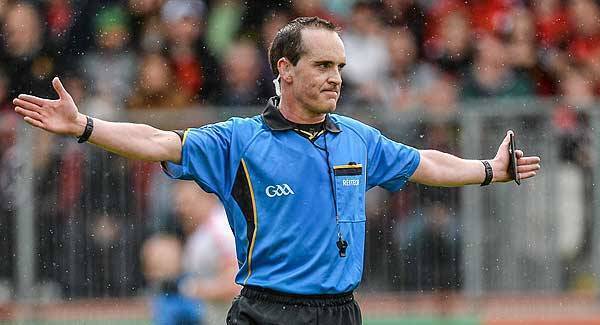
Coldrick simply made a bad call
He too had taken a lead role in the black card education process only to see it bite him in the backside.
It took the good nature of Pobalscoil Chorca Dhuibhne to make amends for the mistake in January when one of their players was allowed to remain on the pitch despite adding a black card to a yellow. The Dingle school offered Coláiste Chríost Rí a replay and everyone moved on.
Would Down have been as obliging to Tyrone had they won as Conor Maginn wrongfully remained on the pitch? Thankfully, we’ll never know.
What we do know is Coldrick appeared in an excellent education video about the black card in December. Considering that and how on Sunday he fell foul of not calling a blatant black card offence shouldn’t be interpreted as ironic. He was asked to appear alongside referees’ chief Pat McEnaney in the video. Although the optics might suggest otherwise, he never claimed to be an out-and-out expert on the new rules.
Neither is it ironic that last November he warned of testy times for the black card during its infancy.
He said at the time: “Referees will go out there and they will implement the new rules as they’ve been laid down and whatever happens at the end of that — and obviously, referees are behind these rule changes — once the association gives its full backing to these rules, there’ll be no issue from a refereeing point of view.”
Coldrick couldn’t have foreseen what happened on Sunday. He made a blunder, one that he undoubtedly regrets, but he’ll move on if he is allowed to.
Last week in these pages, McEnaney asked that referees who have bad games be judged the same way as players on off days. Did the request fall on deaf ears? Possibly.
On RTÉ Radio One last Saturday week, this writer called for patience to be shown to referees as they came to terms with applying the black card in an altogether more intense environment of the championship.
And yet we didn’t hold back on Coldrick in Monday’s report. How can we reconcile those seemingly contradictory perspectives? Quite simply, as one of Gaelic football’s best referees we expect a lot from the Meath man.
Just as players are not all the same, so too are referees and the standards Coldrick has set are higher than some of his colleagues. So to see him misjudge as obvious a decision as he did in Omagh was startling.
Others, those as cynical as Maginn’s takedowns of Mark Donnelly and Sean Cavanagh or Niall Morgan’s trip on Jerome Johnston, might say it was justice. By that we mean it was a largely unpunished Cavanagh pulldown on Ciaran McManus last August that copperfastened the necessity for the black card.
That’s a myopic school of thought, of course, and as harsh a critic Mickey Harte has been of the black card he made sure not to direct his angst at Coldrick. Will other managers who find themselves in the same situation — as some surely will — be as considerate?
The GAA’s policy of appointing the same referee for the replay has long been cancelled, but they mightn’t have gone too far wrong in appointing Coldrick again this Saturday. Instead, his fellow county man Cormac Reilly has been handed the role.
But what better message could the GAA have given that they were standing by their man than putting him in the middle six days later? Undoubtedly, he’ll get his chance to redeem himself again in forthcoming fixtures.
The black card, as much as it is a necessity, is also a challenge. McEnaney might say it’s “an extra tool in the toolbox” but Peter Canavan and Martin McHugh are right when they suggest it is a heavy one for referees to carry along with the rest they have to consider.
They will, though, learn to lift it. Coldrick will too.
Was it a curse? Was it justice? No, it was just a bad call. Don’t think he doesn’t know it.
Email: john.fogarty@examiner.ie
We won’t say it was a case of the Emperor’s New Clothes but there was something slightly underwhelming about Sky Sports’ championship launch in Croke Park yesterday.
It had little to do with the identity of the pundits — all four men can call a game — but the hyperbolic manner in which they were presented was quite unnecessary.
On reaching level six on the Hogan Stand, the working media were directed to a corporate box where the windows were blackened out. The reason? So that no prying eyes could see the identity of the analysts or presenters as they posed for promotional photographs at pitchside. Gimmickry at its finest.
We understand Sky Sports wanted to make a statement; promising steak and tabling mere sizzle is not the way to go about it.
Perhaps the heightened security around the stadium as the stage for the upcoming One Direction concerts was being constructed unintentionally added to the build-up but the pomp and ceremony that surrounded Sky’s gig seemed overegged.
After all, the quartet it unveiled have already been seen on our screens with TV3.
They were conservative choices and perhaps in keeping with Sky’s long-standing tradition of not rocking the boat too much.
As it puts out the feelers in its debut season with the GAA, that is understandable, but sky will earn more respect simply telling it like it is.
It was only three years ago the Ulster Council came in for some sharp words for the clash of an Armagh-Down provincial quarter-final with a Champions League final. The problem was it was out of their hands. The combination of RTE’s request to show the game and an Orange march close to Armagh city meant they had no choice but to go ahead with the game at 7.30pm, which was 30 minutes before the soccer kick-off.
In Páirc Esler on Saturday, Down and Tyrone supporters will be able to take in the 6.30pm game, moved forward from the provisional 7pm throw-in, and the majority of the all-Madrid Champions League final in Portugal on TV. Obviously, RTE’s inability to show the replay has helped the Ulster Council. Nevertheless, they should be commended for taking a sensible and conscientious move to accommodate their patrons.