2013: A gift that kept on giving
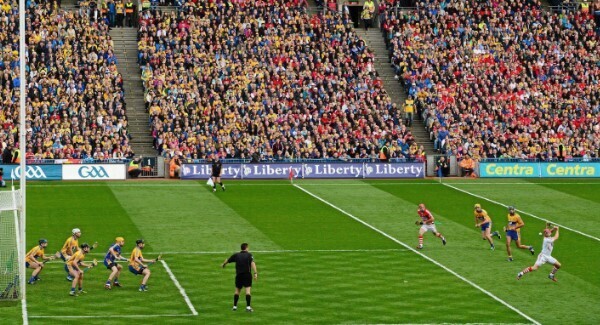
Late August 1997 and Ger Loughnane is talking about life, the universe and hurling in a hotel in Ennis.

2013: A gift that kept on giving

Clare are 70 minutes away from a second All-Ireland title in three years and the whole world has turned to saffron and blue.

At this precise moment indeed, with the Banner having seen off Cork, Tipperary and Kilkenny to reach the final, it appears unlikely that hurling will ever be the same again. But Loughnane knows better. He knows he has to make hay in good weather.


“We have to win as much as we can while we can,” he agrees. “Because sooner or later the Big Three will be back.”

Two years later they were. The 1999 All-Ireland final saw the end of a five-year McCarthy Cup sequence that went Offaly-Clare-Wexford-Clare-Offaly and the beginning of a 14-year sequence monopolised by the traditional trio (Tipperary two, Cork three and Kilkenny nine).

The empire didn’t so much strike back as come storming back with guns, tanks, air support and thermonuclear weapons.

And then came the summer of 2013 when the defending champions, sapped by injuries and ageing legs, lost a significant measure of their gross national output and thereby drifted back to the pack. As an aside, and to return to a point this observer has made here before, Kilkenny’s four-in-a-row team reached the end of the road, or at any rate the end of their natural lifespan, on All-Ireland final day 2009. It was one of Brian Cody’s greatest achievements to do such effective nip and tuck work that they bounced back to win two more titles.

But in 2013 they were, on their scoring figures, eight points an inferior team to the outfit of the previous two seasons. And as Kilkenny changed, so everything changed also. Cork and Dublin and Limerick moved forward a step, Tipperary backward a step. Clare took two steps forward, Galway two steps back. Waterford stayed where they were but won a minor All-Ireland. The hurling landscape on New Year’s Day 2014 is a very different place to that on New Year’s Day 2013.

The cycle has turned again, as if to illustrate Donal O’Grady’s point here a while back about the manner in which hurling undergoes a tectonic shift every 20 to 25 years. Limerick in the 1930s, Wexford in the ’50s, Galway after 1975, the madness of the mid-1990s. Offaly’s victory in 1994 lit the touch paper for half a decade’s conflagration of ancient certainties; Clare’s victory last September ought to be the catalyst for all sorts of fun over the next few seasons.

There are two ways for the aspirant classes to seize the throne in hurling. The first is to be blessed with a living legend who by his regular performance of unprecedented and miraculous feats strikes out for a better place and drags an entire county with him: witness Mick Mackey for Limerick in the 1930s and Nicky Rackard – even if by then he was past his best — for Wexford two decades later.

The second is to blossom at a juncture when the ruling classes are not the powers they previously were: witness Galway and Offaly in the 1980s and Clare in 1995. The flaw in Waterford’s cunning plan a few years back, unfortunately, was to materialise with a really good side at a juncture when Cork and Kilkenny possessed even better ones. A team designed by Blackadder with timing by Baldrick.

Okay. None of the above is to declare that, say, the boys in red and white won’t be back this year, or that Eamon O’Shea won’t have got a handle on the Tipp job in his second season there, or that Cody won’t succeed in coaxing a last hurrah out of his ageing cadre of superstars.

Yet manfully though they performed this summer, Cork are surely as likely to stand still in 2014 as to take one last step forward. And Tipperary have seen fit to outsource their psychological welfare to the care of a former Armagh footballer (what would John Doyle have said?). And spend an afternoon on Noreside polling random punters as to the identity of the next great Kilkenny forward and you’ll be met with blank stares and mumbles.

What can be said without fear of contradiction, then, is that Championship 2014 will see eight cars – Clare, Cork, Dublin, Galway, Kilkenny, Limerick, Tipperary and Waterford – start from more or less the same position on the grid. A similar dispensation will obtain in 2015 and, unless a new superteam materialises almost overnight, in 2016 too. It’s like we’ve fallen asleep and woken up in 1997 all over again. And it’s only great.

What’s more, some of what we might term the decade’s constitutional requirements have been met. Tipperary have already done as much as they did in the 1970s, ‘90s and noughties by winning their one All-Ireland early on. Kilkenny have already done as much as they did in the 1980s and ‘90s by winning their two All-Irelands early on. If such patterns are repeated – and no sport repeats itself the way hurling does – then the gap in the market exploited by Clare last summer will not be closing any time soon.

Gerry O’Connor, joint-manager of the county’s under-21s, phrased it with refreshing practicality recently. Enjoy Tony Kelly, David McInerney et al while you can, he urged, because as young as they are right now, they won’t be around forever. It is Loughnane in 1997 retreaded. Eat, drink and be merry, for tomorrow we die. The shadow will, inevitably, return.

So who will the All-Ireland champions of 2014, ’15 and ’16 be? It’s not hard to visualise Clare capturing another title in that period; the only surprise will be if they don’t. But whereas a team can descend from the clouds and win an All-Ireland, as the same county did in 1995, a team does not descend from the clouds and win consecutive All-Irelands.

That the Banner triumphed a few months ago in the most exhilarating fashion counts for precisely nothing today. The clock has been reset. The challenge now for Davy Fitz and his players is to cope with the weight of the crown, with its attendant responsibilities and its hidden demands. Smart, ambitious and devoted to their manager though they patently are, it is a big ask for a bunch of early 20somethings.

Elsewhere Galway’s issues down the spine of the team are a bit like Gay Byrne and Ronan Keating; they just won’t go away. Waterford continue to remain an All-Ireland quarter-final team but will probably need three years before becoming a regular semi-final team again. Limerick’s misfortune – shades of Waterford themselves in the ’00s – may be to arrive with a promising group of youngsters just as Clare arrived with an even more accomplished group. Kilkenny and Cork will need considerable time to build a team that wins more than a one-off All-Ireland. And feel free to dismiss this as a long shot if you choose, but the not-at-all-heralded Tipperary minors of 2012 may prove of more long-term value to the county than anticipated, if only because nobody has been salivating over their potentially golden prospects the way they did about the 2006-07 crop.

But logic suggests that one stock worth a punt for the medium to long term is Dublin. Were they the third-best team in the country in 2013? Were they perhaps the second-best? How much closer would they have come to Cork but for Ryan O’Dwyer’s second yellow?

And had they beaten Cork, is there not a valid case for surmising they’d have made a better fist of closing down Clare’s attacking game in September than Cork did? Whatever the case, Dublin have kicked down all kinds of walls under Anthony Daly. Even if their track record under him entail following a good season with a disappointing one, they’re there for the next few years.

They’ve become accustomed to contesting All-Ireland underage finals. Most critically of all, they have the numbers. Over the next decade, that will count. It has to.

All of that said, we finish with an obvious caveat. Making even medium-term prognostications is a fraught business to which the usual terms and conditions apply.

Take, mar shampla, All-Ireland finals day 2010, when a young Tipperary stymied Kilkenny’s drive for five in the showpiece, with the latter county extracting some measure of consolation from the afternoon by seeing off Clare in the curtain-raiser. Had you been told at five o’clock that evening that one of the teams in the senior final would win the next two All-Irelands, you wouldn’t have been surprised.

Had you been told that four of the players who featured in the minor decider would be winning senior medals in 2013, you wouldn’t have been surprised either.

And you’d have been right not to be surprised. You’d just have been wrong about the identity of the two teams. The destination of the next three, four or five All-Ireland titles? Who knows.

The one and only thing we can be sure of is that the journey will be a hell of a ride.

More in this section

Sport

Newsletter

Sign up to our daily sports bulletin, delivered straight to your inbox at 5pm. Subscribers also receive an exclusive email from our sports desk editors every Friday evening looking forward to the weekend's sporting action.

Cookie Policy Privacy Policy Brand Safety FAQ Help Contact Us Terms and Conditions

© Examiner Echo Group Limited