LIAM MACKEY: Uneasy lies the head that wears the crown

Which, I have to say, came as a bit of a shock. Over the years, I’ve become so used to hearing people in other countries employ a narrow vocabulary to describe our football – usually involving some variation on the ‘buckets of blood’ theme – that, frankly, the thought of the boys in green being appreciated for their aesthetic quality took a bit of getting used to.
Fortunately, I was soon back on more familiar territory – a Liffey-watered voice, belonging to a seasoned veteran of the Irish football scene, pronounced a somewhat less lyrical verdict on what he’d just seen against Kazakhstan. “That was,” he declared, “muck.”
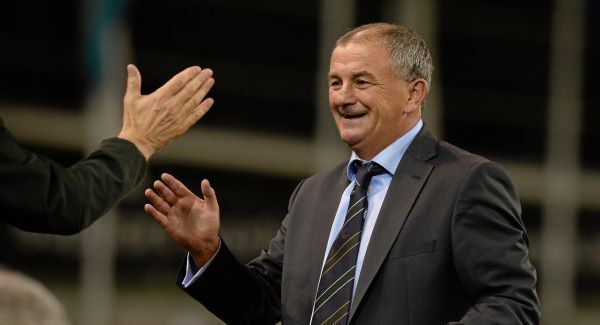
Beauty or the beast — you pays your money, you takes your choice. And, as Noel King said the morning after, lively differences of opinion are an essential part of what makes football so compelling. Of course, the man they call Kinger had calmed down by that point, even admitting that he’d “lost the plot” in overreacting to an entirely legitimate question from RTÉ’s Tony O’Donoghue the previous night.
My own suspicion is that TO’D was merely unlucky to suffer some collateral damage, as it were, in a diverting war of words in which King’s real enemy was the RTÉ panel in general and Eamon Dunphy in particular. And King was well within his rights to be upset. To be baffled, as many of us were, by his decision not to employ at least one orthodox winger against Germany but more especially against Kazakhstan, is in no way to condone the crass personal ridicule with which Dunphy sought to denounce his tactics.
Unfortunately, a disproportionate level of abuse has become the default setting for too much media comment on sporting matters in this country and, to that extent, King was merely the latest in a long line of high-profile public figures – not a few of them managers of the Irish football team – who have been considered fair game for a right good kicking in the public prints.
The consolation for someone like Giovanni Trapattoni was that he could avoid the worst of it over in Milan, not that I ever believed for even one minute that someone of his longevity in the game cared a fig for what the professional pundits here thought about him, for good or ill. After a man has spent most of his life swimming in the shark-infested waters of Italian football, even the Dunph in full, amped-up-to-11 flow, must seem about as scary as Nemo.
It was very different though for Trap’s predecessor, Steve Staunton, who was subjected to some really brutal stuff in print and on the airways when Ireland’s international fortunes nosedived under his stewardship. Staunton is no wilting wallflower but even he must have been wounded at times by the way in which elements in the media contrived to construct a crude caricature which was based entirely on his failings as an international manager while conveniently erasing from history his magnificent record as a player for his country.
Noel King is no wilting wallflower either but, considering the ferocious demands of his brief – just a few days to prepare a transitional team for two World Cup qualifiers, the first away to Germany – excessive criticism of how he went about the job was the football punditry equivalent of using a sledgehammer to crack a nut (and that’s without even touching, for now, on the subject of the enemy within – sulky footballers with itchy fingers).
Indeed, had Ireland actually lost both games – and the first, let’s say, by a landslide – the circumstances under which he’d stepped into the breach meant King would still have merited, if by no means a free pass, then at least a certain amount of sympathetic wriggle room.
In fact, as we know, he did much better than that, his 3-4 aggregate loss over the two games comparing favourably with Trap’s 3-7 against the same opposition a year ago.
My own view of the last two games is that, yes, Ireland could only have benefited from the inclusion of an orthodox winger, in particular against Kazakhstan, wherein Aiden McGeady’s eventual call from the bench, while welcome, was still belated. But I also think it was nothing short of self-evident that Ireland’s possession-based game on Tuesday night – while sloppy at times and certainly lacking in penetration – meant that for the first time in a long time, an Irish team looked entirely in control of its fortunes, almost comfortably so, over the course of 90 minutes, that early Kazakh bolt from the blue notwithstanding. And, yes, some of the better passages of Irish passing were, as my friend from Astana observed, lovely.
At the very least, the next manager of Ireland will have a better idea of the creative potential of this Irish squad, as well as its still obvious limitations, on the back of King’s decision to abandon 4-4-2 and give an airing to the Plan B which even Robbie Keane had previously said is alien to the Irish football being.
Meantime, I’d like to record here the little-known fact that King once published a book of poems about football – I still have a copy on my shelves. But after the couple of weeks he’s just put in, I’d be very disappointed if his long awaited literary follow-up isn’t a novel of the blockbuster kind, an epic ode to the joys of the beautiful game..
Call it ‘War and War’ and sure the thing would practically write itself.