Missing final could be least of your worries
I know myopia is generally attributed to the man in black with the whistle, but this sportswriter has often heard ‘I don’t know what match you were looking at’ shot at him by members of the public.
Granted, there was plenty of white wine available to me before, during and after the game, but I didn’t take anything harder than a cup of coffee.
Yesterday I didn’t see much of the game at all for a good portion of the first half, but the reason why is quite simple.
I spent the game in a corporate box thanks to Fighting Blindness and the National Council for the Blind in Ireland, hearing about AMD, or Age-related Macular Degeneration.
This is a condition that affects people over 50 and relates to deterioration of the eye’s central vision, and as part of their publicity drive — this is AMD Week — we were invited to watch some of the game with glasses specially modified to replicate the condition.
The experience was a frightening one, to be honest: relying on your peripheral vision — which is usually unaffected by the condition — is not a recipe for fully inclusive viewing pleasure. Obviously removing the glasses was an easy option; as an ever-present accompaniment to your vision it took on a far more serious hue.
The medical experts on hand pointed out the traditional reticence among men or, more accurately, Irish men to look after their health, and eye care is no exception to that rule.
The condition is one of thinning of the pigment as the eye ages, but early detection is the key, and the key to early detection is seeing your eye surgeon when you detect any issues.
A harsh reminder on All-Ireland Sunday?
Maybe. But then again, your sight is for always, not just to watch Dublin win the Sam Maguire.
* Check out fightingblindness.ie and ncbi.ie for more information.
We touched on it here last week, and this seems the right opportunity to return to the topic now.
Yesterday in Croke Park it was interesting to see Stephen Cluxton stroll up the field to hit dead-balls for Dublin in the All-Ireland final.
The obvious point of comparison was with Anthony Nash in the hurling decider just a couple of weeks ago, when he encountered, shall we say, significant obstacles to his progress when he went up field to take two 21-metre frees and a penalty for Cork.
That level of intimidation wasn’t visible yesterday.
Only a cynic would say that a county like Dublin wouldn’t stand for that kind of messing, because what was sauce for Cluxton was also sauce for his opposite number in the Mayo goal, Robert Hennelly.
When both men jogged the 100 yards or so deep into enemy territory there was a refreshing lack of shouldering and jostling and general fool-acting. One Mayo player even draped an arm across Cluxton’s shoulders, and presumably he didn’t pinch his back as he did so.
You’d only hope it’ll be the same Saturday evening for the hurling final replay.
Because this isn’t a parochial matter. You’re talking about the shop window for the GAA. Whatever about sudden rushes of blood to the head, it’s unacceptable a player can’t walk unmolested to take a free.
It doesn’t happen in other sports that, in such a situation, a penalty taker is manhandled as he goes to hit the ball with the play stopped.
To have scenes that would hardly do credit to a Junior B hurling game being played out in obscurity somewhere on All-Ireland final day doesn’t reflect well on those concerned, or the GAA as a whole.
The fact that Cluxton and Hennelly were able to go about their business with nobody acting the hard man simply underlines the lesson — that it doesn’t have to happen at all.
The background hum.
Before a ball was even thrown in yesterday in Dublin, it existed. The atmosphere in Dublin was unlike any this reporter has experienced before on an All-Ireland final morning.
It reminded me of something a baseball star once said when asked about the difference between a regular-season game and the World Series.
The player said he had never forgotten the low background buzz that accompanied him all day long during the World Series games. From the moment he woke up in the morning in his hotel room, to the journey down in the lifts, all through breakfast and the trip to the park — there seemed to be a continuous hum, a noise that never became intrusive but which provided a soundtrack to the activities of the day.
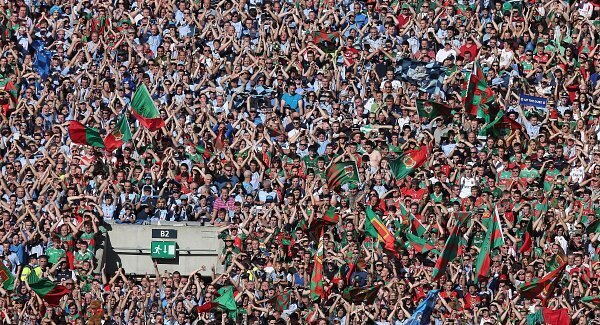
That was what Dublin resembled yesterday long before the throw-in, the hum of possibility made flesh. It wasn’t loud, but it was noticeable. Anticipation turned into decibels, and provided, almost entirely, by the Mayo support. Naturally enough the Dubs weren’t arriving into O’Connell Street and Mountjoy Street off trains and buses, but coming in more diffuse groups, but frankly they weren’t needed.
The men, women and children in green and red provided plenty of atmosphere yesterday by themselves.
It was a bit of a jolt to hear the news of Ken Norton during the week. The great American boxer had passed away at the age of 70: which was more of a shock, the notion that Norton, pictured, had died, or the reality that he was 70?
Even the fact that he had a son who was winning Super Bowls with the San Francisco 49ers almost 20 years ago couldn’t quite scrub the image of Norton looking like he had been carved from a slab of granite as he clobbered Muhammad Ali in Yankee Stadium. I only learned a few years ago that Norton — who appeared in the, ah, niche movie Mandingo — was once lined up for a film role that would have changed his life.
However, for reasons unknown Norton had to pull out late on in the casting process, opening the door for a former American footballer to get the part.
The footballer was Carl Weathers. The movie was Rocky. Would Sylvester Stallone have beaten Ken Norton? Not in a million years.