Daly's golden goal
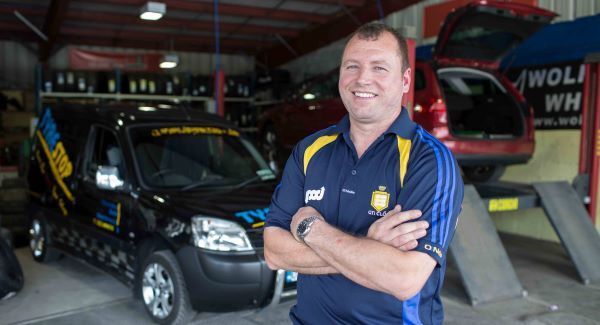

It happens all the time in the garage. A stranger will squint at him, wonder is that his somewhere familiar face, and enquire, “Are you by chance that Daly fella who scored the goal?”
There was a time where the goal’ was the one against Kerry in ’92 which ensured a cow wouldn’t be milked in Clare for a week.
He’s also the fella who back-heeled a point in a championship game against Tipp, once scored a hat-trick in Croke Park in a league quarter-final, played for Ireland when the International Rules series was first revived in 1998; probably Clare’s greatest footballer ever, certainly their greatest-ever forward.
Yet more than anything in the public memory Martin Daly will always be that moment, the fella who scored that miracle goal against Cork in 1997 in Cusack Park.
If his goal and Clare’s win against Kerry in ’92 showed all the little guys of the GAA world that they could shake it up if they’d rise up, then his last-minute goal against Cork in Ennis changed football too.
Cork, in Larry Tompkins’ first year in charge, had trained harder for that first-round game than Rocky Balboa had for his fight against Ivan Drago. They’d met collectively 185 times in 251 days, flattening the sand dunes of Inchydoney, the hill in Macroom and numerous teams en route to that year’s league final.
But as Brian Corcoran would put it in his autobiography years later, “A season that was meant to end in front of 70,000 in September ended in front of 14,000 in June.”
For Corcoran it was the day that the countdown to his (initial) retirement began — “What had those last nine months been about? What was my life about? Was I wasting it away?” It precipitated the advent of the qualifiers too. Players couldn’t continue to invest so much effort and time into training and then be gone in 70 minutes. If any game summed up the magic and the cruelty of the old do-or-die championship, it was Daly’s goal and Cork’s loss. When Daly recalls the lead-up to that game, he remembers a quiet confidence within the group.
They were an established Division 1 unit. They’d taken Cork to a replay the year before and should have won it too. The commando training Tompkins subjected Cork was pioneered by Clare under John Maughan and continued under John O’Keeffe. They were at home. So, yes, there was a quiet confidence. But robust, complete confidence? He’d be lying if he said they had.
“We were still playing Cork. We thought we could beat them but did we really, really think we were going to beat them? You’d probably have to say no.”
At half-time Cork were ahead six points, playing some devastating football. Daly had scored a few early points off Cork debutant — and captain — Brian Murphy but then Owen Sexton was moved onto him.
“Now there was a tough competitor,” says Daly. “He had pace and he was sticky, but not one of those lads who’d drag and pull you. He’d beat you by playing football. I had my work cut out with him.”
As the second half developed though, Cork would kick wide after wide while Clare continued to grind and grind. Ger Keane kicked some wonderful scores to keep them in it and then Daly would rise to the urgency of the occasion.
As the game crept into injury time with Clare trailing by three points, he kicked over a free near the touchline.
“At the time, I probably didn’t realise how important that kick was. It was just a case of rushing it to get it over the bar so there’d be another kickout.”
A minute then. Clare won a free about 30 yards out in front of the Cork goal. A goal seemed impossible. But a goal was imperative. John O’Keeffe had communicated that to his key players.
“Johnno was roaring at Ger [Keane] and pointing down towards the ground. Obviously, time was up. I said to myself, ‘Right, we better do something here’ so I made the run and Ger found me.”
What followed was incredible. The temerity of Keane to think he could pop a pass to Daly so close to goal; the audacity of Daly to make the run, get the pass, throw a shimmy, get a shot off that would roll into the bottom corner; how porous and then wretched the Cork defence were. Tompkins would later admit it wouldn’t have happened on Niall Cahalane’s watch but these days you wouldn’t need a Cahalane to prevent it. Someone would have checked his run, blocked his shot, but back in those innocent days there was no blanket to smother it.
Clare weren’t quite as naive. When Kevin O’Dwyer went to place the ball for the kickout, David Keane rushed in to kick it over the fence. By the time O’Dwyer had clipped him and retrieved the ball, Michael Curley’s whistle sounded. Cue pandemonium. Daly’s feet never touched the concrete passage to the dressing room, swept along by this tide of hysterical humanity.
“I know a couple of the Clare hurlers from that time who left a few minutes early, thinking ‘Typical; Cork are going to scrape through’. But just as they were getting into their car around the Queen’s Hotel, this roar followed them up the road that just hit them. Right away they knew it was no ordinary score, that ‘Jesus, the boys must have won’.”
The footballers, unlike the hurlers, would not win Munster that year; despite Daly’s dazzling performance which would cost Mike Hassett his captaincy and All-Ireland medal, Kerry would shade the Munster final with Pa Laide conjuring up a wonder goal of his own. But those Clare footballers were respected by those Clare hurlers. In fact they were imitated by them.
Before he would revolutionise hurling Ger Loughnane had quietly observed the Clare footballers run the hill of Shannon. He would subject his hurlers to the same regimen. They’d likewise flatten the hill near his home in Shannon. And then there was Crusheen. Notorious, torturous Crusheen. Waiting for them there was Mike McNamara, hardship and along with it, the footballers. They’d be at one end while the hurlers would warm up down at the other. Cue one of the most agonising and comical standoffs known to GAA man.
Daly’s best friend and best man, Colin Lynch, noticed Mike Mac hardly ever left his charges off the field before O’Keeffe’s.
“And you know what the worst of it?” says Daly. “That got back to us. Some lads met each other out one night and some hurler said to one of our lads, ‘Janey, lads, will ye finish up a bit earlier? We’re getting killed!’ The next night so [footballer] Barry Keating’s saying, ‘Listen, we’re not going into that feckin’ dressing room until them lads go in first!’ So we train like lunatics for over two hours but Johnno has his training all mapped out and says ‘Right, lads, that’s it for tonight’. And the boys go, ‘No, we’ll run!’ And that night the hurlers went in first. That might’ve happened only once or twice but it happened because we heard back that they wouldn’t go in until we had.”
Or, as Lynch has corrected him, “It wasn’t that we wouldn’t go in. It was that Mike [Mac] wouldn’t!”
Just like the hurlers, the footballers prided themselves on that hardship. For awhile Daly thrived in it. Seamus Clancy, their hero and All Star of 1992, recalls a teenage Daly first appearing on the scene.
“When Daly came into the panel that March, we already had serious training done. One day we were doing these 300m sprints on the strand and Daly won the first one. So we all lined up at the flag for the next one, jostling one another, like a horse race. Next thing Daly flies off, big strong legs on him, wins it again. So we say to ourselves, Daly isn’t winning the next one. He won the next seven. Eventually Maughan says, ‘Lads, if Daly wins this 10th one I’ll run the shite out of ye’. So he was clocked. Yet he managed to get up and still nearly won it. That was Daly when he came on to the scene. Serious athlete, serious young buck.”
He would slow down over the years. By the time he was 28 he’d played his last game for Clare. An MRI scan had revealed why he was struggling to put on his socks and walk down the stairs; why his back kept going into spasm every few hours in the garage where he worked as mechanic. Since he was a kid, his back and its discs had been misaligned.
“I remember going down to [Ger] Hartmann and him telling me, ‘Look, you can’t do this anymore. When you’re 40 years of age you need to be able to pick up your child’. And at the time I remember looking at him, ‘Come on, man, cop on’. I was young, free and single. But now I’m 40 and I do have an eight-week-old child. And I do struggle to pick him up because my back’s crocked. And that’s because of football.
“I might go for a run or a game of golf and feel grand but then I could be at work or sweeping the floor at home and it’s there again. Every morning I come down the stairs I have to use the banister. A few hours later it might loosen up but I always wake up with a stiffness in my back. I’ve come to live with it now, even if it’s only going to get worse. I probably should have stopped playing altogether at 28, health-wise. But Ger did mention something about playing ‘a bit of club’ and sure I played for the next 10 years with it.”
So does he regret he did? He answers in the form of a question himself. “What, and not to have won a county championship?”
Only the birth of Mark the other week can rival the joy of winning that county title with Lissycasey in 2007.
He has no regrets. And no anger towards slogging away with the county on those quiet killing fields of the ’90s either.
“We probably lived on being fitter and harder than other teams so that was what done at the time. Plenty of our group of lads are 100%. It was just my back had a weak spot and gave up earlier.”
For years footballers across Ireland would make a pit stop into Daly’s garage anytime they passed through Ennis. For decades the people of Ennis and Clare would call into Francie Daly’s garage. During the Celtic Tiger years in particular, it was thriving. Martin bought it, managed it, selling cars as well as fixing them. Then the car business, like so many others, crashed.
Last summer he closed the doors for good. It was a wrench — and a relief.
“The breaking point was my honeymoon. Lorraine and myself had gone up the town in Vegas for a few hours and when we came back to the hotel I had 72 missed calls. My father alone called 10 times. And I said to my wife, ‘I can’t go home and do this’. You’d finish work at 7[pm] and there’d be another four calls. I needed to get out of it. It was very tough, it had been our family business for years, but now I was starting a new family and I had to think of them and myself for a change.”
Francie Daly is fine about it now. At his age he didn’t have the fight anymore and so now dances instead, set-dancing all around the county. Martin is thriving too. For a few months it was unsettling being out of work but then he got the franchise for TyreStop in Ennis, on the Tulla Road. The hours are still long but he was never afraid of hard work. Now at least when he finishes at 7pm, he’s finished. “I don’t worry about it till the next morning. Money can’t buy that.”
Football is another escape. A couple of times a week he coaches a junior club, Coolmen. Couldn’t meet a more committed bunch of lads at that level. With a young kid and wife at home, it’s a chore going out the door but then it’s heaven once he’s out on that field.
That’s why he can understand Mick O’Dwyer’s motives for still doing what he does but he’s not exactly sure why Clare are with Mick O’Dwyer.
“No one can doubt Micko’s record and his passion but I think a lot of the younger lads wouldn’t have the same respect for Mick as my generation. Only a few of them would barely remember him winning with Laois. None of them were playing when he was winning with Kildare. Most of them weren’t even alive when he was winning with Kerry. The only time a lot of them would have seen him with a team before would’ve been Wicklow. Don’t get me wrong, he’s a super man, driving up and down from Waterville at 76 years of age, and still a certain authority about him. But the aura someone of my generation would have for him wouldn’t be there with young lads.”
Some kids these days, he senses, don’t respect the jersey. “They get a minor trial and they’ll say, ‘No, I have other stuff on, it’s too much hassle’. Is it because Clare are in Division 4? Maybe, but Clare had won nothing when I was underage, yet we couldn’t wait for the paper to come out on a Thursday to see if our name was on the panel.”
And sure, a lot of them wouldn’t recognise Daly either. He might have scored the two most important and glorified goals in Clare football history, been one of the best inter-county forwards of the ’90s, and with the club remained probably the best forward in Clare in the ’00s, but a whole generation don’t know or can’t recall there was a time when Clare football was serious and sexy. Others will though. And anyone who was in Cusack Park that day 16 years ago will never be able to forget.
That fella Daly who scored that goal.