Anthony Daly: I do wonder what the football crowd make of our game now?
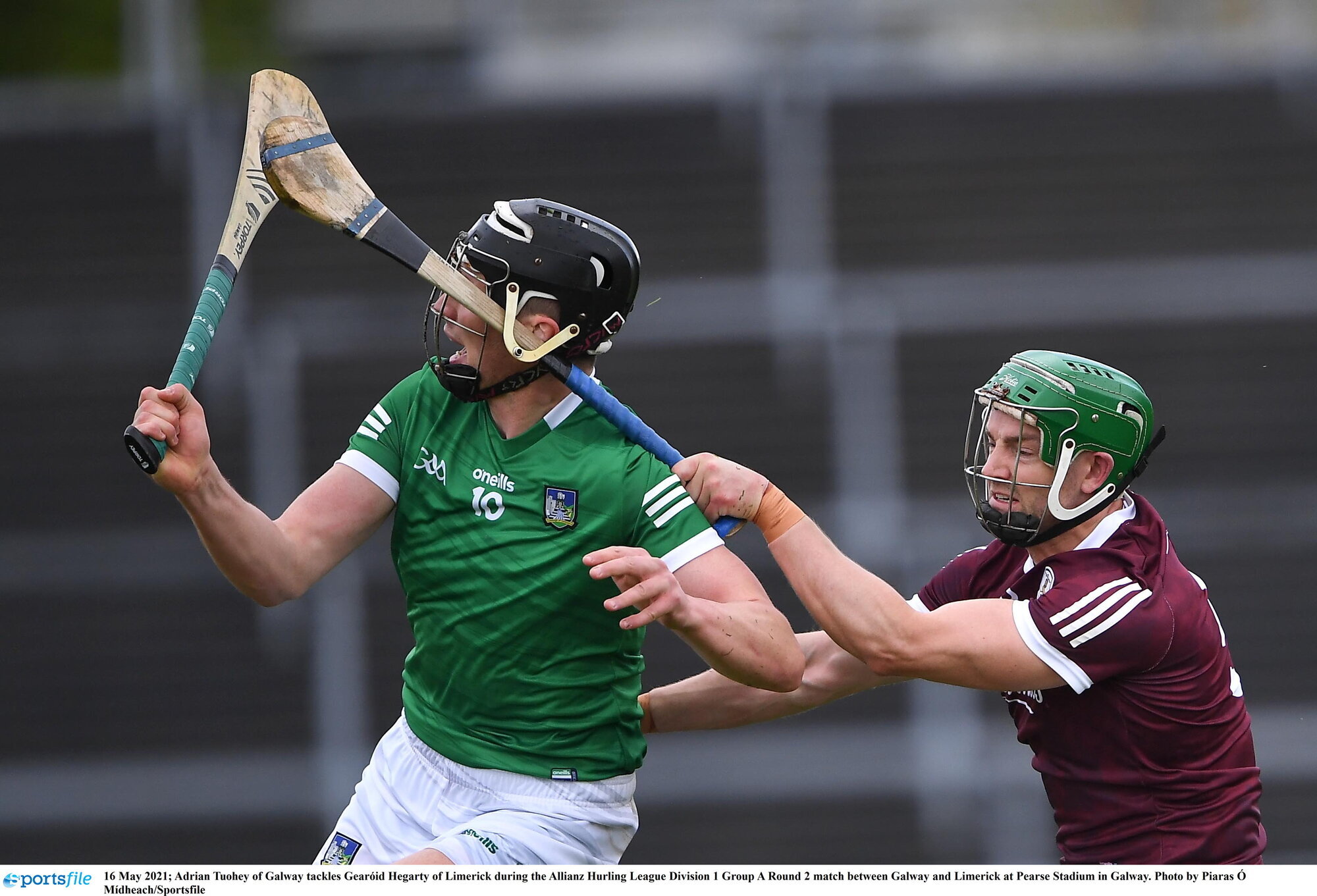
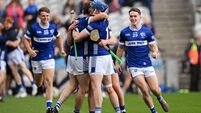
TOO CLOSE FOR COMFORT: Limerick’s Gearóid Hegarty is tackled by Galway’s Adrian Tuohey during yesterday’s Allianz HL Division 1 Group A game at Pearse Stadium. Galway showed how important it is to win that middle-eight battle, writes our columnist. Picture: Piaras Ó Mídheach/Sportsfile

‘Just back from Thurles and I have to say hurling is in a dangerous place. Too many short puckouts, handpasses, lateral passes and most players filtering back. It’s essentially turned into football. And that, I’m afraid, is no compliment.’
– Brian Carroll, former Offaly player, on Twitter.
Not long after I moved back to west Clare, I got involved with the Shannon Gaels football club. There are some fanatical hurling people in west Clare but it still is football country. The Gaels lads were dead sound but getting involved was also another way of assimilating myself into the culture of the area, especially when I was running a pub there.
In 2003, we were beaten in a county quarter-final replay by Kilkee, who went on to reach the Munster club final. I was the manager/coach and we played fairly defensive stuff, primarily because it was our way of staying in the contest against really good teams.
When I got involved with the Gaels for the second time, after I’d departed as Clare manager in 2006, I was only a selector. I remember coming back from a Sunday Game live show, decked out in a suit and shirt, with a Shannon Gaels tracksuit over me, and walking the line in Cooraclare in a fancy pair of shoes. We lost to Doonbeg in a quarter-final when we were six points up but the whole experience opened my eyes to guarding and protecting possession.
Aidan ‘Horse’ Moloney, the former Clare footballer, was coaching the team during my second term and I learned a lot from him. Even though I’d already been an inter-county hurling manager for three years, that was the first time I’d ever really heard the term, ‘Turn back in the tackle and have a runner coming off the shoulder’.
By the turn of that decade, so many football tenets had become key parts of the hurling culture. I saw that myself first hand when Martin Kennedy – who hailed from a football background - coached the Dublin hurlers in 2011, when possession games, and a real emphasis in tackling, framed so much of our training approach.
The game has continued to evolve since but, while hurling people always resented any comparisons with football, nobody can deny how similar both games are now. I’ll be the first to admit that we can have a very snobby attitude towards football, and how it compares to hurling.
I’m always sewing it into Tomás Ó Sé and the football pundits on The Sunday Game when we’re subjected to some lateral hand-passing/basketball slugfest. But I seriously wonder now what the football crowd make of our game?
After the Cork-Tipp match on Saturday evening, Brian Carroll shook his head to me in Semple Stadium. ‘Imagine if there were 30,000 people here?’ he asked. ‘They’d have gone in over the wire, Dalo.’
I couldn’t disagree with Brian. Of course, I fully understand the nuances of this debate. Sure, after I played a sweeper with Clare against Kilkenny in 2004, and did the same with Dublin against Kilkenny in 2009, some lads are still accusing me of introducing that virus into hurling. I don’t want a return to just hit-and-hope, but there still is a balance to be struck between game management and not strait-jacketing expression.
The All-Ireland champions always naturally dictate so much in how the game evolves, especially in how everyone else tries to copy a winning template, and Limerick have certainly set the current style agenda.
They are very systematic, but they are still attractive to watch, especially in how they always have a long out-ball option to Aaron Gillane or Seamie Flanagan. Limerick are so physically strong too that they don’t turn over as much possession in the tackle as other teams who are trying to copy that Limerick style.
Their stick-passing is also really sharp and crisp, especially in how they utilise Cian Lynch, Tom Morrissey, and Gearoid Hegarty when linking the build-up play. If Limerick are forced to play the long ball, Gillane will look for the third man runner off him if he can’t get the shot off.
When other teams aren’t yet fully comfortable with that style, watching it break down so often can be painstaking and laborious for supporters to look at.
The wet and slippery conditions were also a factor in so many turnovers and so much spilled ball on Saturday evening but you’d also have to admire how both Cork and Tipp stuck to their gameplan when it would have been so easy to deviate in a dogfight.
One of the by-products though, is high free counts. There were 48 frees in the Waterford-Westmeath game yesterday. I don’t know how many frees there were in Pearse Stadium but, just like the Tipp-Limerick match nine days ago, there was no real flow because of the constant whistling.
In co-commentating for RTÉ over the last two days, I often found myself trying to explain refereeing decisions to the listeners. At times, it’s hard to know what actually is a free now.
Late on in Salthill yesterday, Aaron Costelloe was knocked back and was trying to get up on one knee when he was blown for over-carrying. What was he supposed to do? I appreciate that new rules have been introduced but Gearóid Hegarty’s yellow card was a reminder that the game is being refereed differently from last year.
During the Galway-Limerick game, I was getting texts from friends that aren’t huge hurling supporters.
‘Hurling isn’t that much fun to watch anymore,’ said one. ‘Is it me or is this referee just too whistle happy?’ asked another.
We were all giving the referees the benefit of the doubt last week but you’d wonder now are they just being dictated to by higher powers, who want to see a different game?
I understand the desire to clamp down on some unsightly elements of rough play but, considering how the game has become so dominated by guarding possession, that trade-off is turning people off.
Limerick are still missing some of their big guns but Galway showed how important it is to win that middle-eight battle.
On the other hand, Galway have the physicality and some serious operators around the middle to physically go toe-to-toe with Limerick.
But not every team does, which makes you wonder what yet might happen, and the further impact that could yet have on the game, when teams study how Galway went about their business yesterday?
It’s still early days. Some teams still haven’t enough match-fitness or gas in the legs to see out games. Constantly altered starting 15s underline how many players are still picking up injuries in training during the week of games.
Even after only two weekends of hurling, you can’t be too critical. The wide counts was sky-high in some matches, especially some of the shooting from Tipp and Wexford, but they still both secured results.
That match in Ennis also showed what hurling will always have over football. When Clare were eight points up with the endline in sight, two quickfire goals were able to turn the game on its head and jack-knife it into Wexford’s direction.
After Jason Forde landed the equaliser on Saturday night in the fifth minute of injury time, there was still time for Cork and Tipp to manufacture three more shots at the target.
That’s the real magic of hurling, which the game will always have over football.
And we just want to see more and more of that magic as the season unfolds.