Building Advice: Will a heat recovery system work for my renovation?
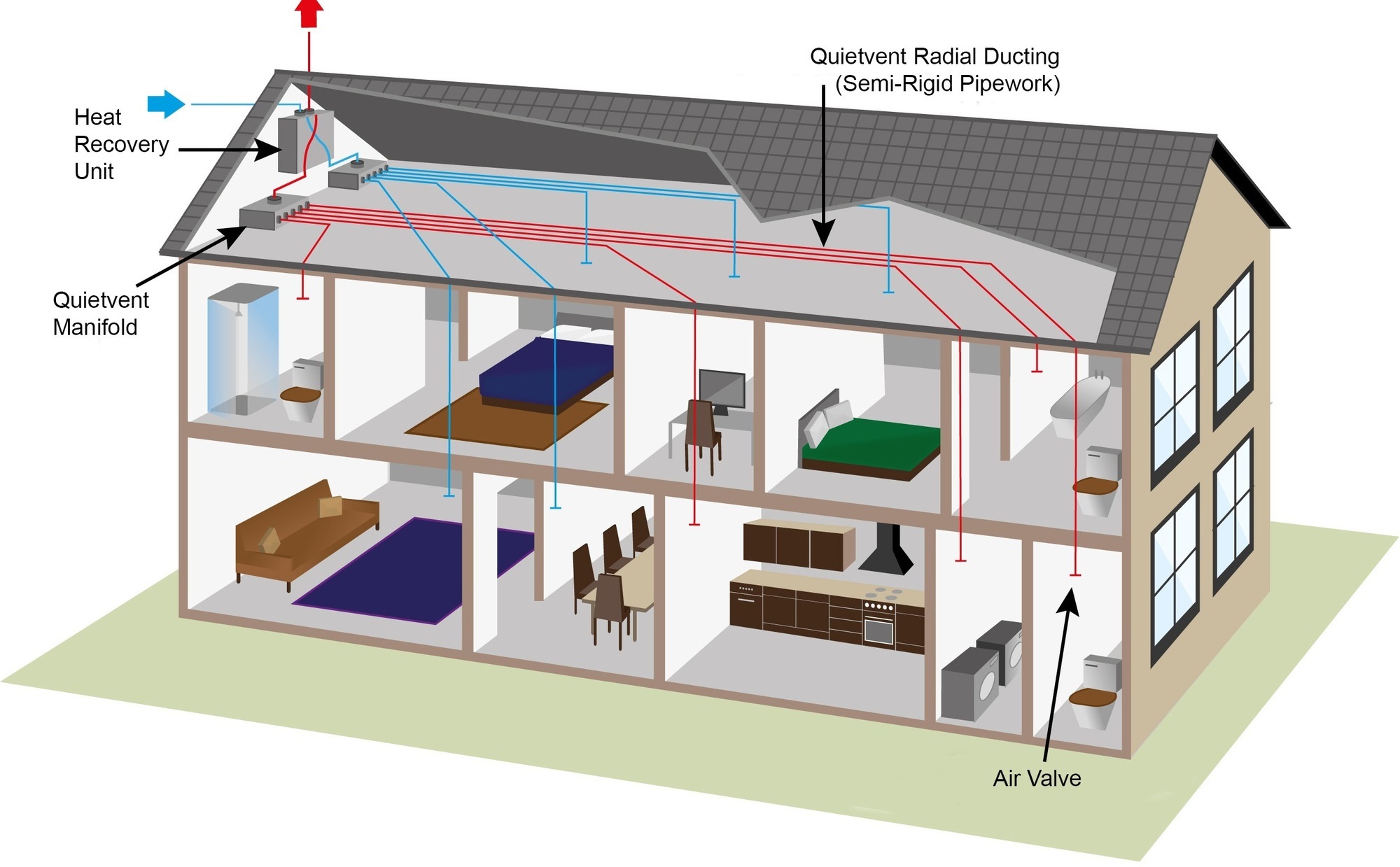
Suitability of a heat recovery system for a stone cottage depends on several elements
Heat recovery systems work by capturing waste heat in the dwelling. Waste heat can be created from the processes (including equipment) that occur while occupying the internal space. So, you take what is produced and you reuse it.

Heat recovery systems work by capturing waste heat in the dwelling. Waste heat can be created from the processes (including equipment) that occur while occupying the internal space. So, you take what is produced and you reuse it.

We have just bought a very small stone cottage, open to the roof in the long main section with a mezzanine bedroom and gable-end bathroom. It’s full of charm but basic and we are hoping to make it safe and warm for now. 

We think it will be easy to heat with a 10kw wood-burning stove, and we might be able to extend it in the future.

A friend advised us to put in a heat recovery system because ventilation is an issue, with no extractor at all in the kitchen, or even the bathroom, but at least there are windows we can open or put in the ‘retro’ Xpelair in the glass?

But a friend in the know has said the best thing we can do is to put in a heat recovery pump. “It’s the best money you’ll ever spend and solve lots of old house issues, and help with heat circulation,” he says.

We’d only ever thought heat recovery systems went into new builds, and not so much in retrofits. It could be easy to run a box section with vents along the apex of the roof, but we’d have to get the duct through a very thick end wall between the bathroom and the main lofty living/mezzanine room. 

He thinks a system can be bought for a few thousand euros and he did a job in a semi-d with one himself which he swears by. What do you think?

Trevor

Hi Trevor, congratulations on your purchase. 

The building sounds lovely with the long section open to the roof. I see that you are happy with the heating aspect of your home but you are concerned about ventilation. So, where does heat recovery fit in and will it be suitable?

For those readers who are not familiar with a heat recovery system, I just want to set out a few points of interest. Heat recovery systems work by capturing waste heat in the dwelling. Waste heat can be created from the processes (including equipment) that occur while occupying the internal space. So, you take what is produced and you reuse it. 

It typically involves a heat exchanger, which transfers thermal energy from a warm source, such as exhaust air created during occupation, to a cooler medium, such as incoming fresh air or water. It can also remain a sealed internal transferer only, without involving outdoor air. 

Fresh heated air is then distributed throughout your house using ducts and grills. In your case, Trevor, I believe you are considering a sealed system because you are not in favour of penetrating the walls. 

Coring stone structures can be an expensive business and there may also be a dislike of installing a modern grill on an older property. Where a house is a protected structure, coring holes in walls is frowned upon and is likely to require planning permission.

If we dig in and focus on efficient heat recovery, it is best that the waste heat recovery is at a consistent level. Where the main heat source is a stove, this becomes a little bit tricky. I say this because a stove in most cases — and I might have to be corrected on this — can be an on and off again affair. 

This on and off again use means that the system is starting and stopping regularly. A consistent heating system is less demanding on a heat recovery system, will allow the system to last longer, and will ensure a congruent environment for the house itself, as well as the occupant.

When a stove is in the mix, there is an unsealed or semi-sealed environment because the stove has to draw air. This air comes in via ventilation. This is opposing a system that is sealed and again this may impact the efficiency of the heat recovery system. Where a system is inefficient, it quite often impacts the pocket, making the choice a very costly installation.

Brigid Browne: 'Heat recovery can be an excellent system as long as it is designed correctly and for the specific dwelling.'

If you are worried about ventilation an alternative solution is as follows: for your cooker you can get a recirculating cooker hood instead of having to pull an extractor fan through your stone wall to the outside. The filters will need to be cleaned so follow the instructions. 

There are several of these units on the market, in all colours and sizes. It might make a beautiful feature in your house so that’s something that might be fun to look into.

For the bathroom, you may need to bite the bullet here. An extractor fan works best and if you were to limit its travel to the outside and avoid the use of flexible ducting where possible (a good fan will come with its own ducting kit) this might be the best solution. If you can vent through your roof, definitely do so. If this is not an option and you have to go through the wall, don’t panic. The aperture may be much smaller than you think and the great thing about rubble wall construction is that you can tease out a bit of lime mortar or a small stone or brick instead of coring.

For the main body of the house, I suggest you look at a positive input vent (PIV). This has been designed to reduce condensation and mould growth. A PIV can be used in houses with a floor area of up to 200sq m. It can be placed in the attic space and uses the ventilation into the attic to feed it. 

As you have no attic as such and as it is best practice to be able to access it for maintenance, you might consider placing it high up on your wall and venting out through the roof using a cowl to prevent water entering the external side of the aperture.

A number of products are being developed every year and you may have to do a bit of trawling to find the right fit for your house. But it will likely be less invasive and less expensive than a heat recovery system.

Heat recovery can be an excellent system as long as it is designed correctly and for the specific dwelling. I always advise my clients to speak with a mechanical and electrical engineer for independent advice on each system. They are the best professionals to guide you through all the options but they will likely need more information from you to begin the process.

  • Brigid Browne is a chartered building surveyor and chair of the Southern Region of the Society of Chartered Surveyors Ireland. She is the owner/ managing director of Cashel-based Fortress Planning which offers a range of services including assigned certifier, design certifier, building surveyor, and conservation consultancy to clients all over the country — www.fortressplanning.ie
  • If you have a property related query or issue you would like to raise with Brigid, please email irishexaminerpropertyqueries@scsi.ie


More in this section

Revoiced

Newsletter

Had a busy week? Sign up for some of the best reads from the week gone by. Selected just for you.

Cookie Policy Privacy Policy Brand Safety FAQ Help Contact Us Terms and Conditions

© Examiner Echo Group Limited