Kieran McCarthy: What are the advantages of using a strip foundation?

"You only get one chance to get your foundations built right so take the time, do the research and discuss with your engineer and site team"
Kieran McCarthy: What are the advantages of using a strip foundation?

Learning Curve: Laying of the foundation stone at the School of Commerce, Morrison's Quay, Cork in June 1935

Hi Kieran, 

We are just about to start our new home build in Co Kildare. 

My question for you is are there any BIG advantages of using a strip foundation over a raft foundation other than being able to have a stepped strip footing?

Killian Carroll

Hi Killian, 

Thank you for your question. It is certainly an exciting time as you begin to plan the foundations of your new build home. You set out the pegs of the perimeter of your house and you get a local digger driver to clear the site down to formation level (the level of your finished floor, less the thickness of the floor, the insulation, and the hardcore underneath).

Next you look to see what foundation you will be using. In many cases this is predetermined for you once you begin excavating and the engineer looks at the quality of the building ground under the footing trench, but let’s look at how this works, what the options are and the characteristics of each.

Generally speaking, most houses are built on strip footings once you have ground of reasonable bearing capacity under your footings. The process is generally that you clear your site, mark out the blockwork walls on the ground floor and begin excavating for standard strip footings.

Once the excavation begins, a competent site supervisor needs to review the quality of the ground. If in any doubt the engineer who is supervising the project should be contacted for their opinion. If the ground is deemed to be suitable, then a normal strip footing can be employed. If not, it may be a wider strip, a raft or indeed a piled foundation, though in most cases a strip will likely work.

A strip footing is formed when a digger digs out a trench under the future blockwork walls of your home. This trench has a certain depth and width as specified by your engineer. The depth needs to cater for the thickness of the footing plus frost cover and course in with your blockwork. The width is determined by the load being imposed by the weight of your house and the load bearing capacity of your future house. The bigger the house and the poorer the load bearing capacity of the ground, the wider the strip foundation.

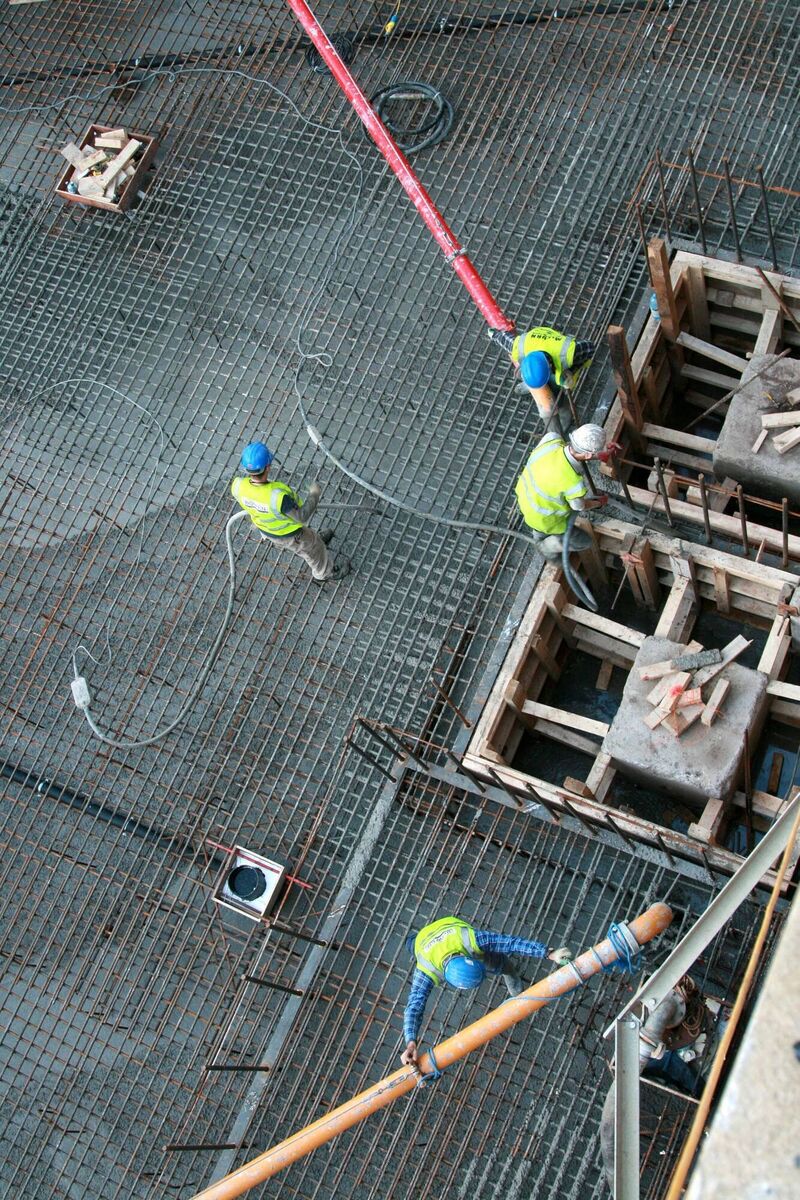
Pouring the foundations for the city centre development between Academy St and Patricks St. Surrounding roads were closed to allow for the a continuous supply of concrete by 20 cement lorries supplying the site.Pic: Miki Barlok

The advantages of strip foundations is that they are generally considered the most cost effective foundation because they use the least amount of concrete in their construction. They are the easiest to build in that they do not require complex shuttering (timber support mouldings) and they do not require complex steel fixing as they are generally constructed of steel mesh which arrives pre-formed from a builders merchant, just cut on site to suit. They are also considered the quickest to build on site due to their ease of construction and, yes, they do have a reasonable amount of adaptability to cater for sloping sites and indeed stepped slabs.

The disadvantages of standard strip footings is that they require quite deep strip footings which can be time consuming and expensive if you have rock on site. In addition, because the load bearing walls are supported on relatively narrow strips, these will not suffice in situations where you have poor ground underfoot.

The other disadvantage of strip footings is that if you are building at a boundary or adjacent to another building, you need to allow for the width of the footing beyond the outer face of your blockwork when setting out our building, which may not be ideal.

Raft foundations are a different foundation type where the blockwork walls are all build on one wide slab which covers the entirety of your house footprint. The raft is a large concrete slab which has been thickened underneath where the blockwork walls will lie but requires much less excavation compared to a strip foundation. 

KMC Kieran McCarthy
KMC Kieran McCarthy

The advantages of a raft foundation is that it can be built on ground of poorer bearing capacity as the weight load of our new house can be spread over a larger area (the footprint of your home as opposed to just a thickening of our wall perimeter). The design of the raft is typically that it does not extend beyond the outside of your wall perimeter thus allowing you to build on a boundary adjacent to existing structures (while avoiding their foundations). The fact that the raft requires less excavation means that a raft can save on rock breaking if you have a rock underfoot.

The disadvantages of a raft foundation is that they are generally more expensive. They need to be especially designed by your engineer which is an additional cost and their construction is more complex. They require steel to be bent and fixed to a particular design. They may require a more complex radon membrane arrangement and they will require much more concrete to build, which is expensive.

So, which one to choose? As a general rule we opt for a standard strip footing unless directed otherwise by the engineer or if site conditions dictate. We find this more straightforward, most cost effective and easier to schedule. 

I would emphasise that any decisions you make in the ground regarding your foundations needs to be made in conjunction with your structural supervising engineer as they will be designing it to suit your ground conditions and they need to sign-off on the foundations and all following construction stages. You only get one chance to get your foundations built right so take the time, do the research and discuss with your engineer and site team. The foundations are by far the most important part of your house, the integrity of all other elements depends on what structure they sit on below ground.

  • Kieran McCarthy is a building engineer and director of KMC Homes bespoke A-Rated new home builder, serving Cork and Limerick. 
  • He is also co-presenter of the RTÉ property show Cheap Irish Homes. 
  • Check out KMC Homes’ brand new website kmchomes.ie Follow Kieran on instagram @kierankmc for more home building information, tips and Q&A advice.
  • You can also follow Kieran on the Built Around You YouTube channel and @kierankmc on TikTok.


x

More in this section

Revoiced

Newsletter

Sign up to the best reads of the week from irishexaminer.com selected just for you.

Cookie Policy Privacy Policy Brand Safety FAQ Help Contact Us Terms and Conditions

© Examiner Echo Group Limited