Jennifer Sheahan: What Ballymaloe taught me about designing a better kitchen
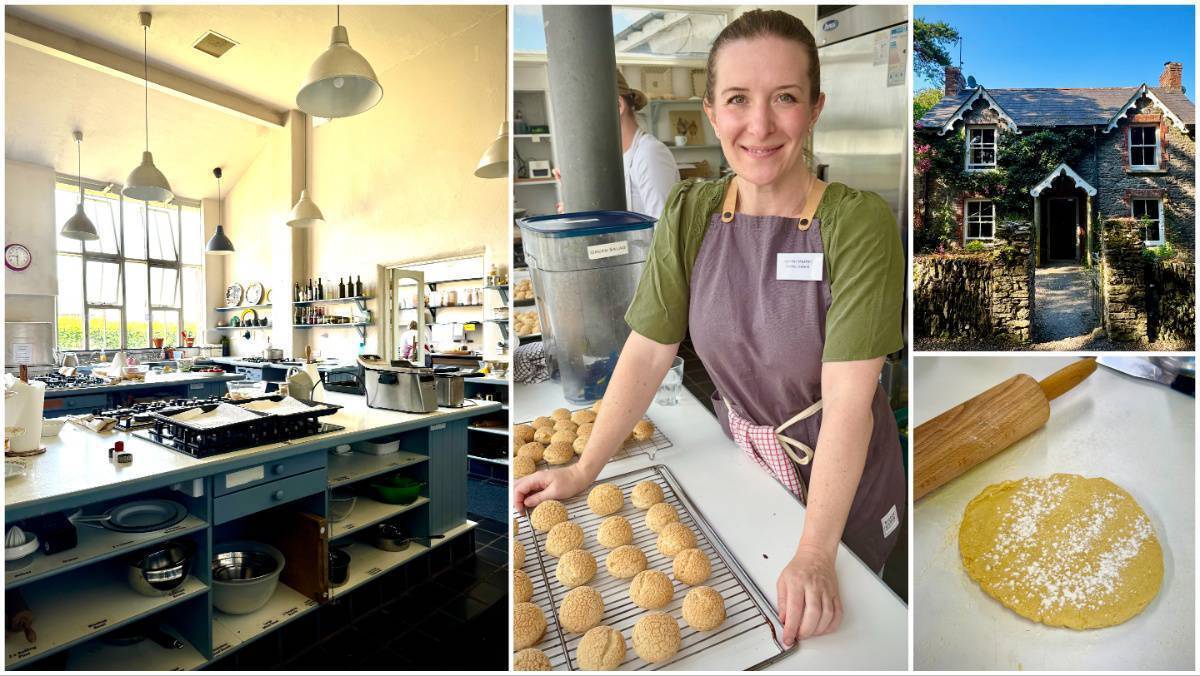
The kitchens at Ballymaloe Cookery School, left; Jennifer Sheahan during the Rachel Allen-taught course, centre; and top right, the cottage accommodation for students.
As an avid amateur baker and lover of all things food-related, I have wanted to do a course at Ballymaloe Cookery School for years. I had a Big Birthday a while back, and I put the word around that anyone who wanted to get me a present I would love couldn’t go wrong with Ballymaloe vouchers.
I always have the course list tab open on my laptop, so when a two-and-a-half-day “Baking with Rachel Allen” course appeared, I snapped it right up.
If you have never been down to Ballymaloe Cookery School, it’s worth the trip on its own (though do pop over to the hotel and shop also, and take in Ballycotton while you’re at it).
To step into Ballymaloe is to enter another realm, characterised by quality and passion. The standards they hold themselves to are extraordinary. Every square foot of the place is spotless and thought through.
Craft is taken seriously. The ingredients are mostly grown right there on the farm, or if not, then they usually haven’t travelled far. The pottery is local, the furniture is well made, the equipment is chosen for quality.

Many of the staff have been there for decades, which tells you everything, and they clearly love the work — they are as intent on you enjoying it as they are on you learning anything.
I had a better experience and learned far more than I expected, and my expectations were sky-high.
I could fill every edition of this paper for the remainder of the year waxing lyrical about the wonders of Ballymaloe, but we only have a certain amount of space here, so instead I’m going to tell you about what my few days there taught me about kitchens.

I love my kitchen, of course, but theirs are designed by and for people who cook for a living, and while I’m not planning to rip mine out and start again, there are certainly some things I picked up that will help me create a better workflow.
Well, OK — maybe I will change a few things next time the budget allows.
Having thoroughly snooped through all of the student kitchens, I discovered that below counter height there are no cupboard doors.
None.
Everything is a drawer. Anyone who has ever knelt on a cold tiled floor with their head and shoulders inside a corner press, gingerly pulling a mixing bowl out of the back while trying not to knock everything else over, only to bang their head on the countertop on the way back up, will understand immediately why this is genius.

A press forces you to kneel down and lean in to try to find your things. A drawer glides open and brings your things out to you. Deep drawers take pots, lids, mixing bowls and small appliances, and you can see all of it at once from standing height.
Drawer runners cost more than doors, but it is an upgrade I would prioritise if the budget is tight. I will make kitchen life immeasurably easier.
This is an area I did not design well for in my kitchen, and may look to change in the near future. Underneath all of the ovens in Ballymaloe, even in the little on-site cottages where students stay (which I highly recommend doing), have vertical storage spaces for trays and racks.

Every kitchen has trays and racks, so why this is not a universal feature is beyond me. I did not design in storage for flat things — baking trays, cooling racks, roasting tins, chopping boards — and it is a consistent source of irritation for me.
At Ballymaloe there are open vertical shelves directly under the ovens, so trays and racks neatly slot in on their sides like files, immediately to hand when needed. If you are planning a kitchen, put in a vertical divider unit for flat items and thank yourself for years.

If, like me, you already have the kitchen you have, an under-counter wine rack cut down, or a cheap freestanding tray divider in the base of a press, will do the same job for very little.
The other tray revelation: their baking trays fit inside their fridges. So rolled dough, pastry cases and biscuits go straight in to chill, still on the tray they will be baked on.

Mine do not fit, and I have spent years transferring things onto plates and then back again like an eejit. Measure the internal width and depth of your fridge shelf and purchase your trays accordingly.
Possibly the most useful feature of Ballymaloe kitchens (besides the kitchen angels prepping and cleaning everything for us) was the vast expanse of clear countertop space at every workstation. It’s easy to give up workspace when designing a kitchen, in favour of more gadgets and gizmos, but this is a mistake.
Even if you are short on space, the practice of clearing away clutter and preparing a space for yourself will vastly improve your cooking and baking experience.
Designing in space for that clutter is the next step. Everyone has post, unread magazines, water bottles, keys, and other paraphernalia lying around.
Most of us don’t think to design in an intentional landing zone for this crap. It’s a good idea to designate a drawer or a basket that can keep it all out of sight. If your countertop is cluttered with appliances and bowls, adding a shelf could help lift everything up and give you a clear space underneath.
Other fans of Terry Pratchett’s Discworld series may be familiar with the Vimes Boots Theory, which says that buying cheap, crappy things will cost you more in the long run. Investing in quality, in well-made items that will last for years if not generations, is good for the planet and good for your wallet.
Many of the items I clocked at Ballymaloe are brands I know myself to be long-lasting and reliable. Victorinox knives — not expensive, not necessarily glamorous, but of excellent quality — were in every kitchen and indeed feature in a large number of professional kitchens. Silverwood baking tins with loose bases are an excellent purchase for your baking needs — they are sturdy, British-made, and will outlive us all.

Other tools well worth investing in for the keen cook include a good bench scraper, which I already owned for smoothing buttercream and had never once used for its actual purpose — scraping down a work surface and moving dough around without warming it with your hands.
Other items I picked up were a flour dredger and a flat wooden spatula, which is far superior for scraping scrambled eggs and what have you out of pots.
All of these are widely available online, and the Ballymaloe shop stocks most of it if you are going anyway.
It fits the wider ethos of the place: buy the good version, use it for thirty years, do not replace it twice in five. Cheap equipment is a false economy in exactly the same way cheap sealant is.
The things used constantly — salt, bicarb, flour, oil — sit on open shelves at eye level rather than behind a door. There are open salt cellars to hand, so a pinch of salt is a simple pinch rather than trying to pour the right amount onto your fingertips from a shaker.

Recipes are hung from clips at eye level, off the counter and out of the splatter zone, which is so simple and so obvious, and makes it not only easier to read but also clears up space on the worktop.
None of that costs anything. They are all easy design decisions about how to make your kitchen work better for you.