How clever design can make a tiny home feel more expensive than a larger property
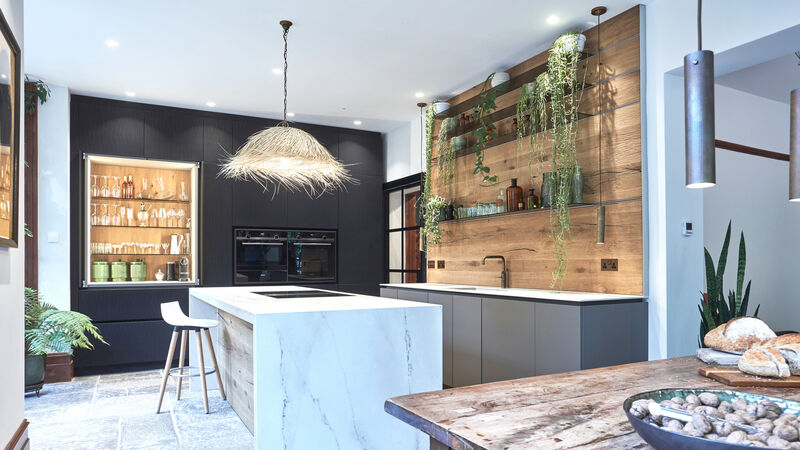
A well-designed home doesn’t come down to size. Picture: Richard Pinches/Kendell + Co/PA
When interior designer and presenter Julia Kendell first started her career, she says property value was measured by a single blunt metric — square footage.
A speaker at the Homebuilding & Renovation Show for the best part of 20 years, Kendell says: “Bigger was better, full stop.”
Whenever anybody was building an extension, or new property from scratch, it was always about “let’s build the most we can get away with", she adds: “Because square footage tends to equal value, therefore that’s what people would assume to do.”
But in recent years, she says there’s been a massive shift in terms of the number of times people move house. “Talking to most people now, even much younger people, if they’re lucky enough to get on the property ladder, that’s their forever home," according to Kendell.
“They won’t be thinking ‘We’ll move house in five years' time because it’s just so expensive, so people are saying ‘How can I afford to get on the property ladder?’
“‘And how can I make this something that’s going to suit me forever?'”
Moreover, with build costs per square meter "so monumental now", she adds: "It makes a lot more sense to build what you need, not what you can get away with. Also, there’s been a shift away from extravagant living. You know, this whole sort of ‘We’ve got to have a massive house to show off to the neighbours kind of thing.’
“It feels a little bit dated to me now. And again, a lot of people I’m talking to, particularly the younger generation, that’s not really what motivates them.”
Indeed, she says it’s about having a home that really functions well for them and the family. “And feels all the things that a home should be to you, providing a feeling of safety and security — like when you get through the door, and can really drop your shoulders.”
This is not about space, she says, it’s about how well your home is organised and how it’s furnished. “So it supports you and your family on a day-to-day basis.”
A television designer across several shows such as and , and owner of kitchen design company Kendell and Co, the 57-year-old says: “Clever design can make a compact home feel richer, more luxurious and liveable than a poorly planned larger one.”
Here, she shares some top tips to achieve that illusion…
Ceiling height is one of the most underrated indicators of quality, highlights Kendell: “Even a modest increase, from a standard 2.4 metres to 2.6, can transform how a room feels.
“Higher ceilings improve light, airflow and visual breathing space, making rooms feel calmer and more expensive.”

“There’s good reason why models are tall; elongated proportions show clothing at its best, and the same is true for interior spaces.”
If structural changes aren’t possible, there are still tricks worth using, she says: “Ceiling-mounted curtain tracks, full-height doors and vertical panelling draw the eye upward.”
Painting ceilings the same colour as the walls (rather than stark white) removes hard visual breaks, suggests Kendell, making the space feel taller and more cohesive: “I’m a big fan of colour drenching… a lot of homes don’t have coving anymore, and where you have the junction between the wall and ceiling, it feels very clumsy to me; a white ceiling and coloured wall, it’s not a nice feature.”
“And that’s where your eye looks, and you don’t want that to be the thing your eyes are focused on. So having the same colour ceiling and walls means you’re drawn to other pretty things in the room.”
In design terms, she says height creates drama, width simply fills space.
Light is what makes rooms "feel alive”, notes Kendell: “A small, well-lit space will always outperform a large, gloomy one. ”
She suggests maximising natural light by prioritising window placement and proportions. “Taller windows, even when narrower, feel more elegant than squat, wide ones.”

And favours sheer curtains, shutters or well-fitted blinds for maintaining privacy, without sacrificing daylight.
Where possible, Kendell says to consider internal glazing, glass doors or borrowed light from hallways and stairwells to maximise light throughout.
“So basically, internal glazing is where you have a glass panel between one room and another,” she explains. “So often the front of a house is south-facing, and the back is north, and the middle of the property, into the back, can feel quite dark.
“If you can potentially steal light from the lighter areas, by virtue of installing some internal glazing between room spaces, and allowing that light to filter in, it makes a big, big difference.
“Capturing daylight in a property is everything.”
“One ceiling pendant in the middle of the room is a dead giveaway of a space designed on a budget,” states Kendell. “High-end interiors always use layered lighting.”
She says lighting should be at the front of anybody’s priority list when thinking about the redesign of a room, or building something from scratch.

“Unfortunately, it seems to be the one thing people leave until last, unless it’s a new high-end property with control systems and the like.
“And they often leave it to their builders and go ‘Oh, you put in what you think’ because it’s one of those things they don’t really understand, or comprehend the impact it has.”
But if you make it a priority and think carefully, "it will bring the room to life”, she adds.
Aim for at least three sources per room… ambient lighting (downlights or wall washers), task lighting (reading lamps, kitchen under-cabinet lights) and accent lighting (table lamps or picture lights), advises Kendell. “Whatever you want to highlight and draw attention to, it will absolutely transform the space.”
“If you spend all the money in the world, and you’ve got a very boring lighting scheme, it’s never going to look fabulous… and won’t feel fabulous to be in.”
“Clutter is the enemy of luxury,” notes Kendell, and says one of the most effective ways to make a home feel expensive is to make storage disappear.

She suggests built-in wardrobes, window seats with hidden compartments, floor-to-ceiling shelving and integrated media units to free up floor space while creating clean lines. “The TV is always the enemy of a designer — we all want them, and they’re getting bigger and bigger. Inevitably, it’s what your eyes are drawn to when you walk into the room — and from a high-end design perspective, that’s not ideal.”
“So the more you can disguise the telly, or not make it the focus of the room, the better.” Hence, the popularity of a media wall, where you can build the TV into a space which looks considered. “It’s about everything feeling like it’s been thought through, not patched together,” says the designer. “And that’s what makes a room feel comfortable to be in, function well, and look good.”
Premium interiors aren’t created using a plethora of different materials, says Kendell. “Designers prefer to use fewer, quality materials to provide cohesion throughout the property.”
She says to limit your palette and repeat finishes across rooms to create flow, and believes engineered wood flooring throughout feels far more luxurious than a mix of carpet, tile and laminate.
“We always use the same flooring throughout the property, the same internal doors. Therefore, if you’ve got oak doors, you’d have an oak staircase; oak in fixtures and fittings, where appropriate.”

If chosen carefully, she says it shouldn’t increase the overall cost.
“In kitchens and bathrooms, prioritise worktops; taps and handles over expensive cabinets… these are the elements you touch daily, and quality shows.
“A small room finished beautifully will always feel more expensive than a large one finished cheaply.
Julia Kendell will be at the Homebuilding & Renovation Show in Birmingham, offering free one-to-one consultations, March 19 to 22; National.homebuildingshow.co.uk.

CONNECT WITH US TODAY



Be the first to know the latest news and updates