Is sitting the next smoking? Compact, desk-locked styling may be neither productive nor ergonomic
How to create a home office or workstation that works for you
Is sitting the next smoking? Compact, desk-locked styling may be neither productive nor ergonomic

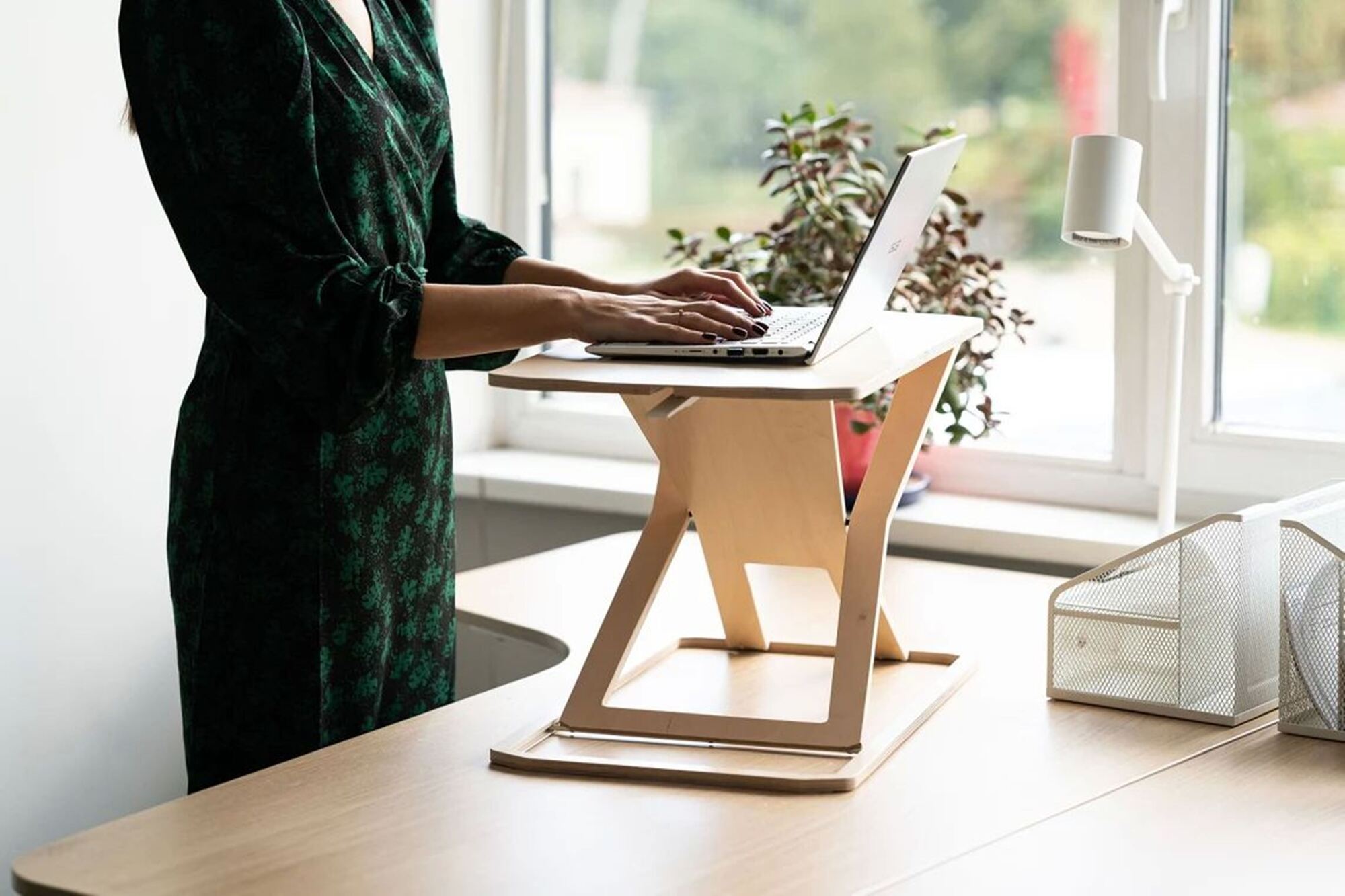
Get on your feet and away from a conventional seating position with a sit-stand or standing desk. Function Site desk converter in Baltic Birch Ply at Etsy, €134.30.

In the past, putting everything within reach of your seated position would be standard advice for a home office, in fact, any desk job. This seemed like smart ergonomics where space is tight, and we are deliberately burrowed away to invoke separation from the domestic landscape and to increase a sense of privacy. 

Well, whether you’re stuck on a length of counter wedged in the eaves, or enjoying a halcyon architect-tailored sanctuary down the garden — most of us have got it completely wrong.


Compact, desk-locked styling is not the key to a productive, serious home working environment. A 2022 study led by Simon Fraser of the University of Vancouver, showed that sitting for eight or more hours per day was linked to a 20% higher risk of getting heart disease or dying from any cause, compared to those who sat for half that time. Prolonged sitters were also 49% more likely to have heart failure.

These figures are closing in on the risks presented to our longevity by smoking and obesity, coining the phrase “sitting is the new smoking” in the medical world. Office-based workers spend around 73% of their workday and 66% of their waking day sitting (British/Australian study, SMART Work & Life (SWAL) 2019).

The NHS in Britain argues that prolonged sitting slows the metabolism, reducing the body’s ability to regulate blood pressure and blood sugar, and break down body fat. 

Suddenly that cute file cabinet you’re rolling out with a finger from under the desk doesn’t look that adorable. It’s not just your body that suffers. Longer periods of solitude together with physical inactivity reduce concentration and focus too, as stillness tells your brain to slow down. Tilting your head downwards, lids lowered, is a signal for sleep, not alertness — ask any nodding student at a warm, college lecture.

Osteopath Judith O’Sullivan explains, “Prolonged sitting or prolonged standing in the workplace (and that includes any home-office set-up) may result in poor posture which can lead to stress on the joints and pressure on the intervertebral discs. This can alter the natural curves of the spine resulting in poor spinal alignment causing tension and restrictions throughout the body.”

Judith O'Sullivan, osteopath, with a practice in Mallow and Fermoy, advocates for movement day-long with a home office set-up, mallowosteopaths.com.

Leaving out the primal positions of hunkering, squatting or sitting crossed-legged — not practical, the very best position is a lively combination of standing, walking, and sitting alternatively. The gluteal muscles that hold you up, waste away in a chair. Yes, there are times, when you’re say writing up a report where your backside will inevitably lodge in the chair for hours. 

There’s actually no hard evidence to date that by themselves, standing desks used over a working day radically improve cardiovascular health. What they can do is give you an alternative position. 

Over-use a standing desk or riser platform, and you’re just swapping out lower back, and neck pain for cramped calves and varicose veins. Add an anti-fatigue mat or even a balance board and avoid being static wherever you work. Standing height is in the area of 90cm for a surface. Ensure you get this right as there is no chair to tickle up or down a few millimetres.

Where you do have to sit at a conventional desk height, the right chair’s rock-solid stability and matching the chair and desk to your height might spare you creeping pain issues in the future. The bowed angle of the neck puts enormous pressure on the cervical spine — concerning to any osteopath or chiropractor. We’re looking for eye level at the centre of the screen or a fraction lower.

We can set these ideal positions for a laptop, by adding a larger, independent screen at eye level, allowing the laptop to act as a keyboard and mouse point. Alternatively, you could elevate the laptop screen on a plinth and use a separate wireless keyboard (€35) and mouse (€25). Take a look at the UpRight Go Posture Corrector that uses an app synced to your phone, and a small unit on your upper back to send you a light vibration to the serial sloucher; around €75, Amazon.

At the desk you should be centred and straight, your feet flat on the floor, your legs bent at a 45-degree angle, your thighs comfortably parallel to the floor or a fraction lower than your hips, with your backside nestled into your chair. Your arms will be parallel to the floor, not reaching up or down or pulling you forward out of position to reach the keyboard. You should be able to cross your legs without thumping the underside of the desk. 

The keyboard can raise your working height be a few millimetres, so watch out for any signs of strain. Don’t bring any large screen closer than about a metre, as even with blue-light protection this can be very exhausting for even a couple of hours (we all forget to blink once immersed in work).

With chairs, you really do get what you pay for. A good swivel chair rated for regular use will set you back in the area of €350 to well over €1,000 for something branded with exquisite, full spine articulation. Second-hand suppliers such as CJM at Marina Commercial Park in Cork can source branded seating that’s not wrecked if you’re willing to persist in the search for a favourite iconic bargain. I like a tilting chair for stretching out the back like a cat during breaks and phone calls. Casters also allow relaxing slides and glides to storage elements.

The human spine is not straight or fixed. Any chair that allows you to move is a bonus. More on chairs next week.

Judith advises, “As an osteopath, I would always recommend varying postural positions throughout the workday. When combined with regular movement activities, five minutes per hour, these actions can help improve blood flow, nerve supply and lymphatic drainage resulting in reduced restrictions and injuries.”

So, with a reasonably comfy, primary desk situation, let’s get moving. If you are alone at home, set up three potential working hubs with clear, clean surfaces and comfortable sit or standing heights to place your laptop or take a few notes while on the phone.

If you’re not Zooming or on Meet or Teams, stretch out on the floor for a longer phone call. Otherwise, prowl around in just the way you would in an office environment when distracted, interacting, taking sensitive calls or even desk-bombing colleagues, and breaking for lunch and snacks.

Standing desks and high counters allow you to activate more muscles in the body while you naturally shift from foot to foot, raising the heart rate and burning a few more calories (just 24 per day according to a study by the University of Pittsburgh in 2016).

A step further, treadmill desks, and balance boards for all their hilarious dorkiness, are having an impact on the on-site work environment — because it’s regular movement, interrupting sedentary, frozen posture that matters. Because we don’t want to just replace standing with sitting, height-adjustable sit-stand desks, or portable sit-stand platforms, are enormously useful.

The latter can take any surface, including our kitchen counter to a standing height for your laptop, giving you a new position and refreshing outlook during a long, solitary day.

Yo-Yo is a good entry-level desk aimed at the home office user, in a motorised standing desk that can be finessed to your height. Made from reinforced steel it doesn’t have any fussy, central stability beam and offers a steady surface at all heights (72.5cm to 122.5cm). Colour options are silver, black or white. €490, yo-yodesk.ie.

I grabbed a second-hand Humanscale Float desk on DoneDeal, and I can attest to its fluid performance from 70cm to 120cm with no motor or crank needed. It includes a discreet counterbalance mechanism that drifts it up into position and handles up to 60kg of desktop weight.

In white, it’s not bad, even set down in an open or broken-plan setting if you tidy your detritus away for the evening. From €1,500 new from a range of suppliers with a choice of 120cm to 180cm tops, including O’Brien Office Systems, Cork.

Go-Stand is an Irish company specialising in standing desks and retrofit platforms. It offers desk-top work-stations, ideal where a sit-stand or standing desk is not feasible. Its 800 Ergo sits has twin platforms and sits on your current desk or on the counter and rises and falls on a gas mechanism with dual-squeeze handles.

You can add a separate keyboard to your set-up on the lower platform if that suits you best. €174. For a larger unit, explore the 950 Ergo at €199.99; gostand.ie. For more organic, woody table-mounted lectern stands and wall-mounted desks, explore Etsy.

More in this section

Revoiced

Newsletter

Sign up to the best reads of the week from irishexaminer.com selected just for you.

Cookie Policy Privacy Policy Brand Safety FAQ Help Contact Us Terms and Conditions

© Examiner Echo Group Limited