Dermot Bannon: Secret to a home workspace and how to prepare for meeting an architect
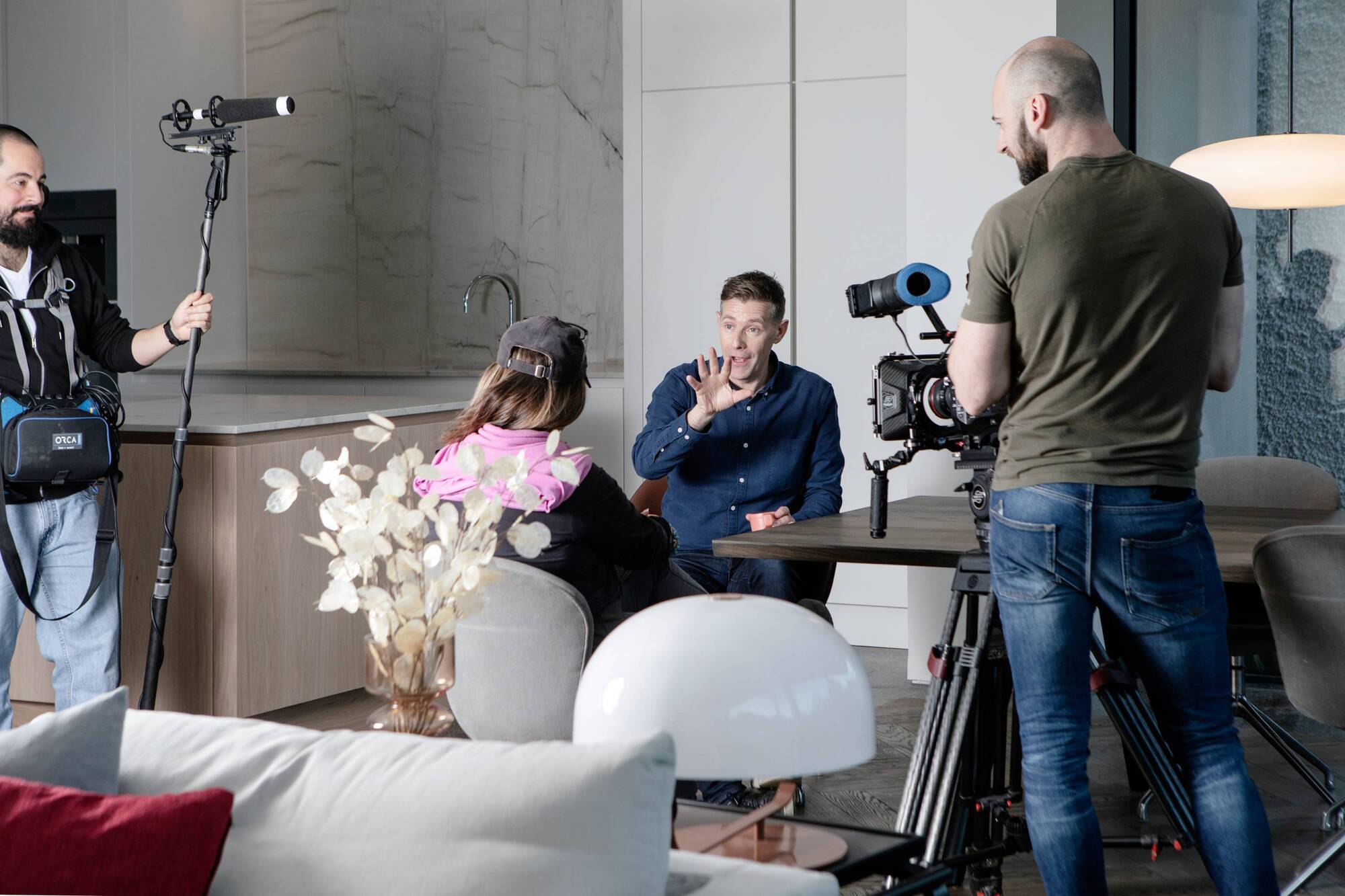
Dermot Bannon filming in his home during Room To Improve: Dermot's Home. Picture: Ruth Maria Photography
What is the secret to finding the sweet spot in your home for a dream workspace?
The hybrid working style may be here to stay, and letās face it, we are not all going to be in a position to install a palatial loft-style home office anytime soon.

I call Dermot Bannon to find out.

Irelandās most high-profile architect doesnāt miss a beat. āJust get your laptop and get yourself set up in the nicest spot in the house,ā he tells me. āThatās what I always say to people. Is your front sitting room bathed in light all day long? Well, you want to be in there.ā
I am talking to Dermot ahead of the Simon Open Door campaign, which is run in conjunction with the Royal Institute of the Architects of Ireland and kicks off this week.

As I swiftly swivel a few degrees to catch the rays streaming in the window, we talk about other clever tricks people can deploy to tweak their room settings as well as the questions homeowners need to ask to maximise the opportunity the Open Door campaign offers them. You can register at www.riaisimonopendoor.iewww..ie to take part in the event, which runs from May 4-14.
In return for a ā¬95 donation, homeowners receive an hour-long consultation with an RIAI-registered architect to discuss building, rebuilding or renovating their homes.
This year consultations can take place online or in-person and all funds raised go directly to Simon Communities to support their work tackling homelessness.
How did Dermot get involved?
āBefore I did , I was working for another practice and I used to take part in the Simon Open door event. Iāve been taking part in it since its inception,ā he says.
āThen I was asked if I would mind becoming an ambassador. Itās a great day. Thereās a bit of a festival feel about it ā as an architect youāre getting to meet people, there are new people in every hour. Itās a bit like speed dating.
Many people āhave lots of questions for architects but they donāt feel their project is big enoughā, notes Dermot.
āAnd for a ā¬95 donation so they donāt feel itās a big enough spend. Iāve often had people come into me with very small problems and they can go away and find they donāt need to engage an architect ā the architect might have solved the problem in the consultation,ā he adds.
The tiny matter of huge extensions being a case in point.
āLots of people come in with the need for an extension,ā says Dermot.

The good news is often that homeowners may discover they might have more space than they thought, after the consultation.
āMany people are not using 80% of their house at all,ā adds Dermot.

āI often meet people who are going through milestones, suddenly after years there are just two of them, their children are reared, they are downsizers who have reared all their children, paid for them through college and now itās their turn to enjoy life and they have a big clatter of rooms and they are trying to bring all these rooms back to life.

āItās often simply about reconfiguring their rooms.ā
So how should homeowners prepare for a consultation with an architect? Bring plenty of photographs and lots of plans, advises Dermot.
āAs an architect, I examine the whole house. If someone comes into me and says, I need to put in an extension, I want to try to get a picture of it.ā
Gather up āas much information as you can as well as photos of the house,ā he adds. āWhat are the nice views; weāve got phones now, find out where north is in relation to the house, everyoneās got a compass on their phone so thereās no excuse.ā
I want to know what Dermot thinks about those echoes we have been hearing, across all those warehouse-like living room/kitchen/dining room/s that the end of open-plan living could be in sight?

Heās unconvinced. āOpen-plan saved us during lockdown ā it meant that we all tended to be in the same room,ā he says. āThe room was big enough that it was suitable for us all to hang out but not to be sitting next to each other ā there was psychological comfort there; it was like an open-plan office but still there was the comfort of being in your own bubble.
āBut hopefully weāll get back to family gatherings and an open-plan space works for all that.ā
In fact, itās the open-plan area in his own home that is his āhappy spaceā, he admits.
āI love our open-plan space. We have a little spot at the front and we have a couch that we meant to throw out but then lockdown happened and the dog sits up on it and I sit there, and thereās a view out to the church opposite,ā he says. āIt just goes to show that you can be in a separate area in an open-plan space.ā
Tricks such as creating alcoves and good use of lighting are what make open-plan and broken-plan spaces work best, he adds.
āThe kitchen table has to be a space where you can do homework but also during the pandemic you needed to have a takeaway there, so you could turn down the lighting for instance if you needed to create a special space.

āLighting, furniture, positioning of doors ā there are lots of little tricks to making open-plan spaces work. I donāt think open-plan is dead at all.ā
That said, he is also interested in the concept of the āgetting away from it all roomā ā somewhere you can Zoom call and watch TVā.
When renovating his own house, Dermot says he was able to use āall the lessons I learned over the yearsā.Ā
ā was a gift, in a certain way," he adds.
āI now know the perfect layout for a kitchen, because Iāve done so many. I know what works. I know the same for a living room ā I know what makes a cosy living room and what makes a warehouse. Itās kind of like a doctor with 20 or 30 years under their belt ā Iām the same when it comes to houses.ā