Time for a cuppa? Here are the hottest vintage-style kettles
QUIVERING on the edge of September, it’s time to put the kettle on five times of an evening (conservatively). What better time to look at some of the hottest, iconic kettles, their lines firmly rooted in the past century or so.
The three principal forms are the squat, stovetop, the taller cylinder pot and the dome or pyramid, made desirable by Smeg (KLF04) and the Morphy Richards. After that, the chassis, colour, finish, spout, handle and controls will determine styling.

If you go electric, you’ll notice this winter that temperature control is taking over the kettle market. Discover more about how to avoid scalding your coffee grinds or bruising those delicately shredded leaves, taking a more exact heat to the infusion. Gooseneck spouts are another must-have if you fancy a cup of Joe over a traditional cha.
Here comes the history. Harrow-educated British engineer and entrepreneur Rookes Evelyn Bell Crompton (1845-1940) introduced the first electric kettle in 1891, with a bottom-mounted little "radiator" to heat water.
His technology was so good it was bought in by Carpenter Electric Company in Chicago, who had introduced their own kettle to America in the same year (but which took an exhausting 10 minutes to come to a boil). It was 1922 before the element as we know it was produced for the market by Swan, and being shocked by your kettle was not unusual in these early designs, largely in copper.
The K1, finessed in 1960s to the K2, was very first automatic switch-off kettle using a tin steam jet and bimetallic strips for operation, were made by William Russell (1920-2006) and Peter Hobbs (1916-2008) in 1955. Previously, a kettle could boil dry if not monitored.
This year Russell Hobbs has released a 65th-anniversary edition that sits perfectly on a 21st-century counter. The Kettle You Needn’t Watch came in chromed steel and today retains its honest, arched black handle, still extremely elegant in honest canteen steel, and recalling stovetop or crane hanging kettles. The spout has been improved to be sputter-free straight to the cup, although I remember my mother’s 1970s K2 as having a silky, streamlined pour.
The K65 has the familiar little red trigger and includes an ultra-slim swivel base (these add extra stability to the kettle’s position on the counter) and a rapid-boil feature (50 seconds for one cup). Choose from a brushed stainless steel or copper plate kettle.

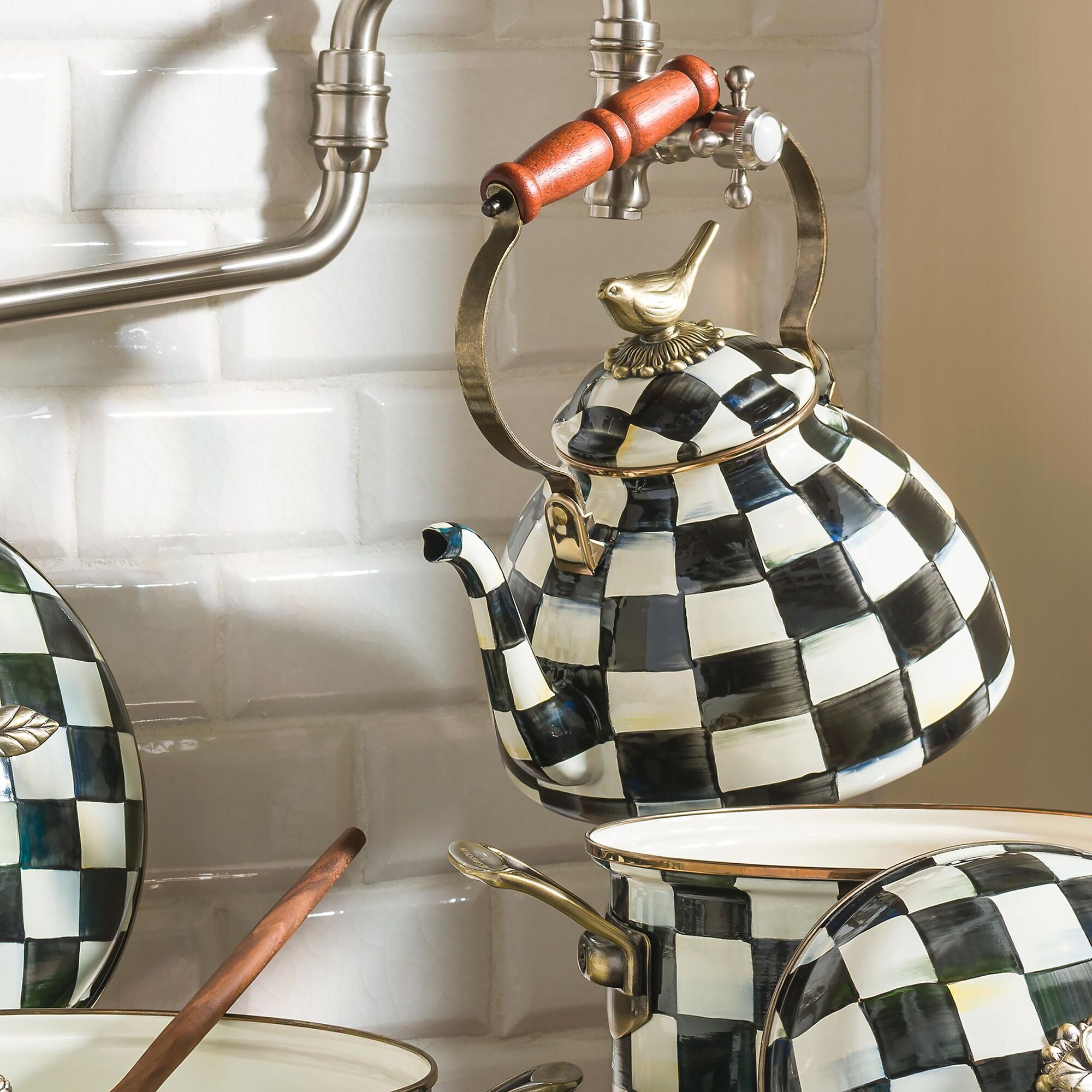
If you want an original K1 or K2, ensure you have it checked by a RECI-qualified electrician as you would with any older appliance with uncertain wiring. K65 is priced at €74.99, Argos, and the Vintage K2 is priced from €200. If you want to go right back to an unashamedly nostalgic stovetop kettle, wood handle and all, MacKenzie-Childs is the brand to explore. Prices from €165. Try amara.com.

For 50s vintage beat, KitchenAid’s Artisan 5KEK1522 is only equalled by Smeg’s enamelled countertop collection. The matronly shape of the KitchenAid includes a brooch like the mechanical dial on the décolletage, showing the preset temperature as the kettle performs the boil set by another modernist control slider on the base between 50C to 100C. “Suit your infusions: nicely warm for delicate green tea or hot for coarse assam,” the brochure croons.
When the kettle is off-base, you can still see how hot it is, and the dual-wall construction is relatively safe to the touch. Available in hard anodised aluminium in six colours, €159, Harvey Norman.
If you prefer a stove look with the enamel rockabilly jacket, the Dome, 5KEK1222BWH is rather lovely in white in an all-white and timber kitchen, €100, also at Harveys.
KitchenAid has subsumed concise digital precision to another kettle, the SKEK 1032 (a superb alternative to the iconic goose-neck funnel of the Stag EKG beloved of hysteric coffee devotees, €166, coffeedesk.com).

If you like that exquisitely slender spout to tenderly and slowly soak your coffee grounds look up the Bodum Melior chrome, also with that Middle Eastern informed gooseneck spout, finished off with cork heat protection for your hand. Smart and a superb price, €52.95, cookinglife.eu, and other Bodum suppliers.

Want to go app-berserk and fancy a kettle shaped like a fat vintage handbag? Check out the Casa Bugatti Jacqueline Compatible with the Bugatti B Chef app (available on iPhone, iPad and Android). An arty lump, it allows you to set the kettle to boil at a certain time every day of the week and to serve up baby’s bottle water at the perfect temperature, €368, amara.com
One of the most celebrated, postmodernist informed stovetop tea kettle, also suited as a tea-pot to bring to the table, has to be Michael Graves’ c1985, Bird Whistle for Alessi, with magnetic stainless steel heat diffusing bottom suited in 18/10 stainless steel. €120. Pick up a gold-plated bird and dragon-shaped whistle (set of 2) for €49, amara.com — very pop art and cheaper than vouching for their complete Tea Rex kettle and whistle (€395). In the aptly named Mami kettle c.2003, Stefano Giovannoni blows up a Bauhaus beauty into a maternal chrome bosom — just €97 on offer from Alessi’s home site, eu.alessi.com.

Don’t ignore the multiple calming forms of Naoto Fukasawa, and my choice as an Alessi investment, architect Frank Gehry’s asymmetric Pito c.1992, which features two mahogany fish forms leaping on a highly sculptural body and a whale song whistle to its boil, €395. eBay Pito kettles are as much as €100 over the Alessi RRP — be warned. If you have just €200 to brew up a classic stove Alessi stovetop — order a 9091 kettle by Richard Sapper, c.1982, with the sound of fluted boat sirens on the Rhine designed into every boil. Alessi is a fertile ground for wedding presents as the kettles generally offer a loving, companion creamer. If you’re buying a stovetop kettle for electromagnetic use, ensure the piece is a match for your induction hob.