Why this blue flower is areal beauty
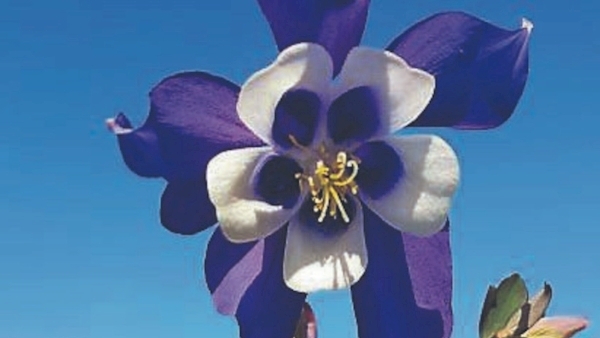
A photograph of a blue aquilegia sends hurtling down memory lane.
I remember the first time I encountered an aquilegia flower. I was about five or six years of age and I remember to this day how struck I was by the beauty, colour and detail of the flower. I was awestruck that something so perfect and beautiful could emerge from a bunch of nondescript leaves and soil.
That same evening was also the first time I saw the flowers on Aesculus hippocastanum, the horse chestnut, another revelation. I had up to then only ever associated conkers with this tree, but of course the seed or the conker had to originate from somewhere. The flowers of the horse chestnut are relatively short live in terms of their beauty, but what a display they give, standing like horticultural candelabras at the tips of each stem, a real floral fanfare each spring.
It was in my old family home of Dunsland in Glanmire where I saw these beauties, I am now 47 and I was sent hurtling down memory lane recently when my friend Tony Milner sent me in a photograph of an aquilegia plant that he had grown from seed last year. I’m not altogether sure how a picture or how a flower can be so evocative but this one sent me right back.
The rich blue outer petals which, to be correct should be termed, sepals, the same beautiful colour as the proud spurs which face backwards to expose clear, white inner petals surrounding a bunch of yellow stamens which seem to be just calling the bees and hoverflies to come and feed.
I know that the colour blue/purple along with yellow is supposed to be particularly attractive to bees and the easier it is for the insects to get the nectar then the better and from the plants point of view for, it is attracting these pollinators that is important.
How beautiful they look to us and how nice they may seem in a vase are irrelevant horticulturally but what I don’t understand is why so many different parts? Accepting that everything in nature has a purpose, why the spurs? Why such intricate detail? Is it to attract a plethora or a specific type of insect?
Who knows, all I know is that I find them one of the most beautiful flowers out there. The good news is they are readily available and easy to grow from seed. A packet sown now will be up in a matter of weeks and in flower next spring.
Once established they will set seed easily and promiscuously, giving rise to offspring of many different and mixed colours. I’m not alone in my appreciation o fthese beauties, known also as granny’s bonnet, columbine, cocks and hens and bishop’s hat.
YOUR QUESTIONS ANSWERED
Yes, that can be very serious damage, removing the bark of a tree is like removing skin from a human.
Firstly, this is where water travels up the tree and food travels down to the roots and thus, in the area where the bark has been removed this can no longer happen. Secondly, it is, like any exposed wound, vulnerable to infection and it is often through wounds like this that disease can enter a tree.
It is physical damage in that it was done by an animal or a human and not a naturally occurring disorder.
There are different thoughts regarding painting something on it to protect the wound — a bit the same way as there are different opinions on whether we should put a plaster or not on a cut on ourselves.
In this case, I think it is irrelevant as the damage was done so long ago that the tree seems to have callused over the wound and it looks, now, quite clean. I don’t think that it will lead to the tree dying or falling; however if more of the bark had been removed from the tree, then it would have been irreparable.