Otherworldly ambience of a Mediterranean island
This Christmas we’re in Ibiza, a sentimental journey for me. When I first lived here in the early 1960s, nobody north of the Pyrenees knew where it was or what it was.
Now, it’s possibly known better as a brand than as a Spanish holiday resort in the Mediterranean. Cars are called after it, rock groups, sunglasses, perfumes, a make of distressed jeans (?), and discotheques.
Then, it was an island unknown to the outside world, isolated from the commerce of mainland Spain by order of el Generalísimo Francisco Franco, Caudillo de España por la Gracia de Dios (Dictator of Spain by the Grace of God).
During the Spanish Civil War, Ibiza remained loyal to the left-wing Republican government elected in 1936. When Franco’s right-wing forces triumphed, ‘expulsion’ was its punishment.
Nobody could have guessed that it would later become better known internationally than Majorca (Mallorca), its larger cousin, already a thriving holiday resort when I moved there with my wife and infant children in 1961 — but quickly moved on to Ibiza, which was much more our style.
Majorca was a favourite resort of the Brits, and, indeed, the Irish.
It is a beautiful island with forested mountains, olive groves, and productive farmland, as well as wild areas that are home to birds and animals not found in Ibiza: Larger islands, with diverse habitats, attract more species than smaller ones. Majorca is even big enough to have a railway.
It was not until the mid-1960s that Ibiza began to attract a modest volume of package holidaymakers centring on the seaside town of San Antonio: Previous to that, Ibiza town was the only foreigner hang-out, largely oddball travellers and expatriates, most of whom washed up there by chance.
Small in number but diverse in nationalities, those who could raise a few quid a week settled there, enjoying sun, wine, and a bohemian lifestyle among comrades of the same persuasion.
My wife and I knew nothing of it until we heard rumours during our first few weeks in conservative Majorca.
It was, indeed, a place ‘out of this world’ and, indeed, out of time. We felt it in the very earth we walked on, in the very air.
It seems to have been recognised as otherworldly by every cultural group that ever came and went — Phoenicians, Carthaginians and Romans, Goths and Visigoths, Vandals, Byzantines and Arabs, probably even by the Barbary pirates that came to plunder.
Into the pantheon of their own gods, they adopted Tanit, the endemic goddess of the Earth and of fertility. Visitors speak about the ‘timelessness’ of the landscape, and of feeling this same unworldly presence today.
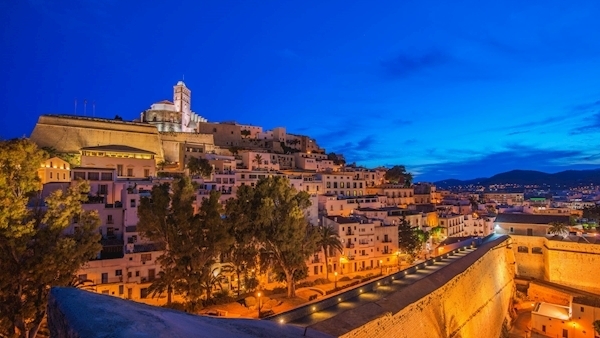
In the capital, Ibiza, defensive walls, 25m high and 5m thick, enclose the magnificent Old Town (Dalt Vila) which rises in dense terraces of houses linked by labyrinthine stairways and lanes to a citadel and cathedral silhouetted against the sky.
The sky isn’t always blue, of course, for this is a Mediterranean island and has distinct seasons (we are not in the Canary Islands of almost endless summer) but this year so far the winter days have been lit by sharp, yellow sunshine until five in the afternoon, light-jacket weather most of the time.
The history of the colonist peoples who waxed and waned through history is fascinating, especially that of the Phoenicians, the first great explorers — the first civilisation that was born and grew to maturity in the birthing bowl of the Mediterranean and that dared to sail through the Pillars of Hercules and into the Atlantic and the infinite world.
Also, there will be stories of the Roman conquest, of the Barbary pirates, and of the rich Carthaginians who came here to die and to be buried in the sacred Ibiza earth, believing Ibiza was already half-way to heaven.
This is a faith shared by the thousands of modern ravers who, in the summer season, ride the brain waves of ecstasy in the vast, booming discotheques that have become icons of the island where thousands of young holidaymakers worship the music until overtaken by exhaustion or the advent of dawn.
There were just two worlds when I first came here. There was Ibiza, the capital, where the raggle-taggle expatriates hung out, writing or painting, but mainly talking and drinking in a handful of bars.
Beyond, there was the countryside of unmade roads, hamlets and a few small towns.
Now, a new world of nightclubs and discos have been added: Amnesia (capacity 5,000); Privilege (10,000); Ushuaia (4,500); Pacha (3,000). All but Pacha close in winter.
Hours and hours of zombie dance music doesn’t turn me on, but it does the kids, 99% of whom survive it unscathed. Good luck to them and to all my readers in anno 2019!
CONNECT WITH US TODAY



Be the first to know the latest news and updates