Let the frequency of your joy vibrate with the frequency of spring
I’m more of a “white rabbit, white rabbit, white rabbit” guy than an April Fool’s prankster, (saying the words out loud on the first day of the month is supposed to bring good luck), but if you are a frequent visitor to this page, then you’ll know that I love to explore, not just gardening traditions but occasionally non-gardening traditions to explore a lesson or potential insight for fellow gardeners and myself. In this instance, it may just be: “don’t be fooled”.
The origin of the April Fool’s concept is somewhat obscured by alternate facts.
Some would have you believe it stems from the 16th century and the new Gregorian calendar with the shift from the beginning of the year to January 1.
Prior to that move, the new year or beginning of the agricultural year (according to the Julian calendar) was cued by the spring equinox and the rise in vernal temperatures at the end of March.
Those people slow to reset their ‘happy new year’ to wintertime, were deemed fools with their outdated salutations in April.
Others would have you believe Chaucer in his Canterbury Tales (1392) was the inventor of a ‘prankers’ day that found favour among the literate and usually was a prank against the non-literate or peasant classes.
Not sure if a ‘put you in your place day’ is of any use to humanity even if I will engage in it a bit, a little later in this column.
All I will say is that the arrival of the warm season flushed previous generations with a jovial nature.
It is no joke that mental health groups across Europe support spring walks, gardening and listening to birdsong at this time of the year — as a way to lift depression and engender positivity. Spring is not just symbolically new life — it is an energy that transforms.
The fresh green unfolding, the blue sky appearing earlier and lasting longer, the extra bit of warmth in the day — all add to the psychology of wellness — all impact chemically on our endorphin release.
Spring was traditionally embraced as a way to celebrate the rising sap in our sacred trees and the potential of the soil to receive new crops.
Society may be further removed from the land and its cycles beyond YouTube curiosity or a lamb watch app. However, pre-industrial age, all that seasonal change stuff got us a bit giddy. Now phone-age man hasn’t the time to notice.
We once venerated spring joy and giddiness through the role model of our gods.
It was enshrined with Lud for the Celts and the prankster Manannán mac Lir for the Irish (we were Irish before we were Celts and a fair bit after that cultural adoption too).
It was Pan for the Greeks, Cybele’s hilaria for the Romans, Uzume in Japan, Bes in Egypt, and more besides — all rejoicing life with laughter.
So have a laugh today. It’s almost your duty as a guardian of the earth, as a gardener, to do so. Let the frequency of your joy vibrate with the frequency of spring. Just don’t be fooled.
We gardeners need our wits about us too. For example a few years ago I happened to be inside an Irish-based store of a big British gardening chain — they happened to have a special offer on mole traps that day.
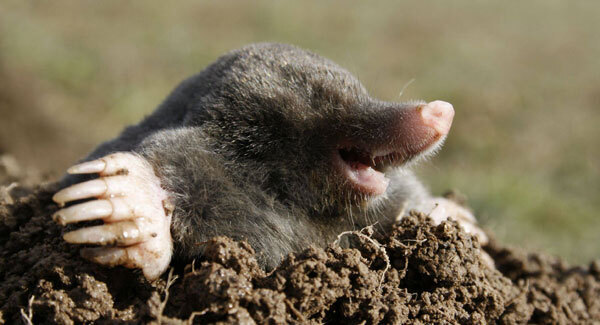
Hang on a minute I thought, ‘moles don’t exist in Ireland’. They never made it here over any Ice Age bridges. They got as far as Britain and no further. Is this the biggest con since Saint Patrick and his imagined snakes?
I can’t tell you what I said to the manager as its still under the terms of my suspended breach of the peace, but the words such as ‘up’, ‘stick’, ‘that’, and a word that sounds like mole many have been used.
Not every bargain is a bargain and fake news or false urgency is not new. We don’t need mole traps and we don’t need fret-lists or frivolous top-tips when it comes to gardening.
There are gardening pundits and wannabe pundits out there on a bandwagon, humming the same tunes over and over. And then there are ones who forge new axles and try to steer into new territories.
For me, the idea of being a gardener is to grow yourself, as well as plants, so try new things.
However, there are plenty of fools — be they self-appointed social media gardening gurus or established ones in the public eye — who just prattle on about chitting potatoes and starting dahlias every spring — a chorus of the same speak and same weak technique. And week after week, its rinse and repeat.
All that is just reading from a dog-eared hymn sheet — it’s not rejoicing. Enough with the ‘horticultural’ suggestions that are limiting and dreadfully dull. Not everything needs to stay at novice level.
There is enough dumbing down in the world. Give us some inspiration. Get some passion. How about some substance over style.
I rant, I know, but this low calibre information dissemination is not new. Long before we had that term ‘fake news’ we had ‘received wisdom’.
We were told that digging the garden over in winter did it good, that frosts broke down the soil to good friable (ready-to-sow) tilth.
We were told by English experts often under the patronage of northern millowners from a much frostier climate than Bandon or Dublin.
If that’s still being repeated, then you are a bigger fool for listening. Here our soggy rather than Arctic winters only make a mush of the turned sod and leaches out many of the nutrients.
I am mainly no dig but I will excavate to break up compaction – no need wasting energy on a total turnover every year. Compaction reminds me of another foolish non-essential — the lawn roller — as good as a mole trap in my books.
I never got the rolling of lawns, that billiard table ideal was a bit too anal (if I may use that word in a respectable newspaper) and definitely a whiff of grouse-shooting — for my liking.
More received wisdom, but the real truth is that rolling creates compaction.
Healthy soil is a bit spongy or at least has some aggregation to it: that’s an uneven lumpiness which allows spaces for soil mass to consist of 25% air and 25% water and the rest organic matter.
Compaction squashes out that lumpiness and eradicates much of those air and water pockets.
And so, apart from the compressed compaction making it harder for roots and worms to penetrate — the deficiencies in air and water potential makes it a struggle for grass to thrive and hence a whole regime of aerating, adding sand, fertilising and so on.
Maybe if you are in England with the moles. Maybe if you are a bowling club...
We veg growers are not exempt from foolish things. There is a tradition of planting first early potatoes around St Patrick’s Day and then planting out second early potatoes in the first half of April and waiting the second half for main crop potatoes — that is just nonsense.
The fallacy that you ‘time stagger’ the planting thus making them early or later, in truth, has nothing to do with planting but everything to do with harvesting: you can plant all at the same time, they each take a different amount of days to complete fruition; so earlies are ready first, seconds are lifted second and mains later on. Get those chits off the window sill and all in. No fooling.
Had a smile, had a laugh, had a rant and a dig. Even a pun. Not a bad day. Now it only remains to discuss dahlias ... oh where oh where did I leave that hymn sheet?
CONNECT WITH US TODAY



Be the first to know the latest news and updates