Witchy winter wonder at the Fota arboretum
Peter Dowdall visits some friends, old and new, on a walk around the world-renowned arboretum at Fota.

Witchy winter wonder at the Fota arboretum

I enjoyed a lovely January walk in Fota recently. Not in the Wildlife Park but in the stunning, if under-appreciated and utilised, arboretum.

It was one of those lovely January days, the sun was shining brightly in the blue sky, not the bright orange sun nor the dark blue of high summer, rather the blinding whitish sunlight, low in a sky that’s more Wedgewood than royal blue.

A gorgeous day to be out and about but at the same time the walk needed to be brisk to stay warm and I ran the wrath of my travelling companions each time I stopped to put my nose and smart phone into some shrub or other to capture some close-up image of a bloom or coloured leaf, as my fellow walkers were much more interested in the aerobic benefits of our stroll than the horticultural.

I cannot tell you how many times I have visited this magical place, I grew up nearby and have been enjoying these gardens since I was a small child.

I recorded two series for RTÉ in the orchard here and yet each time I discover something new.

This time was no different, I came across a mature orange tree growing outdoors near the pond in full fruit.

Okay it’s not an orange tree in the true sense of the word, in fact it’s Poncirus trifoliata or the ‘Japanese Bitter Orange’.

The fruit is citrus-like but no, you wouldn’t actually mistake it for an orange. The foliage however is quite like its citrus cousin.

I can’t understand how I never noticed it before as it’s quite a substantial size and according to the label, was planted in 1935, more than a few years before my first visit.

That’s the joy of a garden such as Fota, each time you visit you notice something different, something new perhaps or new to you.

Depending on what time of year you visit, too, will have a bearing on what you notice. At the moment there is one area which is all about the Daphnes and in particular Daphne bholua ‘Jacqueline Postill’.

Later in the year you won’t even notice these plants as they’re not doing their thing, so to speak, but during December to March they fill the air around them with their heady, sweet aroma.

I’m nervous to even write about these beauties as it could be a call to arms for all those garden visitors bold enough to pinch a ‘slip’ to bring home as a memento.

Please resist the urge to do this when visiting Fota or any garden as you can imagine the damage that is done when so many people think ‘sure they won’t mind if I take one small piece’.

In fact, it was so bad that for several years in Fota the most impressive of the Daphne’s was surrounded with a fence of chicken wire to keep marauders at bay.

Walking in from the new car park, (not new anymore of course, but you know what I mean), if you pay attention you will notice some beautiful witch hazels planted over the last 10 years.

There is one dark red variety which I foolishly never took the name of, in full flower at the moment and these blooms are complimented by the beautiful copper-coloured autumn foliage which is still holding on, testament to the lack of wind we have experienced this winter.

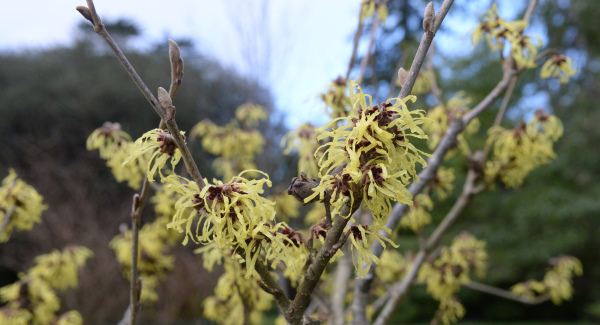
There are five or six different forms of the witch hazel or Hammamellis planted on this walkway, but for me, my favourite is definitely the brightest of all of them, Hammamellis x intermedia ‘Pallida’.

The good news is that it is one of the most widely available forms and the reason it is my preferred variety is because it so bright and cheery.

I said that you need to pay attention on the walk to notice them and that is because, beautiful though the flowers are, they can go unnoticed unless you are looking for them.

Of course, they can stop you in your olfactory tracks in a similar way to the Daphnes, as they too, are richly scented. Not quite as strong as the Daphnes perhaps, but sweet none the less.

The small unusually formed flowers are made up of very dainty and narrow strap-like petals on naked stems during these winter months and in the case of ‘Pallida’ these petals are a bright primrose yellow in colour.

Witch Hazel will become quite a large feature in the garden if given the correct conditions, a mature specimen reaching over two metres in height and needing that much in terms of width also.

They prefer a neutral to acidic soil which doesn’t get too dry in summer, nor too wet in winter in a good sunny position, not at all demanding so are they?

The other season when they are at their best is during the autumn when the seasonal foliage takes on the colours of red, orange and yellow before leaf drop. Winter wonders indeed.

Galanthophiles gather for gala

Snowdrop lovers, known as Galanthophiles, and other keen garden visitors will converge on Ballykealy Manor near Altamont in Co Carlow, on February 4 for the annual Snowdrop Gala.

Speakers on the day are Julian Sutton and Kevin Hughes. Julian is an English botanist and nurseryman who owns Desirable Plants and has a serious bulb habit, and Kevin is a professional gardener and ecologist who runs his own nursery, Kevin Hughes Plants.

Both will speak on snowdrops and other spring treasure in the garden. The lectures will be followed by lunch at Ballykealy and a trip to the gardens at Altamont.

There will be plants available on the day from some specialist nurseries. For more information contact Hester Forde on 086 8654972 or hesterforde@gmail.com.

More in this section

Revoiced

Newsletter

Had a busy week? Sign up for some of the best reads from the week gone by. Selected just for you.

Cookie Policy Privacy Policy Brand Safety FAQ Help Contact Us Terms and Conditions

© Examiner Echo Group Limited