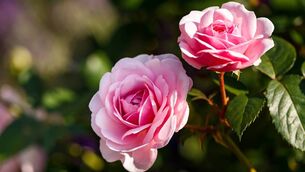
Camellias offer beautiful dark green glossy foliage all year round
I’M not sure whose idea it was to name all our storms but named they are and since last autumn the garden has been visited by Abigail, Barney, Clodagh, Desmond, Eva, Frank and Jack.
Suffice to say that it has been a windy garden this winter — bamboos parallel to the ground and an Acacia that I planted nearly two years ago was bent double during some of the storms.
All have survived, battered, bruised, and bedraggled perhaps but they have come through the storms.
Spring with its new energy, will ensure that they are back to their aesthetic best before too long.
I will however have to move my Acacia as it is in too windy a position because they like to be sheltered.
If it were to reach maturity in its current, too-exposed position, then it would surely come down in some storm in later years as Acacias are shallow rooted and thus need some protection from the wind.
Several plants, among them, Camellias and Rhododenrons, develop their buds in early autumn which will open up into beautiful blooms the following spring.
For me, these spring flowering beauties are the aristocrats of any garden.
Camellias offer beautiful dark green glossy foliage all year round which provides a comfortable home for birds nesting during the year.
During the spring, those buds that have somehow managed to stay attached to the plant during the wildest of weather, open up into beautiful showy blooms.
I remember as a child developing quite an addiction to Camellias due in no small part to the fact that our home in Dunsland contained a magnificent collection of this genus.
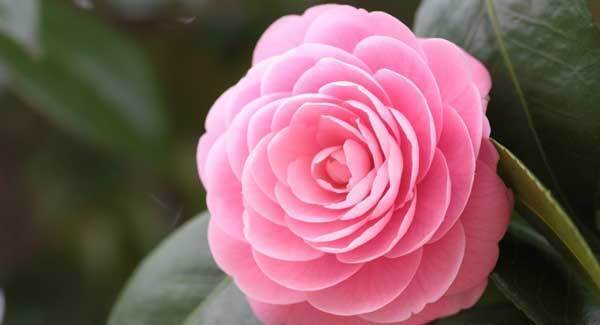
Camellias have only one type of flower, as a growing gardener, I learned about doubles and semi doubles, anemone centred and semi-anemone flowers and there are more.
The simple white of ‘Alba Simplex’ with its centre full of yellow stamens is a real ‘flower’ in its simplest of forms, something that a child would draw as a flower.
The pink ‘Donation‘ is probably the most florific (if that’s a word) of all the varieties, a specimen in full bloom is a sight to behold, all green leaves are hidden behind the most flouncy pale pink blooms.
There are many deep pinks and reds but my favourite of all of them is the regal dark, dark green leaved ‘Adolphe Audusson’.
Semi double flowers, which means simply that the stamens are mixed in amongst the petals, are produced freely during the spring and early summer.
Most of the Camellias that we grow here are of the species japonica which as the name suggests comes from Japan. However, there is an autumn flowering species C. sasanqua.
‘Tiptoe’ is a scented winter flowering form worth keeping an eye out for.
Lovely baby pink flowers are produced during late autumn and winter.
‘Donation’ is a type of C. williamsii as is ‘Debbie’, another favourite of mine.
I could say that about all of them, choosing a favourite is like choosing a favourite child — impossible.
Camellia Oil is extracted from the seedpods and is used in many parts of Asia for cooking but is also highly valued for its moisturising properties.
Containing one of the highest levels of antioxidants of any botanic oil, it is treasured by the Geisha in Japan who use it as a skin cleanser in place of water.
Whilst we think of Camellias purely as an ornamental shrub in Ireland, the species Camellia sinensis plays a huge role in international commerce and it’s not for the flowers its traded, rather its dried leaves.
I can be pretty sure that somewhere close to where you are sitting now there will be a tin or a box of dried Camellia sinensis leaves.
This is the plant that is grown to produce tea.
So you see not everything in the garden stays in the garden, next time your enjoying your cuppa, you might doff the cap to that stunning pink blossom out the window.