Climate Reality Project: Thinking 'global garden' helps your soul - and the planet
The Climate Reality Project, the-not-for-profit organisation set up by former US Vice President Al Gore, is calling on us to come together today for action on climate change and to demand that global leaders do something now, for a better future. You can sign your name to a petition electronically, here.
Al Gore isn’t the only one urging us to take individual responsibility and action to help the planet we live on.
During the Royal Horticultural Society (RHS) John MacLeod Annual Lecture in October, Prof Stephen Blackmore, who holds the title of Queen’s Botanist in Scotland, and who was formally the Regius Keeper of the Royal Botanic Gardens in Edinburgh, sent out a stark message. Namely that we, as humans have had such an impact on the planet that there is now no part of the earth that has escaped our influence.
He makes the point that it is now valid to think of the planet in terms of a ‘global garden’. The impact of humanity on nature’s life-support systems has been so far-reaching that it will be our individual and collective actions that will determine how well it can meet our needs for the future. Speaking ahead of the lecture, Professor Blackmore said:
“It’s often said that nature can take care of itself, but that’s no longer true if we want to live in a world that can support us. We can’t simply ask the government to fix the global environment, they couldn’t do it. The planet can be safeguarded only by each of us changing our behaviour in positive ways that will make a difference to the quality of life in the future.”
Professor Blackmore stresses that every person has a part to play, whether by simply planting up a pot outside the front doorto being the curator of a large Botanic Garden.
“For me the key insight is that it was the cumulative action of seven billion people that created the environmental challenges we face today, and it will be the individual actions of those same people that will get us out of the position we’re currently in.”
In practical terms what can we do? Well here are a few key pointers: Gardeners should be actively choosing plants which attract the greatest range of beneficial wildlife to the garden and support the widest biodiversity.
Urban landscapes need careful attention. Street trees should be used more and the choice of species used as needs careful consideration, ensuring they will absorb the greatest amount of pollutants, thus creating an environment capable of supporting the greatest amount of other species. With increased levels of flooding in Ireland and the UK, gardens large and small need to be part of the solution. Instead of concrete driveways and paving over what was previously a lawn, we should be looking the other way. The more porous and permeable surfaces that we can provide outside then the less hard surfaces there are for flood waters to collect upon.
It doesn’t have to be your own patch that you tend to. If you don’t have a large garden or any garden for that matter, then you can still play a role. Apart from enjoying the health benefits of gardening and increasing your level of fitness you can also help the green environment by joining your local community garden or perhaps your local park is looking for volunteers? Why not take over some, or all of the green space outside where you work. You may be surprised to find there are many like-minded amongst the workforce and before you know it you can have a thriving, healthy garden outside the office.
Again, to Professor Blackmore: “The more you can grow in your individual patch, garden or windowbox, the more you can help planet Earth.” When you are in the local garden centre do try and source plants that even if not native,, have at least been grown locally. These will attract far more species to feed and pollinate, and of course they won’t have left a damaging carbon footprint by travelling half way across the globe.
Your choice of compost too should be given careful consideration. Think about the amount of peat that leaves garden centres in Ireland alone. Truck load after truck load is taken from our precious boglands every year. The problem up to now is that there has been little in the way of a good substitute. Peat improves soil texture and soil structure but it offers little in nutrient value or nutrient retention. There are many ‘peat free’ or ‘reduced peat’ composts on the market now. ‘Living Green’ which is a certified organic product is made up of composted wheatgrass and added wormcasts. I find it excellent and if not a total substitute for peat, as it contains a low percentage of peat, it is certainly a step in the right direction.
Every action has a consequence, every time we throw that plastic in the landfill, buy that Christmas present with far too much packaging, spray weedkiller or insecticide in the garden, every time we fail to think, it can have a damaging effect. And the time for thinking is most definitely now.
* https://www.climaterealityproject.org/ for more information.
was above and below average from a weather perspective. Above average in terms of sunshine and air temperature and below average rainfall amounts and wind speeds. Sherkin Island in Cork recorded the highest average monthly temperature at 12.3 degrees and Casement Aerodrome in Dublin recorded its sunniest day on record with 10.2 hours on October 1st.
This has resulted in beautiful autumn days which have continued so far into November and we have the really unusual situation in the garden of roses and many perennials being at their best, lawns still growing and summer flowering favourites such as tuberous Begonias and Dahlias still giving wonderful displays.
That’s the thing about the Irish weather, it always balances itself out at the end of the year. Average rainfall and sunshine is similar each year it’s just the unpredictability of it that keeps us guessing.
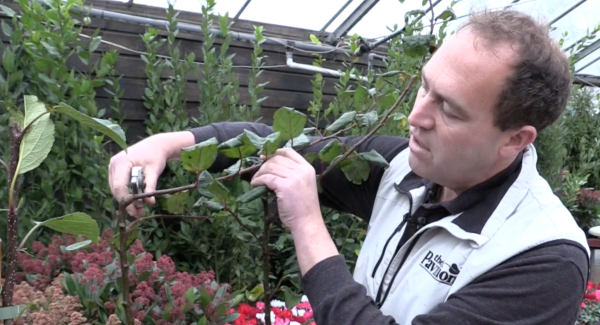
is your window for pruning apple trees.
All fruit should be harvested and either eaten or in storage by now, very soon the last of the leaves will drop from them and it is easier to see the shape and framework of the tree. Whether you are carrying out some restorative pruning on an old, established tree or some formative pruning on a newer specimen there are some general rules of thumb which will always apply, namely remove crossing branches, aim to achieve an open centre with good air circulation to help prevent fungal infections next year.
Remove any diseased growth from the tree, taking care not to leave diseased material around the base and try not to remove the fruiting spurs.
CONNECT WITH US TODAY



Be the first to know the latest news and updates