Vintage View: Domestic central heating
Modern central heating did not appear as an answer to the twin joys of the freezing back/roasted front of the Georgian fireplace at home.
It was born on the mill and factory floor to keep workers at their place during the freezing length of a 19th century winter. It was a luxury accorded to the tropical flowers and fruits in the greenhouses of the aristocracy.
The first ‘wet’ system, commonplace Ireland, first arrived to propagate commercial chickens. These first systems were brilliant feats of engineering using stoves, hot air and steam technology, promising the primal stroke of heat without the limits and dangers of open flame.
Steam based heating, still used on the continent today, was first mooted in the 16th century, but if there was a grand-daddy of modern central heating as we know it was William Strutt (1756-1830). Strutt was a true renaissance man. A bridge builder, architect, philanthropist and bold inventor, he had a whirling genius for setting mechanical solutions to design problems in the industrial landscape that was changing the face of Britain.
Like any English gentlemen with an education in the classical world, Strutt would have been aware of the ancient Roman hypocaust, a system where a flue carrying smoke and heat from a fire was conducted through the walls and floors of a building creating radiant heat for the rooms through the masonry and plaster.
The idea had its problems, not least that the uncombusted materials could and did lodge in the flues taking the whole building with it. In England, France and Russia the system was revived and used for warming greenhouses through the winter in the 17th and 18th centuries, but it had to be very carefully managed.
In the 1790s Strutt started experimenting with guiding clean air around a stove and on through around passages and ducts around a building. In 1819 these principles were incorporated into the Derby Infirmary (engineered by Charles Sylvester) which gifted patients a novel CH system that drew air (rather than smoke) up through a series of stoves placed around the hospital, venting stale air out through a glass and metal dome in the roof. The system was not forced, but used the science of hot air rising, moving it passively around the ducting. By 1834 the Houses of Parliament were not only heated and ventilated by political debate, but by a heating system based on Strutt’s influence at Derby.
Throughout the 19th century it was hot air that heated theatres, barracks and offices, allowing architects a bolder play of grand architecture for community buildings with a year round environment of reasonable comfort. The aristocracy and gentry, who were freezing their family jewels off in their great houses in town and down at the country seat- were crucial in this story. They had the money and curiosity to allow 18th century engineers like James Watt and Matthew Bolton, to have a go at taking the chill off places like Bowood Park, the seat of the Marquis of Lansdowne. Early passive and forced air and steam systems from the 19th century survive in many great mansions, orangeries and greenhouses, marked out by floor-grilles and fat pipes.
Steam heating was developed in parallel with air heating and would soon overtake it as a preferred method in Ireland the Britain in the 1800s, using the crucial new ingredient of a boiler, manned constantly by a dedicated engineer. Robertson Buchanan, and Thomas Tredgold led to the development of new surfacing to send heat out of a network of steam and water filled pipes into the wider atmosphere. Meanwhile in a chicken incubator in Paris, the prototype for today’s wet central heating system was bringing eggs to hatch.
French inventor, Jean Simon Bonnemain (1743–1830) only gets a line in most essays on central heating.
His wet system was the first well known commercial try at using the high pressure travel of water from a furnace to heat a proper building. Angier Marsh Perkins (1799-1881) of London brought in a small diameter pipe and boiled the water in a separate unit from the furnace for yet another gentrified greenhouse. With a few tweaks, finessing and more accurate control, domestic central heating as the ‘Perkins Hot Water Apparatus’ had really arrived for those who could afford it. Taking the combustion source out of the living areas and removing dangers of gas, it would literally change the way most of us live.
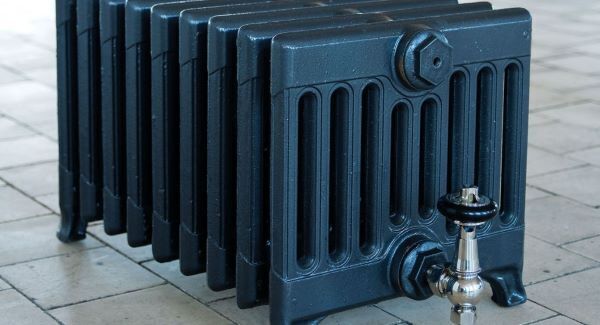
Radiators were fine tuned in Russia in the mid 1800s by Franz San Galli (1824-1904) providing a surface area for heat to release out and warm the space from water or steam filled pipes. A more upright thrusting shape made better use of the floor-space for a radiator, and the American Bundy Loop, developed by American Nelson H.
Bundy (c.1872), allowed a lot of pipe to be concertinaed into a stackable radiator sections. These ‘hot boxes’ caused huge society excitement, especially in the United States where their flamboyant, ornamental possibilities and the chance to showcase an expensive heating system, exclusive to the wealthy, made them a desirable buy.
Makers including The American Radiator Co (US and represented in Hull in England), Beeston Foundry (UK) and French factories were soon fighting it out for attention in a new marketplace, showcasing their fabulous cast iron beauties in New York, London and Paris. Yes- it’s true. Most of the heat from a radiator is actually convected using the air around it, despite the name- it’s a combined technology of air and water heating reaching right back to the work of Mr. Strutt.