Letters to the Editor: Women are active in action on climate
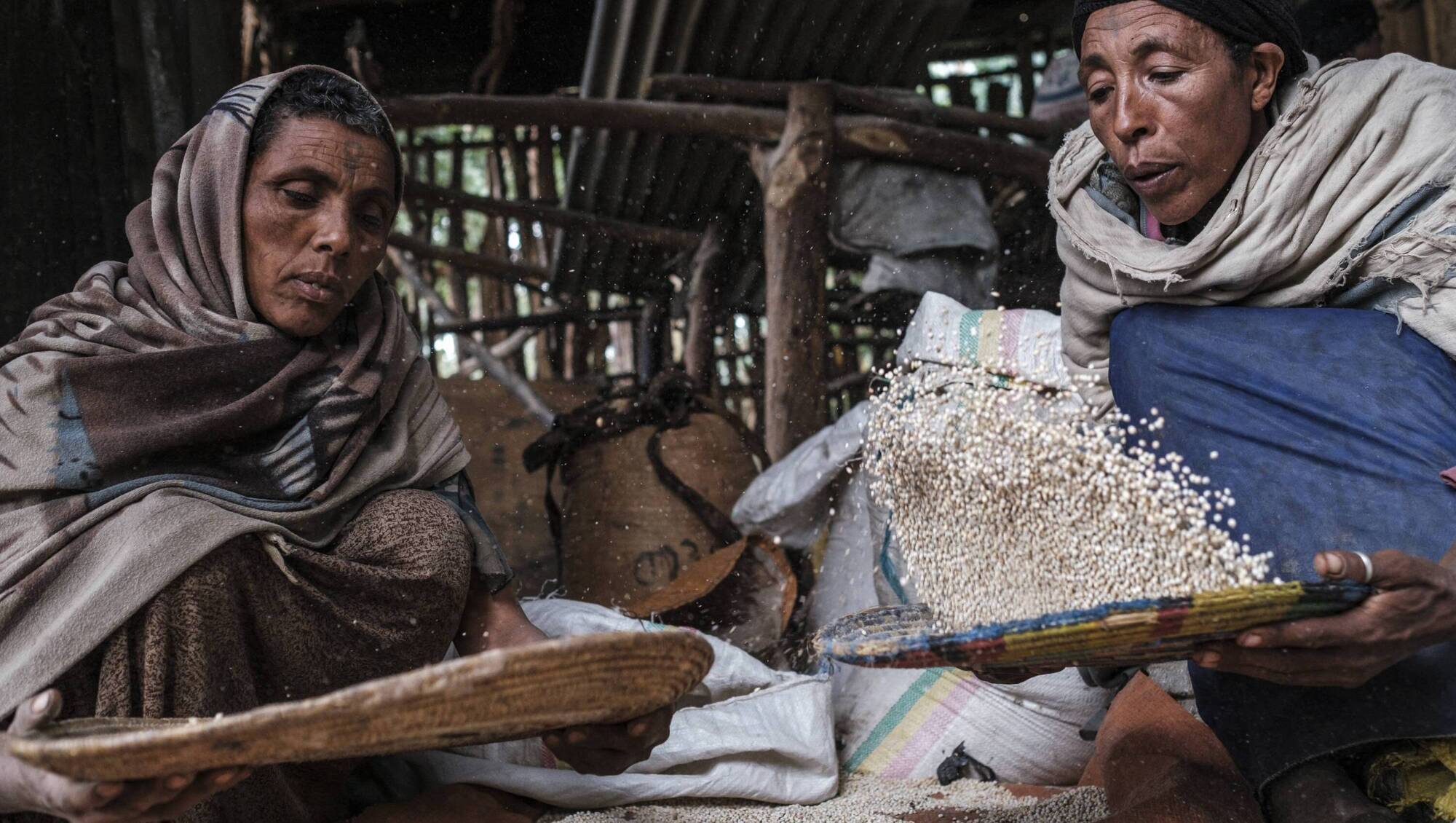
‘Women in developing nations are not passive recipients of support, they are active leaders in building resilient communities and creating long-term, sustainable change.’ Picture: Eduardo Soteras/AFP/Getty
I thoroughly enjoyed Ciara Feehely’s recent article — ‘The smartest climate action would be to trust, and invest in, women’ (Irish Examiner, July 13) — which brings necessary attention to the fact that the role of women in climate action is often overlooked.
However, women in developing nations are not passive recipients of support, they are active leaders in building resilient communities and creating long-term, sustainable change.
The examples of Ethiopia and Eritrea demonstrate how targeted development initiatives that support women and girls can address multiple challenges at once, from climate change to poverty reduction and economic opportunity.
Providing women with access to resources such as clean energy, safe water, and financial opportunities creates benefits that extend across entire communities and support future generations.
As climate change continues to increase pressure on vulnerable populations, particularly in developing countries, Ireland’s commitment to Official Development Assistance remains crucial.
Effective development assistance is not only about responding to immediate humanitarian crises, but also about supporting long-term solutions that empower communities to adapt to the changing climate.
This can only be achieved if Ireland continues to invest in effective development programmes instead of cutting back on aid spending at a time when it is needed more than ever.
As recent summers have made clear, wildland megafires are no longer a regional anomaly, but have become a global hazard.
The US National Aeronautics and Space Administration (Nasa) reports that, due to human-induced climate change, “extreme wildfire activity has more than doubled worldwide”.
Hotter temperatures evaporate soil moisture and dry vegetation, making it more likely to burn.
As physicist Phillip B Duffy stated: “What would have been a fire easily extinguished now just grows very quickly and becomes out of control.”
More intense wildfires are just one symptom of a much larger problem.
A study in the journal Science concludes that global soil moisture is in “permanent” decline because of our warming climate.
The drying of continents, driven by increased heat and evaporation, has been so pronounced that the transfer of water to the oceans has altered the distribution of our planet’s mass and affected Earth’s rotation on its axis.
As continents dry and water resources are polluted and overused, researchers warn that the world has entered an era of “global water bankruptcy” in which critical water systems can no longer realistically recover to their former state.
According to a recent report, the Colorado, Indus, Yellow, and Tigris-Euphrates rivers have undergone substantial changes in flow.
Moreover, “about 70% of the world’s major aquifers exhibit long-term declining trends”. This includes the largest groundwater reserve in the United States, the Ogallala Aquifer, which supports Great Plains agriculture.
As evidenced by toxic Canadian wildfire smoke drifting across the US, deadly European heatwaves, and rapidly expanding “mega-drying” regions in South Asia, the atmosphere has no borders.
As guests of this world, we must insist that our legislators enact policies to cut emissions, conserve water, and protect Earth’s life support systems on which we all depend.
Irish politics is looking less like public service and more like self-congratulation on repeat.
Open the social media accounts of the governing coalition parties and the formula is familiar: smiling faces, staged visits, ribbon-cuttings, announcements about announcements.
It is politics as content and governance as branding.
What you rarely see is the thing that actually matters: results. A politician’s face is not a policy. A post won’t reduce waiting lists. A selfie video helps nobody.
Government wasn’t built to run a marketing feed. It was built to solve problems: Build homes; cut waiting lists; deliver functioning public services.
Instead, we get consultations, working groups, action plans, reviews and an endless parade of political theatre marching from one news cycle to the next, while the problems remain exactly where they are.
Take the National Children’s Hospital. Promised for 2016, then 2018, then 2020 — “unless an asteroid hits the planet”, as the the then health minister put it.
Eighteen missed deadlines and €2.2bn later, the Sinn Féin spokesperson on health David Cullinane called it “a disaster from start to finish”. That project alone tells you everything about the gap between what gets promised at a podium and what gets delivered on the ground.
We’ve already paid for the reports, the consultations, the frameworks.
Irish politics has mastered the language of promotion, but it has not learned the discipline of delivery.
Until our leaders put the public’s needs ahead of self-promotion, public trust will keep doing exactly what it is already doing: draining away, in plain sight, one photo-op at a time.
Performative politics refers to political actions, speeches, or gestures designed primarily to capture public attention, project an image , or signal virtue, rather than to achieve substantive policy goals.
There is no doubt that performative politics prioritises optics, symbolism, and social media over legislative results.
Recently we learned about the cost of deportation flights. I wonder could these deportation flights be put under the rubric of performative politics?
We criticised the last Tory government in Britain, which went out in 2024, for these performative issues in relation to using Rwanda as a third country.
If somebody came from different countries, they would be ejected from Britain, and they would be deported to Rwanda.
A large part of this stratagem was getting the photo opportunities of the flights bringing these people out.
Although we have had limited amount of photographs from the Irish government of deportation flights, we are still having them.