Letters to the Editor: Patchwork of independent TDs would fail to govern
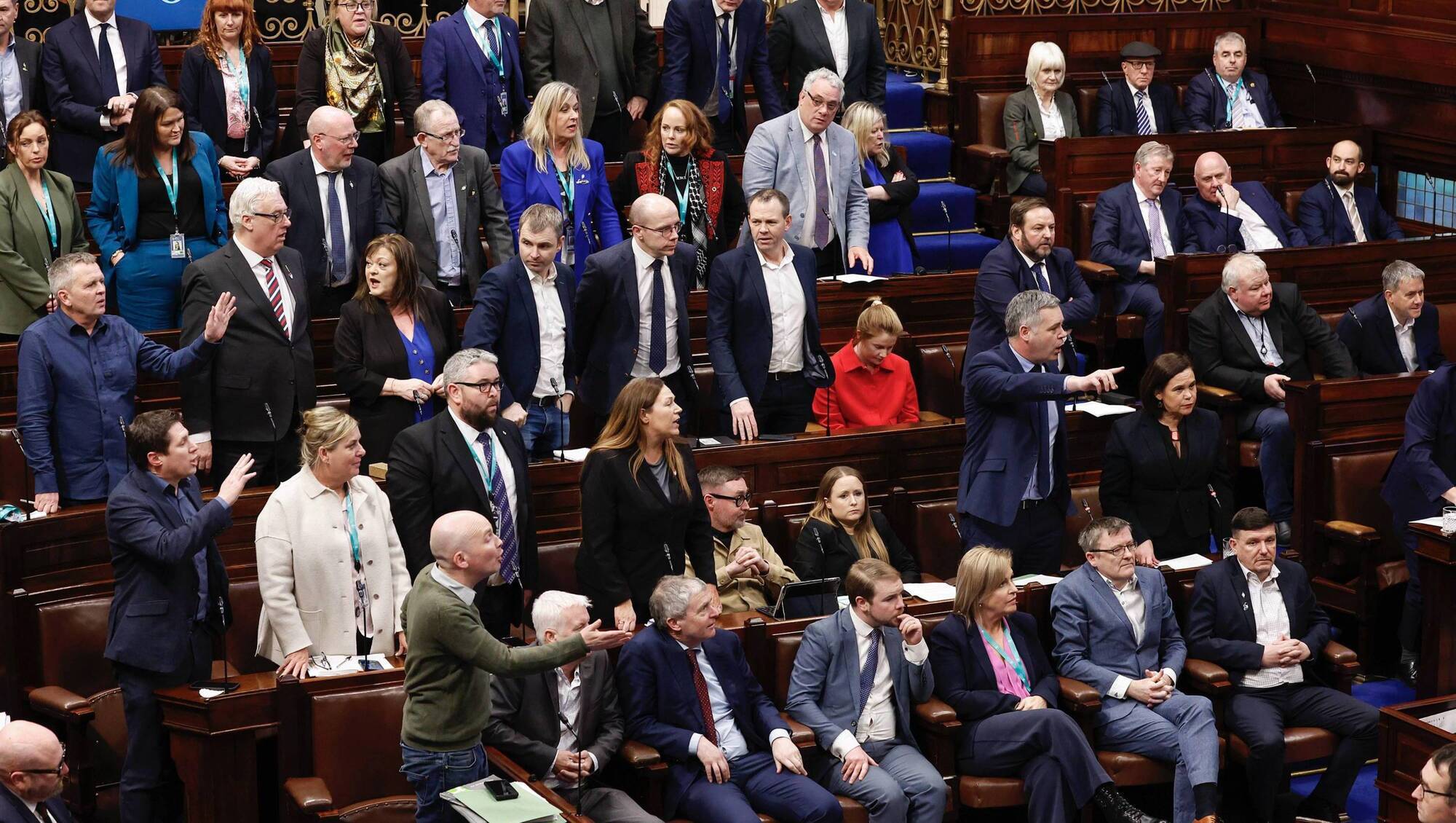
Opposition party TDs and a 'patchwork' of independents in the Dáil chamber. File picture: Houses of Oireachtas
It is always easier to say what you are against than what you are for. It is always easier to say that you would have done things differently with the benefit of hindsight.
Independent opposition TDs can be all things to all people, pump up the volume, farm a small patch on a Monday, trawl the broad ocean with promises to do the devil and all on a Tuesday, float conflicting ideas on a Wednesday, face in all directions on Thursday, fan sectional grievances upward on a Friday, and see if they prosper on the national airwaves, the internet, or in the papers over the weekend. It is far too easy to do.
In government, you have to decide upon a policy in the present with imperfect information about the future. You have to put it into effect and live with the real world consequences of your decisions at a national level. It is an entirely different business because to govern is to choose and those choices carry consequences. The respective candidates in our elections should be weighed and measured on that basis and we are not striking that balance.
Until recently, I believed that having a disparate and numerous contingent of colourful and sonorous independent TDs in the Dáil was a healthy sign in our democracy. I didn’t take the increasing normalisation of heckling, disorder, and general disruption on the floor of our national parliament seriously enough.
As recent weeks have shown at our refinery, tunnels, motorways, main streets and ports, strident oversimplifying demagoguery is a wild gas that has a tendency to spread.
Teachtaí Dála have a responsibility to their wider society to set and show good example when they debate the issues of the day on the national stage inside and outside of Leinster House.
There are many valid criticisms that can be made of the present government. That is true of every government. A strong, vigorous and effective opposition is indispensable to the proper functioning of the state.
However, politics is the only profession where experience and stable continuity are reflexively chastised by many of its practitioners. Our electorate has, since independence, shown itself to be cool, calm, and collected for the most part.
It has always had an innate understanding that governing a country is harder than it looks, that promises are easy to make and good policies are hard to devise and effect.
Until recently, we understood that the Dáil is a national legislative assembly that elects the executive branch of government and you can’t run a modern developed country effectively from a fluctuating hyperpartisan scrum of permanently agitated independents.
We have some excellent independent TDs in the Dáil. But we are electing too many independent TDs overall. If this trend continues, the parliamentary arithmetic that results will eventually make the formation of stable and effective government in this country impossible.
This is a difficulty that cannot fairly be fastened on any individual candidate but it is long past time that it entered the thinking and discourse of every fair-minded voter and commentator.
As a nation, we need to discuss and consider the fact that political fragmentation is more of a choice than an event and as such, it is a choice that can have very serious consequences for the country as a whole. A patchwork of independents will not produce clockwork and the bell tolls for everyone every time one starts roaring and heckling in the Dáil.
As one who regards marriage as the backbone of civil society, I was disappointed to read in the recent Central Statistics Office data that the number of marriages fell from 22,045 to 20,348 between 2014 and 2024, a 7.7% decrease ('There were only 33 more Catholic marriages than civil ceremonies in Ireland in 2024', Irish Examiner, April 25).
Roman Catholic Church marriages were the most popular in 2014 at 13,071. By 2024, they had fallen by almost 51% to 6,425, relegating them to second most popular choice after civil marriages at 6,743.
As a committed Catholic, the decline in marriage rates and the revelation that Roman Catholic ceremonies fell from 91% of all weddings in 1994 to 34% in 2023 concerns me.
Admittedly, modern Ireland is a more secular society but the freedom to practice our faith was hard won by those who fought and died for a democratic republic.
Daniel O’Connell, The Liberator, who won Catholic Emancipation in 1829, maintained that Catholicism was the heart and soul of the Irish nation and often referred to it as the “national Church”.
The unbreakable bond between the Irish Republic and Catholic marriage was exemplified in blood sacrifice by the Easter Rising patriot Joseph Mary Plunkett who wed Grace Gifford in the prison chapel of Kilmainham jail, just hours before his execution by firing squad. In his final words to the priest who married them, Joseph said: “Father, I am very happy. I am dying for the glory of God and the honour of Ireland.”
Keep the faith and be proud of your Catholicism. Tie the knot in a Catholic church to receive the grace and blessings of the sacrament of matrimony for a long and happy life together. This is your lovely day. The day you shall remember the day you’re dying.
By removing the triple lock, Ireland is simply taking back control of the decision-making process regarding the deployment of our Defence Forces overseas ('Ireland must retain triple lock to protect peacekeeping role, says former PDForra chief', Irish Examiner, May 3).
By giving foreign states the ability to prevent the deployment of our Defence Forces by vetoing such deployments at the UN, is merely a dilution of our sovereignty. No other European country has such a restriction on the deployment of their forces.
Removing the triple lock has no bearing on our ‘neutrality’. Many would rightly argue that the State has never been strictly neutral. The assistance given, rightly, to allied forces during the Second World War has been a case in point.
From the time Ireland first considered joining the then EC, the government at that time made it clear that we would be willing to participate in European defence, and that the neutrality issue was not an obstacle. Sean Lemass clearly stated in 1960 “there is no neutrality and we are not neutral”.
Decisions regarding the deployment of our Defence Forces should be made by Dáil Éireann alone, without recourse to foreign governments. Ireland, has benefited greatly from its membership of the European Union, and as Lemass once stated, if it was worth joining, it was worth defending.