Letters to the Editor: Micheál Martin in danger of being the 'careful now' Taoiseach
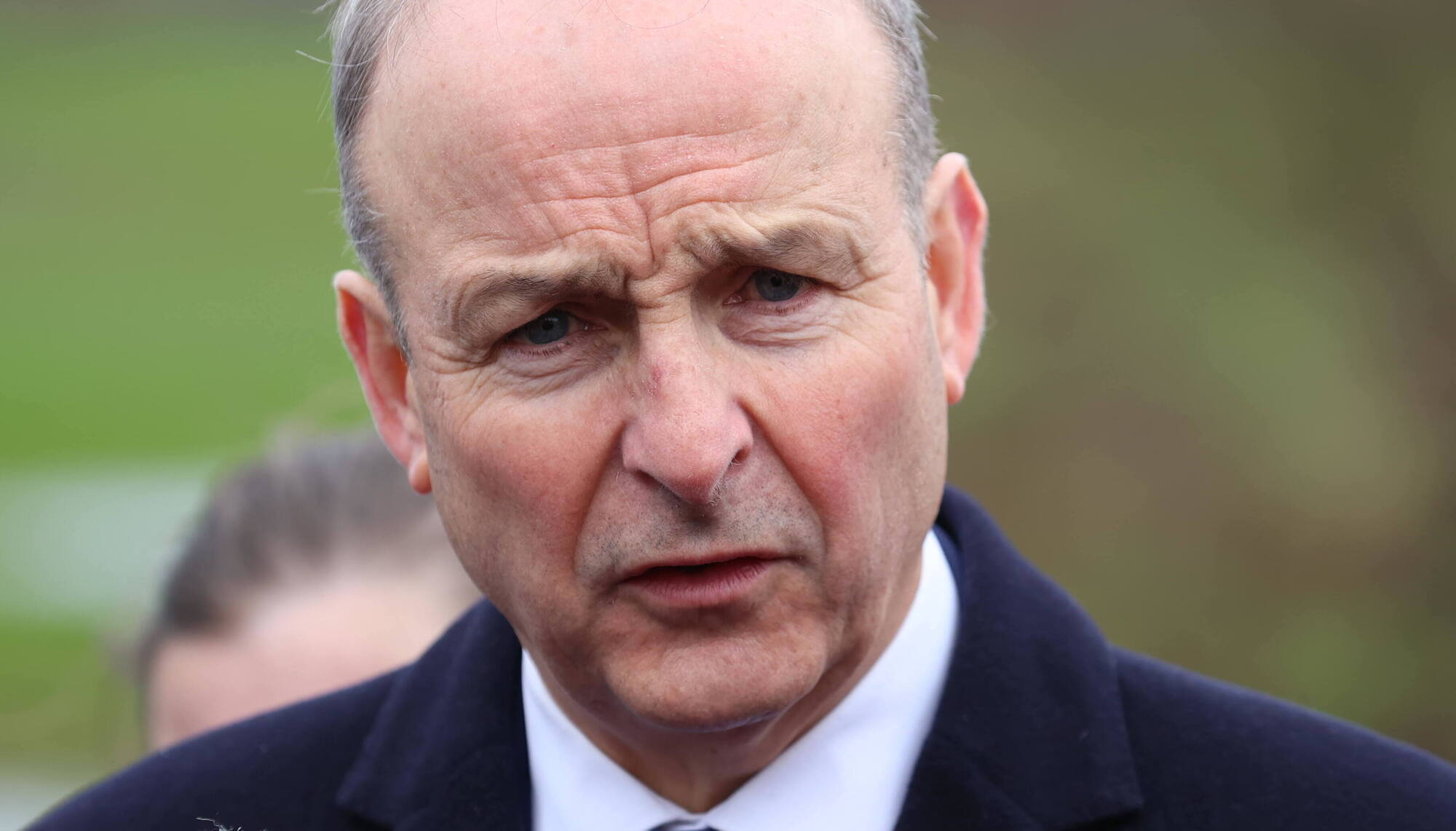
Fintan Lane writes: 'Indeed, Mr Martin lobbed in yet another excuse for even more procrastination around the Occupied Territories Bill, despite the promises made regarding implementation before the last general election.' Picture: Liam McBurney/PA
Judging by a recent newspaper interview, Micheál Martin is in real danger of being remembered as the ‘careful now' Taoiseach.
His advice to the EU, for example, was to moderate its criticism of US president Donald Trump, and he stressed the economic benefits of a good EU-US relationship.

This all sounds fine, of course, until we recall that Mr Trump is currently trying to dismantle international law and undermine established multilateral bodies such as the UN, not to mention his threats to Greenland, and the lethal assault on Venezuela.
The next country on his list for punitive military action appears to be Iran, an attack for which he has not sought any mandate from the UN and which would constitute a clear breach of international law.
Regarding the Occupied Territories Bill, Micheál Martin in his interview likewise urged caution — inertia would be a more accurate description — and said we must be “sensible”, lest we upset powerful people in the US.
Indeed, Mr Martin lobbed in yet another excuse for even more procrastination around the Occupied Territories Bill, despite the promises made regarding implementation before the last general election. He remarked:
This is like a line lifted from the classic comedy TV series .
Either this Government is hopelessly inefficient or it is attempting to shuffle those concerned about Israel’s behaviour in the West Bank down a long and winding garden path. Of course, it could be a bit of both.
Meanwhile, Israel’s illegal settlements in the Occupied Palestinian Territories continue to aggressively expand. Israeli government ministers have boasted that the plan now is to divide the West Bank to make a functional Palestinian state impossible.
You grow up hearing it: men don’t cry, boys must be tough, children learn respect from the back of a hand. In Ireland, this isn’t just old-fashioned advice, it’s a legacy of pain, fear, and hypocrisy.
For centuries, life here was brutal. Famine, colonial rule, grinding poverty. Toughness wasn’t optional, it was survival. Vulnerability was dangerous. Masculinity meant endurance, authority, and control. And yes, hitting children was normal, even praised as moral guidance, because fear was easier than teaching love.
Then came the Church. Catholicism controlled every corner of life, dictating school, law, and social behaviour. The Bible preached love and mercy, but most people couldn’t see past the rules and the rituals. You could go to Mass every Sunday, genuflect, and pray your eyes out, then come home and scream at your kids, punish them for showing weakness. Devotion was often just a mask for cruelty.
This isn’t nostalgia, it’s generational trauma echoing through fathers and sons. And yes, times have changed. Many of us refuse to repeat it. Warmth, empathy, emotional honesty, things that were once signs of weakness, are finally being allowed in.
Ireland’s obsession with toughness and performative religion left a legacy of hypocrisy and fear. Understanding it doesn’t excuse it, but it explains why the men we grew up with could be holy on Sunday and monsters the rest of the week.
Recognising that pattern is the only way to break it, and finally let real love, and not fear, run in families again
There is a lot of unnecessary concern about the great AI replacement making professions obsolete.
People seem to have forgotten that you can now date an AI girlfriend or boyfriend. So, if your employment is affected, just marry an AI with a good job.
Labels belong on bottles. And bumper-sticker philosophy is of little comfort to sika deer in Ireland.
Sika deer (Cervus nippon) were recently classified as an invasive species under the EU Biodiversity Strategy for 2030, a document that commits member states to managing established invasive alien species (IAS).
IAS refers to animals and plants introduced — accidentally or deliberately — into environments where they are not normally found, and which are believed to have serious negative consequences for their new ecosystems.
The sika deer, also known as the Northern spotted deer or Japanese deer, is native to East Asia. Four sika were imported into Ireland in 1860 and released into Lord Powerscourt’s Demesne in Co Wicklow.
The European Commission maintains a list of species deemed undesirable — species that, at best, must be controlled and, at worst, eradicated. It currently contains 114 species: 65 animals and 49 plants.
Ireland, through its various government departments and stakeholders, is now obliged to introduce management measures within 18 months to limit the sika deer’s perceived impact on biodiversity, ecosystems, human health, and the economy.
Yet following the maxim “if they are here, they are Irish”, sika deer have long since naturalised and established their niche in the Irish countryside.
Despite being seen as living targets by the deer-stalking community, sika deer coexist with minimal impact on their environment and little disturbance to the human population.
With the label of “invasive alien species”, sika deer could now face year-round hunting, with killing methods that fall outside firearm and canine regulations, and inclusion in yet another government-approved culling programme — programmes that have already claimed and continue to claim the lives of badgers, Irish hares, and red, fallow, and Muntjac deer.
Words like invasive, pest, vermin, and forest rat are being used as explosive shells in a linguistic battle that seeks to create the climate where our wildlife species can be dismissed, devalued, and ultimately destroyed.
Once we allow language to strip animals of their legitimacy, killing them becomes easier to justify.
We should be deeply wary of any narrative that turns living, naturalised creatures into targets.
During her many years in public life, Mary McAleese has spoken both to me and for me, and so she continues to do so in her recent podcast with two students at her former school, St Dominic’s in Belfast.
Therein she described some Catholic Church teachings as “rancid”, citing issues pertaining to human sexuality, contraception, and the role of women.
I was raised, like most of my generation, as a ‘god fearing’ member of the Catholic Church.
Having, throughout my life, witnessed its grievous wrong-doings, the arrogance of its theocracy, and its obduracy in continuing to exercise exclusion, I have become utterly disillusioned with the institution, and yet I have ‘hung in there’ in the ever-fading hope for a miracle of enlightenment.
Maybe the fire that our former president still endeavours to kindle will eventually illuminate a horizon for a fit-for-purpose institution.
While many Irish people have turned away from the Catholic Church, they are still able to get their Sunday morning fix of condescension and perceived wisdom without having to leave the house. It comes in the form of Brendan O’Connor’s newspaper review panel on RTÉ Radio One.
The host himself has rediscovered a patronisingly pious version of a character he once portrayed, Father Brian.
Together with his council of soi-disant liberal eucharistic ministers, he calls on his flock of listeners to expiate themselves for their acts of “wrongthink” over the past seven days.
He finishes up by thanking his saintly panel of expert guests for their miraculous efforts in redirecting the sinful masses towards the virtuous path.
In BOC we trust.