Letters to the Editor: Chernobyl Children International advocate says we can turn back the hands of the doomsday clock
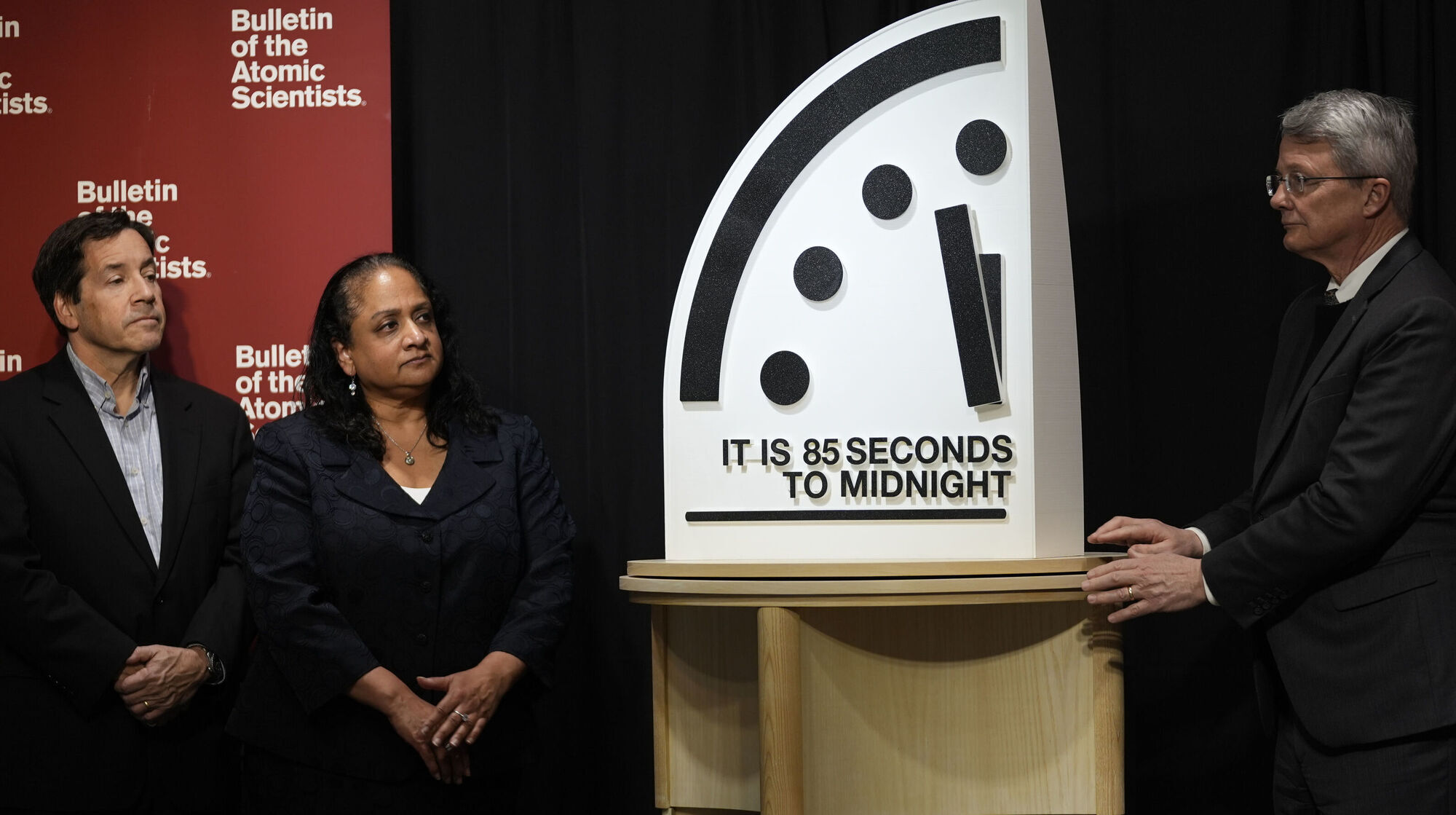
Jon Wolfsthal, Asha George, and Steve Fetter revealed this week that the Bulletin of the Atomic Scientists Doomsday Clock had bee reset to 85 seconds to midnight. Picture: Pablo Martinez Monsivais/AP
The decision by the Bulletin of the Atomic Scientists to move the doomsday clock to just 85 seconds to midnight earlier this week should alarm every government and every citizen. Humanity has never been closer to catastrophe, and the world has never been more unsafe.
This decision reflects a convergence of existential risks, all of which are man-made. The war in Ukraine, the weaponisation of nuclear power, climate breakdown, and the rapid erosion of international arms control agreements together create what the scientists describe as a time of “unprecedented danger”.

Of particular concern is the collapse of the New Start Treaty, the last remaining nuclear arms control agreement between the United States and Russia.
Its effective ending removes one of the final guardrails restraining the world’s two largest nuclear powers.
As voluntary chief executive of Chernobyl Children International, I cannot overstate the danger of this moment.
The ongoing occupation of the Zaporizhzhia nuclear power plant and the recent attack on the Chernobyl nuclear power plant demonstrate a terrifying shift in modern warfare. Nuclear facilities were never meant to be battlegrounds. The risk of disaster, through accident or design, is now perilously and unacceptably high.
As we approach the 40th anniversary of the Chernobyl disaster this April, the world must remember that nuclear catastrophe is not a theory. It is a lived reality for millions of people. Chernobyl is forever. The suffering did not end when the Chernobyl fire was extinguished … and neither would the consequences of any future nuclear disaster.
The Doomsday Clock is a diagnosis of our reality. It must serve as both a wake-up call and a call to action for real, true peace. Yet, this is not a moment for despair. It is a moment for courage and hope. We can, if we choose, turn the hands of the Doomsday Clock back next year.
The existential threats we face today are all created by human decisions. That means the solutions are also human. Through co-operation, diplomacy, and moral leadership, it is still possible to reverse our current trajectory towards catastrophe.
If we remain silent, we are playing with a loaded gun. Each of us has a responsibility to speak out, to demand better from our leaders, and to insist on a future built on peace rather than fear.
Human problems require human responses. With courage, co-operation, and a belief that change is possible, we can still choose life over annihilation, and hope over despair.
The hands of the Doomsday Clock were moved by scientists. They can only be turned back by humanity.
The ongoing Grok abuse scandal perfectly embodies the perils of Ireland’s reliance on foreign multinationals.
The State has become so beholden to a private US company for public service announcements, it’s resorting to equivocation on responsibility for child abuse material on that platform rather than risk losing it.
We embraced a communications monopoly and, in the absence of meaningful competition or a state-owned alternative, we’re now effectively at the mercy of that same monopoly.
On January 13, Micheál Martin defended the Government’s gutting of the Occupied Territories Bill, in part because it would have “...legal consequences for US multinationals here”.
The Irish people overwhelmingly support the proposed legislation. The leader of our country told us he cannot enact the will of the people, not because it conflicts with Irish or EU law, but because it conflicts with anti-boycott legislation in the United States.
In any other context, a world leader telling the electorate that foreign money has compromised the government’s capacity to enact the will of the people would be treated not just as a scandal worthy of resignations but as a threat to national security. It is only because the money is coming from the US that we appear to be treating this as “normal”.
As the now infamous shamrock ceremony approaches, we should ask ourselves why we measure the success of such a diplomatic endeavour in terms of how well the Taoiseach endures humiliation from a supposed friend and ally? Doesn’t that urge to mollify Trump while a nation holds its breath belie the idea that this is a friendly meeting? The truth is we are behaving as a vassal state would. In our case, the US did not conquer us with military might but with money. What’s worse is we opened the doors and begged them to come.
At Davos, Canadian prime minister Mark Carney laid bare this comfortable lie that we’ve all been participating in. He also exposed the very weakness that we pray won’t be exploited every time a Taoiseach sets foot in the Oval Office.
We are one of the subservient states who “compete with each other to be the most accommodating”. We are in a race to the bottom. It’s a race we will inevitably lose.
Right now we have a choice: Continue to cede our sovereignty and our dignity to US capitalists in the hopes of delaying the inevitable, or rip off the band-aid now and join those nations working to build real, sustainable, alliances.
Last Friday, we had the unfortunate experience of arriving back at Heuston Station from a very pleasant short break in Westport only to discover that our car, which we had parked in the set down area in a disabled space and putting up our blue badge fully believing we were OK to do so, had been clamped.
We were met as we approached our car by Gerry, a station manager who had the unpleasant task of telling us we had our car clamped.
Seeing our upset, shock, and obviously really believing that we thought we were ok to park there, he interceded on our behalf with the clamping company. Following his pleading on our behalf, he was successful in convincing the company to remove the clamp for free.
We had arrived at Heuston at 1.15 pm and, as Gerry was finishing his work shift at 3.00pm, he gave us his number and stayed in touch with us.
As the clamping company had not arrived by 3.00pm, he still kept in touch with us and kept us updated. Finally, by 4.00pm, we were free to go.
At a time when we hear so many complaints about some of our services, we would like to compliment Heuston Station and Gerry for their support when we needed help. We are both senior citizens, and the compassion shown to us was really appreciated.
Our thanks to Gerry and Heuston Station for their help, and we will not be parking there again.
Since it reopened, there has been a great deal of negativity and anger about the design, cost, and naming of Bishop Lucey Park in Cork city centre.
Yet, as I left the bustling crowds on Oliver Plunkett St and the Grand Parade and walked into the deserted park, I felt that perhaps we were missing the architects Hall McKnight’s underlying concept.
To me, looking out from the looming soviet mausoleum, the lifeless expanse of gravel before me looked like a mass grave.
I now wonder if Hall McKnight’s bleak vision is intended to remind us of the countless innocent women, condemned to a life of slave labour and grinding misery in the Magdalene laundries under the authority of men like Bishop Cornelius Lucey.
It is a grim coincidence that, while Cork City Council was spending millions honouring the “great man”, it was also rubber stamping a massive luxury student accommodation development that will obliterate the suspected unmarked graves of the victims of the Magdalene laundries in the Good Shepherd Convent, Sunday’s Well.
Our city planners imposed no requirement to look for their remains.
I will remember them when I walk past the park.
Ireland assumes the presidency of the European Union in July. This is a leadership position in volatile times. One area in which we are under-equipped to lead is that of our own defence and national security.
This does not stand us in good stead with fellow Europeans from whom we have received so much since 1973.
Our European allies are aware that we spend 0.25% of GDP on defence.
Ireland has a population 5.3m. Ireland’s Defence Forces number 7,530 full-time and 1,700 reservists in total.
In comparison with similarly populated countries, Denmark (population 5.97m) spends 2.5% on defence and has 21,000 full-time personnel and 63,000 reservists and home guards.
Finland (population 5.6m) spends 2.4% of GDP on defence and has 24,000 full-time personnel and 280,000 reservists. Yes, their histories are different from ours, but the challenges faced in 2026 are the same for us all.
It will not happen overnight, but governments can plan to upgrade defence and security capabilities and commit to this objective for some time to come.
A neutral country, for the concept to be meaningful, must be able to defend its sovereignty.
Ireland can respond responsibly, proportionally, and realistically to the pressures facing Europe whilst maintaining resilient neutrality.
Government and opposition can look beyond the short-term electoral horizon which has been unhelpful in the past and take a lead in guiding these responses in all our interest.
Donal Lenihan’s recent column on Munster rugby ('Time to discuss Munster’s elephant in the room', January 21) is disappointing because it reduces complex challenges to a familiar caricature of weak leadership and parochial politics.
Munster’s reality is shaped less by internal dysfunction than by structural constraints: Smaller budgets, limited squad depth, and a player-production model that simply cannot mirror the utility of a schools-driven pipeline.
These are demographic facts not failures of vision.
The old trope that Munster must move marquee games to Cork is misplaced.
Lenihan refers to Glasgow Warriors and lauds their recent success which, ironically, has arisen while remaining at their home ground Scotstoun, capacity around 7,500.
If capacity were genuinely the issue, the Gaelic Grounds venue, less than 1km from Thomond Park, would offer an obvious alternative. Framing this as a Cork-versus-Limerick issue distracts from more meaningful strategic questions.
But what club, of any sporting persuasion, would not want to play their games at a stadium with a history like Thomond Park.
YouTube “the Munster haka”, “the miracle match”, “The Northampton drop goal”, or “the chabal destruction”, and read the comments. Your typical high-performance guru will dismiss this as nostalgia, but ask players like Dan Carter or coaches like Graham Henry for a different view.
Munster’s 2023 URC title did not come from nostalgia or chaos but from coherence and intelligent use of limited resources.
Honest debate is welcome but, if Munster rugby is to move forward, it will be helped more by clear-eyed realism than by repeatedly rehearsing the same familiar accusations.