Letters to the Editor: Car is king in Charleville road plans
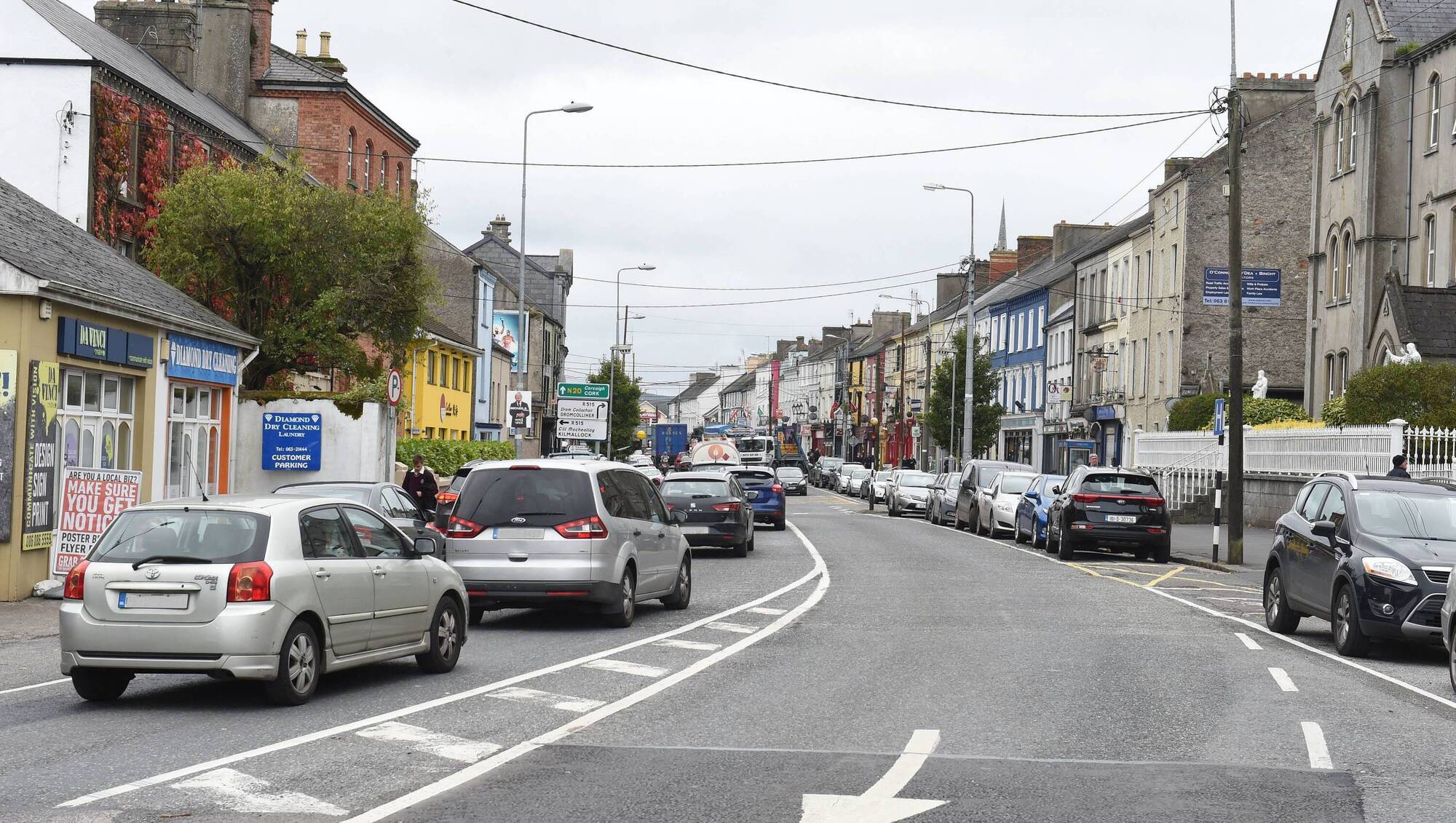
The issue of pedestrian safety in Charleville remains. File picture: Larry Cummins
Having read Sean O’Riordan’s article — 'Charleville traffic plan to be unveiled today' ( , November 29) — I mistakenly believed the consultation in the Charleville Park Hotel would focus on protecting pedestrians, and perhaps offer an opportunity to highlight the needs of another vulnerable group: Cyclists.
It did not; the meeting was about relief roads.
As a society, when it comes to transport, the car remains king. Yet the reality is there are more pedestrians than drivers, and within this group are our most vulnerable citizens — particularly older people and children.
When a pedestrian makes contact with a car, the worst they are likely to cause is a small dent. When a car hits a pedestrian, the consequences can be life-altering or fatal.
Relief roads or not, people will still be crossing roads in Charleville — often in dangerous ways — and traffic will still pass through the town.
Relief roads feel somewhat “pie in the sky” when the long-discussed N20 upgrade has remained unrealised for more than 30 years.
One can’t help feeling these two proposals risk cancelling each other out. Of the nine options presented, one was “do nothing”, which may well be the eventual outcome, as any of the other eight will inevitably attract objections.
Meanwhile, the issue of pedestrian safety in Charleville remains.
So what practical steps can be taken now?
The council’s traffic-calming speed bumps are a welcome measure, but the bigger challenge is human behaviour. Perhaps we need to apply more behavioural psychology thinking to encourage — or “herd” — people toward using existing crossings.
Two simple suggestions are the installation of bollards along footpaths and painted warnings on pavements.
As a cyclist in a town with virtually no cycling infrastructure, I believe facilities for cyclists would also make conditions safer for pedestrians; drivers tend to be more cautious where cyclists are present.
Opportunities to speak directly with council road engineers are uncommon, so although I misunderstood the purpose of the consultation, I took the chance to raise my concerns.
The engineer I met understandably stayed focused on the consultation’s specific remit and showed little interest in broader issues affecting vulnerable pedestrians and cyclists.
I also learned that the proposed relief roads do not include cycling facilities, despite similar projects in places like Mallow doing so. That is welcome news for Mallow residents, but less so for us.
I may well have misunderstood the engineer, but I left with the impression that council departments are not working collaboratively, despite initiatives like active travel projects and the county development plan that in principle support better infrastructure for pedestrians and cyclists.
I would like to thank the council for hosting these events. Even when our perspectives differ, it is important — and appreciated — that we all have the opportunity to have our say.
In the third quarter of 2025, Bermuda had the highest household electricity prices worldwide, followed by Ireland, Italy, and Germany.
Irish households were charged around $0.44 per kilowatt-hour (kWh). By comparison, Norway’s average was just $0.16/kWh.
With wind, batteries, and solar providing an ever increasing amount of renewable energy year-on-year, is it now time to consider breaking up the All-Ireland electricity market into regions such as they have in Norway?
Norway is divided into five zones (NO1-NO5), creating different electricity prices across regions due to local supply/demand and grid constraints, with significant price variations between southern/western areas (often higher) and northern/central areas (often lower), driven by hydropower balance, transmission bottlenecks, and regional consumption.
With Kerry and Cork supplying the vast bulk of renewable wind energy it would mean — using the Norwegian model — that electricity prices in the South-West could be much cheaper than areas that haven’t invested as much in renewable energy and who also happen to have the highest electricity consumption.
Perhaps the answer to our extortionate electricity rates is more competition in the island of Ireland rather than looking outwards.
I view e-scooters with a mixture of envy, fear, and hatred. Firstly, they should have been invented 20 years earlier, when I was commuting over 20km a day on my bike between work experience and college.
They certainly would have increased my cool factor among the teens I was working with.
However, I fear them as a pedestrian and hate them as a driver. I see them as mini death-traps. I can see why criminals would choose them. They are hard to see.
A vertical black line, even a horizontally moving one, does not stand out.
I don’t want to use a device that makes me almost invisible to other road users. It doesn’t seem safe.
Please can somebody stick a QR code on each one and demand a driving test and registration too?
Any of the bicycles with motors should also have them. I could go on, but then I would reveal that this is really a long overdue rant.
Given the debate and survey about religion in schools, it is worth remembering that faith formation is an essential life skill. The teacher who looks out at a primary school class, knows that every single child will, in their lifetime, have to face into trauma and crisis.
While general information about different religions is interesting, it is no substitute for the faith formation (according to the child’s background), which will empower them to cope with the knocks that are a part of every life.
While doing voluntary social work, I have had the opportunity of befriending many people who are carrying the burdens of serious illness and advanced age.
Without doubt, those who have held on to the faith formation which they received in their primary school days are the most successful in embracing their present situation and making sense of it.
I was speaking recently to a middle-aged man who is bravely dealing with the life-changing effects of major surgery. He said: “It is my faith, as well as good medical care, that is getting me through this.”
If we downgrade or remove faith formation from our schools, we will deprive the next generation of a powerful shield that would enable them to deal with dark days.
An opportunity to assert the right of Catholic women to equality in the Catholic Church was thrown away by a misogynistic group of Vatican-appointed theologians by the publication of their decision to exclude women from the order of the diaconate.
There is no justification in scripture or Christian tradition for such a ludicrous and demeaning decision. There is no doubt that this decision was already preordained by the decision of Pope Francis to pack a supposedly open-minded commission with ultra conservative theologians whose misogynist views against the ordination of women deacons were known.
This pre-ordained decision is a mockery of and an insult against the views of the vast majority of Catholic women who find this ingrained prejudice and patriarchical structures totally unacceptable.
A recent poll reported that 38% of Gen Z women aged between 18-24 now identify as religiously unaffiliated — a notable statistic that sits higher than their male peers.
This latest Vatican decision will doubtlessly intensify this trend especially among Catholic women.
Michael Moynihan decries the concreting-over of the forecourt of the old Blackpool fire station and the removal of a tree — “Cork is still waiting for task force while our green spaces disappear” ( , December 4).
Cork City Council’s Eoin English wrote a letter — “Blackpool tree” (December 5) to state the tree had “uplifted” and posed a threat to adjoining properties and “health and safety”.
He failed to explain, however, how the blades of grass might have threatened “health and safety”.
Why did the city council opt for the lazy option of smothering the place in impermeable concrete instead of planting a healthy sapling or two and upgrading what was there?
Every bit of green space is precious to us who live in or love Blackpool. Cork City Council’s love affair with concrete continues apace to the detriment of the natural environment.