Letters to the Editor: Gross carnage by Israel justifies widespread public protests

A reader says we should be doing all we can to highlight the plight of our deprived brethren in parts of the world where violence is widespread
Letters to the Editor: Gross carnage by Israel justifies widespread public protests

Dunnes Stores workers on strike outside the Henry St, Dublin store in 1985. Picture: Eamonn Farrell/Photocall Ireland

Ever since Russia’s invasion of Ukraine, public concern appears to be declining. 

Clearly the violence and bloodshed of war is not impacting the global population as much as before. 

In fact, in our own personal lives, many of us are now deliberately shutting out watching or listening to content that shows or highlights horrendous genocide and bloodshed. 

This suggests that we have, to some extent at least, become oblivious to violence in other parts of the world — including Gaza and Ukraine.

Those of us who live in a free world, without the threat of genocide and bloodshed, should at least appreciate just how privileged we are, and should ideally do anything we can to highlight the plight of our deprived brethren in other parts of the world where violence is widespread.

Irish people, in particular, have a long history of resisting suppression and highlighting injustice, which may be a legacy from centuries of campaigning for our independence.

In addition, more than 41 years ago (in July 1984), one of the most iconic strikes in history took place in Dunnes Stores in Henry St in Dublin, when 10 young Dunnes Stores workers refused to handle goods from apartheid South Africa because of how the all-white government there treated black people.

This courageous and selfless act led to a strike lasting two years and nine months. In hail, rain, and snow, the workers maintained their pickets without pay for millions of oppressed people they had never met. 

The strikers were abused by picket breakers and victimised without pay by their employer.

Yet, they held their ground and eventually forced the Irish Government to ban the import of all South African produce.

For their actions, these workers were lauded by Nelson Mandela, who said that the strikers demonstrated to South Africans that “ordinary people far away from the crucible of apartheid cared for our freedom” and also helped him keep going when he was in prison.

This proves how effective people power was in 1984, which helped to bring apartheid to an end by 1990.

Sadly, over 40 years on, the geopolitical situation has drastically changed for the worst, with Kneecap rap group being criticised in Britain for rightfully stating that Israel are war criminals.

Also, the approach of the EU Commission is highly disturbing.

This especially includes the role of president Ursula von der Leyen, who has failed to directly condemn Israel for war crimes in Gaza, involving the slaughter of innocent civilians including women and children and babies dying of malnutrition.

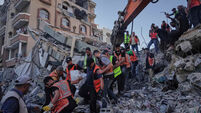
This gross carnage justifies widespread public protests, not only in Ireland but throughout Europe and the Western world, which might help to isolate Israel and force them to stop the killing of people.

Diarmuid Cohalan

Ballinhassig, Co Cork

Corporate elitism in an amateur sport

The choice of language used by the Mayo County Board in sacking its management team was disgusting.

Exactly what might be expected of the owners of an English Premier League club when sacking a manager and, indeed, even then not always so.

Gaelic football is an amateur sport. An amateur sport that is now garnished with the worst aspects of corporate professionalism and elitism.

Major fixtures behind pay walls; highly paid officials; corporate boxes; exorbitant ticket prices — all totally based on the efforts of unpaid amateur players.

Jarlath Burns needs to have a chat with his full-time permanent officials.

Pundits speak of managers losing the dressing room. If GAA HQ is not careful, it may well lose a lot more than that.

Mayo are a proud GAA county.

An apology should be issued from HQ with an assurance that county management teams will be treated with respect in future.

An opening phrase that a manager “has been relieved of his duties with immediate effect” undermines whatever weasel words may follow.

Larry Dunne

Rosslare Harbour, Co Wexford

Modern society lacks respectability

LP Hartley wrote: “The past is another country; they do things differently there.”

When we look at the past through the eyes of the present, we end up taking the moral high ground from society’s abandonment of unmarried pregnant women, to mother and baby homes, to the tough lives of women tied to the kitchen sink rearing large families.

Then, if past generations were to judge the present, they could equally take the moral high ground.

They would be shocked at society’s lack of care for the elderly; at the lack of urgency of governments in insuring young couples wanting to start a family could find a home, and at the abandonment of the practice of religion in favour of pursuit other lifestyle choices.

Each generation judges past generation from the comforts and morals of the present, but the past is a different country indeed.

Up to the 1970, Ireland was a rural society with the majority of the population living in towns and villages, where the good name of the family was sacrosanct.

Rural societies were built on respectability; without this, a family had no standing in the community.

But “respectability” means little to the modern man or woman, having third-level qualifications, the big job, and living in the right address is everything. 

Care of the very vulnerable young and the elderly, though costly, is left to those on the lowest rate of pay.

We live in a generation where money talks and talks loudest for those who have it.

So have we created a better society? Time will tell, and the future generations will be judge.

Nuala Nolan

Bowling Green, Galway

Praise for TD who helped elderly lady

It is rare to see a politician coming to the assistance of someone in need or in real trouble and succeed in making a positive difference to their life.

That’s why I’d like to praise the exemplary support the TD for Cork South-West, Michael Collins, recently showed to help someone in a very vulnerable situation. 

He said he played a small part in ensuring a lady in her late 80s would be able to find another home to rent, but I have no doubts he did more than his best to assist her.

The person was very vulnerable as their landlord had decided to sell the house they had been renting for some years, and it would be hard to find another place to rent in the small town she was living in. 

She understandably wanted to stay in the community she was used to.

Mr Collins stepped in as soon as he heard of the situation and, with others, led the way in finding a place for her to rent in or near the town. 

He deserves a big shout out for helping a human being in serious need.

It highlights the vulnerable position of renters in their 70s and 80s in ensuring long-term and safe accommodation to rent.

Mary Sullivan

College Rd, Cork

US pulls out of funding vaccines

Gavi, the Vaccine Alliance, is an international organisation that helps vaccinate more than half the children in the world.

Ireland is committing €21.6m to Gavi for the period 2026-2030, but the loss of US funding — which is around $300m a year — will have a big impact.

In the last 20 to 25 years, Gavi has taken responsibility in vaccinating children in lower-income countries because the ministries of health in these nations can’t afford to buy vaccines.

These countries are not organised enough to buy vaccines, and vaccine manufacturers don’t see a market for these nations.

Therefore, Gavi has stepped in and organised the financing and the logistics to vaccinate millions of children in the last 20 to 25 years, which even with the simplest vaccines — such as the DTP (which provides protection against tetanus, diphtheria, and polio) — which in turn has reduced child mortality by 50%.

So, on multiple levels, Gavi has ensured that there’s a constant flow of vaccines and children are being saved as a result.

I really don’t know whether logic is the right word, but what logic is being advanced by the US health and human services secretary Robert F Kennedy Jr for the US pulling its funding from Gavi?

I believe that there is no logic to the decision.

Its my contention that it fits with the whole current US Agency for International Development (USAid) in pulling of all health resources where they are most needed in the world.

I find this is extremely worrying for the future, where we have no global health security which means people are going to be sicker thus people cannot prosper.

John O’Brien

Clonmel, Co Tipperary

More in this section

Revoiced

Newsletter

Sign up to the best reads of the week from irishexaminer.com selected just for you.

Cookie Policy Privacy Policy Brand Safety FAQ Help Contact Us Terms and Conditions

© Examiner Echo Group Limited