Letters to the Editor: Reforming mother and baby home restitution scheme should be our focus
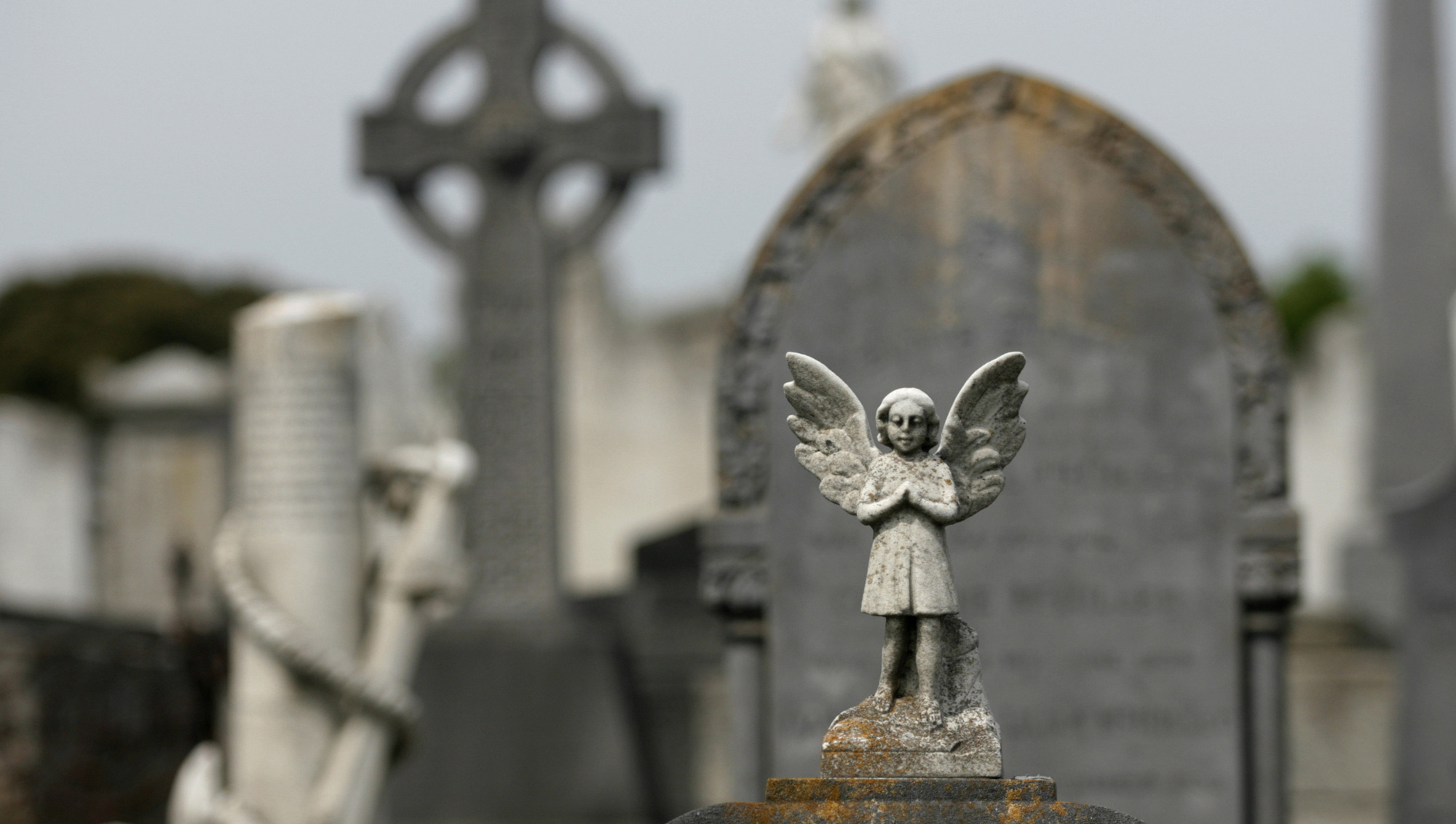
Mount Jerome Cemetery in Dublin where the unmarked graves of 40 children from Bethany House were discovered in 2010. File picture: Mark Stedman/RollingNews
A report that Sheila Nunan’s official negotiations with Roman Catholic Church bodies and the Church of Ireland on mother and baby home restitution payments produced no cash is not a surprise.
The long-delayed result is the product of an exercise in collective hypocrisy, primarily governmental.
The State is keen to defray its culpability by focusing instead on religious institutions it approved of, regulated, and inspected. They shut women away for pregnancy out of wedlock and snatched babies from their arms.
In the institutions, children received substandard care and died at a disproportionate rate.
State responsibility is illustrated by then deputy chief medical adviser Winslow Sterling Berry. In 1939, he undermined an official inspection report on a neglected Bethany Home child by reporting him healthy. The infant died soon afterwards.
Dr Berry later dismissed public concern over illness and death in Bethany by rationalising that “illegitimate children” were prone to sickness. The institution attracted bad publicity, noted the state official and Church of Ireland member, due to attempts at converting Catholic residents. He successfully persuaded the Protestant evangelical institution to pass a resolution prohibiting Roman Catholic admission. His purpose was achieved. Negative publicity departed and children again died in large numbers, this time in silence.
Sheila Nunan reportedly restates the Church of Ireland mantra that it bears no managerial and therefore no financial responsibility.
Its clergy and representatives had a deep institutional, managerial, and clerical involvement, including arranging admissions. Church of Ireland social services were involved. The Church of Ireland Magdalen Home on Dublin’s Leeson St, which included an actual church, was in part managed by a social services representative and by the archbishop of Dublin, no less.
Victims of this collective charade are surviving former residents, ill-served by a pathetic State payments scheme. Some, such as former Bethany resident Patrick Anderson McQuoid, do not qualify.
A newspaper letter last year said Patrick was sent soon after birth to a Bethany ‘nurse-mother’ who neglected and starved him, before coming under the control of Church of Ireland missionary society the Irish Church Missions.
Reforming the payments scheme is where the focus should be.
As the country grapples with the potential fallout from Donald Trump’s tariffs, it is worth noting that the Office of Government Procurement has recently concluded a framework tender for IT equipment — including firewalls, switches, and wi-fi — for a wide range of state organisations. These include schools, universities, local authorities, the Defence Forces, Revenue, and the gardaí, among others.
While framework tenders are typically designed to streamline procurement, ensure compliance, and deliver better value for money, in this case, the Office of Government Procurement’s tender requirements were set in such a way that no EU-owned IT manufacturer could even apply, effectively ensuring that only American vendors were eligible.
At a time when the EU is striving for greater digital sovereignty, it is crucial that the State prioritises procurement policies that support European technology providers. Dependence on non-EU vendors not only weakens our own digital infrastructure but also puts critical state systems at the mercy of geopolitical tensions.
Ireland must align its procurement strategy with broader European objectives, fostering competition, innovation, and resilience within the EU’s tech sector.
Irish government sources have been widely reported as saying that we can expect to see the Government scrapping the Occupied Territories Bill, and insisting that moving to progress it against the background of the imminent tariff war between the US and the EU “would be akin to economic terrorism”.
However, Taoiseach Micheál Martin has denied that the tacit shelving of the bill — for I cannot see how else we should interpret his statement that four months after government formation, there is still “no timeline” for its enactment — is “linked to the US tariffs”.
This stark discrepancy seems all too familiar. It appears to echo the Taoiseach’s outright denial of the American Jewish Committee’s claims, after meeting him last month, that he had assured them the Occupied Territories Bill was “no longer on the legislative calendar”.
To paraphrase Oscar Wilde: To be forced to correct the record once may be regarded as a misfortune; to be forced to correct the record repeatedly on the same subject looks a lot like something else.
There are problems with the International Holocaust Remembrance Alliance’s definition of antisemitism.
Ken Stern, who led the drafting of the definition, distanced himself from it, calling it “a blunt instrument to label anyone an antisemite”.
More than 100 organisations, including Amnesty International, Human Rights Watch, and the American Civil Liberties Union, have claimed the definition has often been used to wrongly label criticism of Israel as antisemitic.
And yet adoption of this definition was included in the programme for government. It was never mentioned in any manifesto, on any doorstep, at any church gate, or parish pump.
This begs the questions: Why was it included? And who included it?
Political apathy is perhaps the biggest problem this country has, which many now believe is rife. Backing this up is the persistent and degenerative low turnout we have at elections and general non-involvement in public affairs. One of its main causes is over-reliance on journalists to take up issues and bring politicians to account.
It is not the job of journalists to bring politicians to account, and that’s a fact. It is their job to cover the issues of the day assigned to them by their media organisation. Unfortunately, that is what many of them end up doing and the more they do it, the less engaged the public will be, in becoming onlookers rather than active participants.
Journalists are unwittingly neutralising public involvement and should back off and let the public take issue with their representatives.
The reliance on journalists to take up the mantle and stick out their necks is profound in this country and is now at a chronic level, bordering extreme.
Media is becoming more pervasive on an array of media devices and leading to saturation. What is there for the public to do when it already appears to be done, at least from a highlighting point of view?
The public in this country need to wake up and not leave it all to the media to solve their problems, because all the evidence suggests that this approach is not working.
Politicians do not answer to the media as such, but have to answer to those who elected them. Should they decide to get involved, or be lazy and let the media have a go off their representatives with no result?
The Conservative MP Andrew Rosindell, speaking in the British House of Commons on March 27, called for Ireland to emulate countries such as Australia, Canada, and New Zealand by choosing to take their “rightful place” in the family of the Commonwealth of Nations.
Mr Rosindell said that this would take the deep neighbourly relationship between Ireland and the UK to the next level, adding that it would be of benefit to global politics.
I believe that the colonial relationship between Ireland and Britain, which has endured centuries of oppression, famine, war, and terrorism, has not recovered sufficiently to consider a formal alliance other than our recent common EU membership.
If Mr Rosindell wishes to further the relationship between Ireland and Britain he might encourage the British government to release the files which were withheld from the Barron Inquiry into the Dublin and Monaghan bombings in 1974.
A full half-century has passed since the atrocity, with no resolution in sight. The British government has ignored four all-party resolutions, passed unanimously by Dáil Éireann, urging it to make relevant undisclosed documents available to an independent, international judicial figure.
It is regrettable that recalcitrant British policy remains unchanged.
Refusal to aid Judge Barron’s inquiry into the Dublin and Monaghan bombings, to reveal its role in the killing of Pat Finucane and other acts of violence or previous commitments does not bode well.
I believe that no British government will tell the truth about its role in fomenting and driving the conflict.
Britain broke previous pledges because it has no intention of exposing its core responsibility for violence, directly or through loyalist agents.