Letters to the Editor: Tánaiste's pledge to raise Sudan crisis with other EU states is welcome
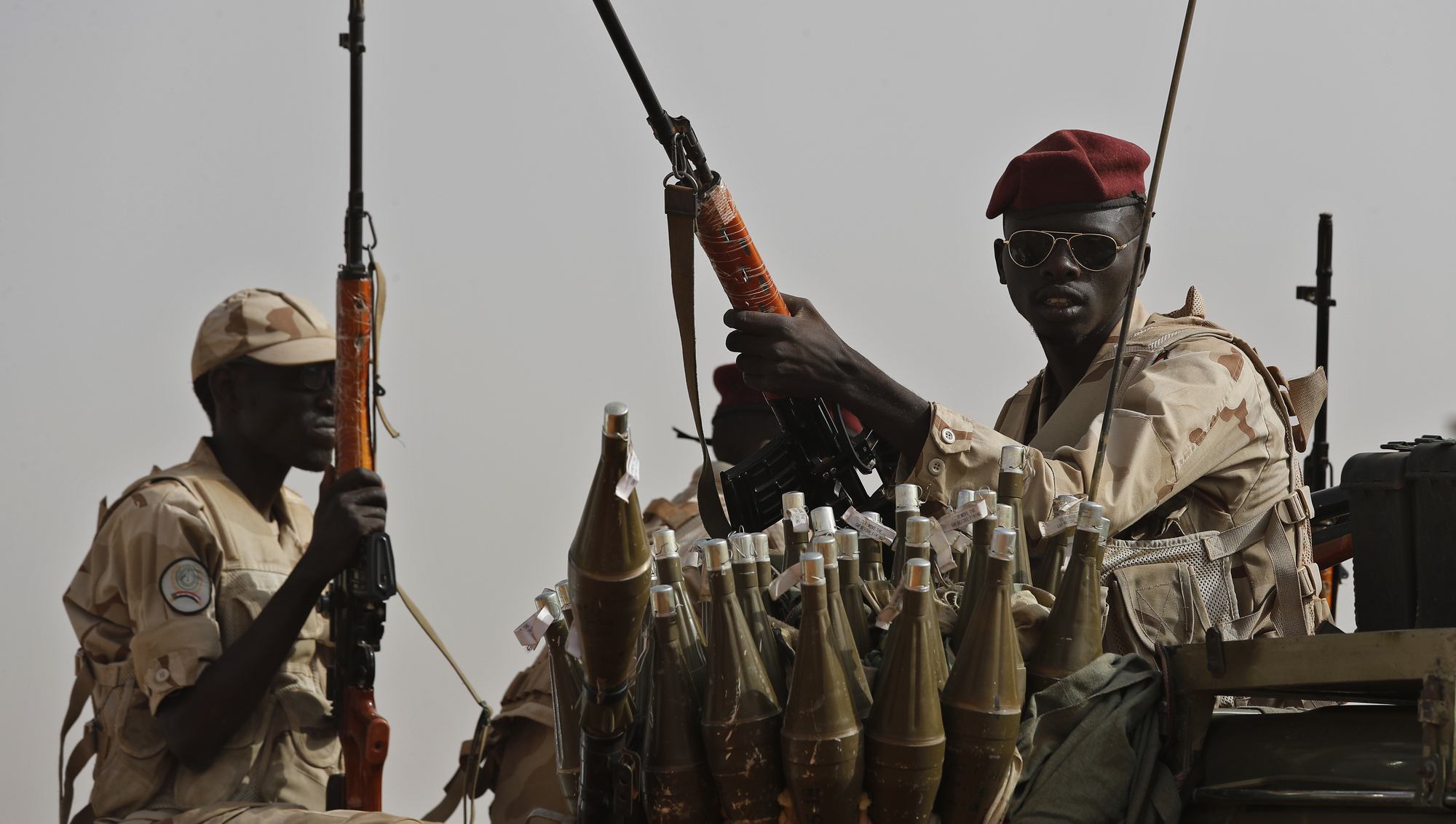
Rapid Support Forces forces in Sudan. Picture: Hussein Malla/AP
Concern Worldwide welcomes the commitment by Tánaiste and Foreign Minister Micheál Martin to elevate the horror of the deteriorating humanitarian crisis in Sudan with his EU counterparts.
The Tánaiste made this commitment in Ethiopia this week, following meetings in Ethiopia and Kenya. Intervention by the EU and the wider international community is long overdue to halt the fighting and create the conditions for a large scale humanitarian response.
It is shocking that Sudan has become “the forgotten war”. The scale of the suffering is shameful. After 16 months of fighting, half the population — 25m people — are vulnerable and in need of humanitarian assistance.
More than 750,000 people are estimated to be facing famine-like conditions. To put it bluntly, this means children are already dying and will continue to do so.
More than 7m people have fled their homes and a further 2m have crossed into neighbouring countries. The health service has collapsed resulting in disease outbreaks such as cholera, measles, malaria and dengue fever.
The Concern team on the ground is faced with the reality of a population edging ever closer to famine. The 90 clinics we support are under severe stress with increasing numbers of sick and malnourished children seeking treatment.
Our teams along the borders of neighbouring Chad and South Sudan are also under pressure as hundreds of thousands of desperate and traumatised Sudanese people have fled conflict in search of food, water, and shelter. The flow of refugees continues daily.
In an increasingly polarised world, the EU has a responsibility to address this scale of suffering. Concern wholeheartedly supports the Tánaiste’s efforts to get the EU to urgently intervene in this massive crisis in Sudan with political action, and to garner the funds and resources necessary to alleviate famine.
Regarding the report on improved air quality in Macroom, which noted that there are fewer trips by bicycle.
The new bypass is very scenic but a great opportunity was lost by not including a cycle lane! What has been done to encourage one to enter Macroom from either side by bicycle? The old Macroom to Ballyvourney road is a death trap and Cork to Macroom, even though wide enough in places, has no accommodation for cyclists.
So for the article to state that the number of cyclists entering Macroom is down is both comical and sad… and a big loss to coffee shops, etc.
Michael Deasy (‘Ireland is a nation of minorities,’ Irish Examier, July 18) says that “a stable, successful, progressive country is a patchwork of minorities”. However, while it is true that new blood can enrich a country, the only way a country can maintain stability is by a process of integration.
The United States, for example, with its motto ‘Out of many, one’, is the most successful immigration country in history, or rather it was, when it had strictly legal immigration and a firm process of integrating people into a common allegiance to American institutions and values.
Unfortunately, in recent decades, because of the breakdown of legal migration and the growth of ‘diversity’ left-wing politics, the result is that the United States is now very divided and sectarian. Likewise, in Europe, immigration has a long history in many countries, but the dogma of multiculturalism, by making a fetish of difference instead of integration, did long-term damage in terms of social and cultural cohesion. We can see the bitter consequences today in Britain, France, Germany, etc, where many people do not feel British, French, or German and do not even speak the languages or identify with the general culture.
Ireland should learn from the examples, both good and bad, of other countries on how to deal with immigration. It can be a good thing, but it has to be managed carefully, be strictly legal, and measures need to be taken to integrate people into a common nation, or else Ireland will end up with the same problems of ghettoes, alienation and separation as we see elsewhere.
This past week has been one of the deadliest for the Palestinians in Gaza since October, with at least 90 people killed in Israeli strikes on Al Mawasi, a supposed ‘safe zone’, on Saturday and at least 42 people killed when Israel bombed another United Nations school on Tuesday. Dozens more people have been murdered since and Israel has bombed at least eight schools in the past 10 days.
The headquarters for the UN agency for Palestinian refugees, UNRWA, is now “destroyed beyond recognition”.
Almost the entire population has been forcibly displaced, most of them multiple times. Famine has spread across the entirety of Gaza as Israel blocks food, medicine, and aid from entering the besieged Strip. Many children have died from malnutrition, dehydration, and lack of access to medicines, while their desperate parents look on, unable to help.
At least 90,000 people have been wounded, many of them catastrophically and countless numbers of patients have died, or will die, due to being denied exit from Gaza for medical care that is impossible in a health system that Israel has systematically destroyed.
The once bustling Gaza, full of life, culture and joy, despite years of Israel’s siege, has been mostly reduced to rubble, and will take decades to rebuild. Hundreds of Palestinian have also been killed in the West Bank.
Despite this livestreamed genocide unfolding in front of our eyes, our Government is yet to take concrete action to sanction Israel for its gross crimes against the Palestinian people, in contravention of the wishes of the majority here who have been on the streets in their hundreds of thousands for over nine months demanding they act.
On Saturday, as people turn out again in huge numbers for our National March for Palestine, we will reiterate our collective calls for action to stop the genocide in Gaza, our humanity demands it.
Gaels against Genocide in Gaza are calling on Gaels, Palestinian support Groups, human rights activists and local people to organise events on the weekend of August 2-4 to mark 300 days of genocide in Gaza.
These events can be small local displays or larger gatherings.
With almost 40,000 killed (including 16,000 children) and over 90,000 injured by Israeli armed forces, it is important for people of all ages and abilities across the 32 counties to continue to show the besieged people of Gaza that they care and will continue to demand an immediate permanent ceasefire, an end to the occupation and the provision of adequate humanitarian aid immediately.
In encouraging Gaels and others to organise events to coincide with with 300 days of genocide, if those organising these events contact Gaels against Genocide in Gaza (@GaelsAgainstGen), with the details, we will publicise the events on our various social media platforms.
If Colin Sheridan can travel to Cairo to follow up on the al-Atrash family from Gaza it proves that Egypt has been as guilty in Gazan misery as Israel. In fact worse. A third of Gazans are named Al Masri (‘Egyptian’) — their families were economic migrants to British Palestine because labour migrates to investment. When the 1948 war broke and they exercised their right of return home, King Farouk slammed the frontier shut on his own people to create a problem.
Since 1967, Israel at least let Gazans work in Israel till Hamas spoiled the party with knives and bus bombs — wrecked the Oslo Accords too. As that was legally a war context it was generous privilege. Hamas needling Israel with 20,000 rockets since 2006, topped by the October 7 massacre, finally had Israel lose its temper.
Perhaps like the 1956 Sinai Campaign and the 2006 Lebanon War certain Arab parties will now be deterred from warring for a decade?
It is time to recognise that Israel has as much right to be independent as Ireland and that the Arab states and ideologues denial of peace and recognition since 1948 is criminal in UN Charter terms.
The same goes for the Arab war on Israeli civilians in near weekly incidents since 1949. Art II of the Rights of Man — written by bewigged gentlemen and officers — accords the right to resist oppression but if you take that to warlike operations then the rules of war are that two can play the same game.
Secondly, the UN armistice Commissions and the “blue helmets” to which Ireland contributes are useless if the UN is so block voting jammed that its forces are powerless to stop Arab “guerillas” walking round them, or in 1967: “the fire brigade fled the fire,” as Abba Eban quipped on behalf of an outraged Israel.