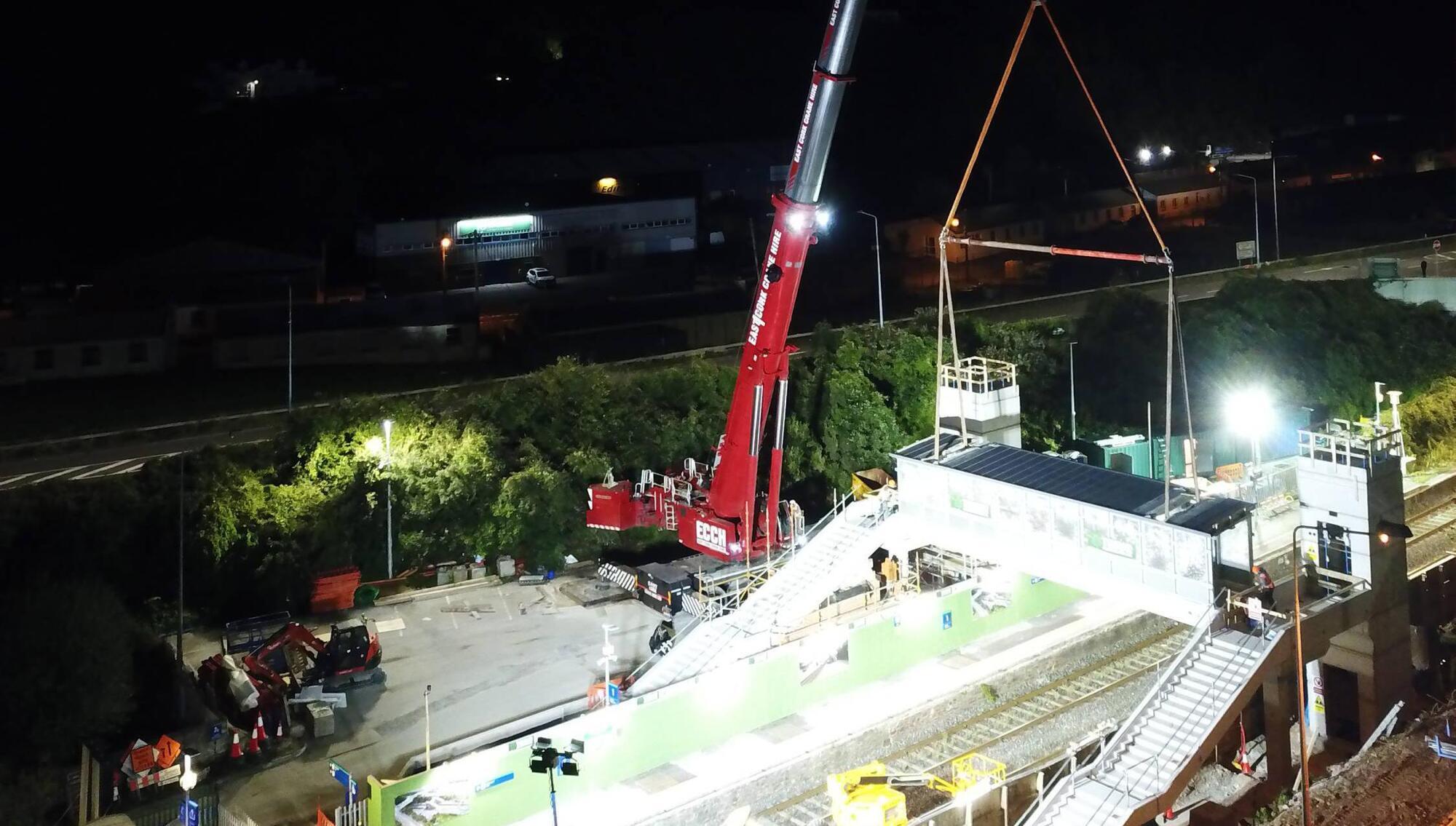
As a customer and taxpayer, I feel I need to comment on the improvement plans and activities in the Little Island commuter train station.
For the past six months at least there has been extensive work carried out to put in what appear to be lifts between platforms and an improved stairwell safer and enclosed — all admirable.
However, the design of this new addition to the station is completely incomprehensible. The crossing stairwell and lift is 70m down the platform from the entrances. Meaning that every passenger requiring to cross from platform 1 to 2 will add at least 210m to every crossing. A small price to pay, I hear you say, for a safe, dry crossing (we won’t mention the possibly €1m to build the thing). But 85% of all foot commuters coming to the train station do so via the Little Island side. That means their pathway passes within 8m of the new walkway bridge: They can see it, but now have to walk nearly 400m to get to the platform going to Cobh/Midleton.
Is there any chance whatsoever that a pathway could be built between the top of the stairwell to the Little Island roadway — allowing 85% of passengers cut huge amounts of time and effort to use the station? Otherwise, they are just adding effort to everybody to use the station.
Secondly, could you please get the trains to stop somewhere near the entrance instead of testing the length of the platform and going as far away as possible from the gateway? For some drivers it seems to be a sport.
But, most importantly, I would like to complain about the worst-designed car park in the history of the universe. Even drivers of very small cars cannot use this car park with any level of safety. I have witnessed multiple scrapes and bashes. The positioning of the raised pathways makes the use of the car park actually impossible to navigate. The laneways are too small and the turning areas are impossible to turn in. There was zero design effort involved in this — there has to be specifications for the design and specifications on the lane width and turning capability of a car park.
Having the contractors of the building project park directly opposite the turning into the car park just adds to the annoyance.
I am open to a position as an engineer with Irish Rail. I have zero qualifications but obviously qualifications don’t seem to matter when it comes to common sense.
Frank Dineen, Little Island, Cork
Volunteering would not be incentivised by a tax break
Cork City councillor Mick Finn has called for tax credits to encourage volunteerism ( Irish Examiner, January 11). As the national volunteer development organisation with extensive experience in this area, we do not think this would solve the challenge of recruiting volunteers.
It is true that many organisations are struggling to engage volunteers after covid. To solve a problem, you first need to understand the cause of the problem.
Lack of financial incentives isn’t the reason people don’t volunteer. The reasons some organisations are struggling to recruit volunteers include:
The need to actively welcome a broader and more diverse pool of potential volunteers;
The need to create more short-term flexible roles that meet the needs of people with less time;
A need for good volunteer management practice around recruiting and retaining volunteers.
A tax incentive would not lead to significantly higher levels of volunteering.
A better use of public funding would be to invest in supporting organisations to engage volunteers. Volunteer Ireland and the network of local volunteer centres provide extensive training for organisations, to help build meaningful and impactful volunteering. Go to Volunteer.ie to learn more.
Nina Arwitz, CEO, Volunteer Ireland
The nuclear option
The EirGrid guide ‘Having our say’ tells us, the customers, what to expect from EirGrid and what EirGrid would like to provide for us.
It says: “We understand and recognise the benefits and importance of learning from stakeholder feedback in influencing our engagement strategy and plans.”
EirGrid claims to be trying to find the best technology options but, whether they like it or not, are forced by government policy to omit nuclear from public consideration.
If all public discussion of nuclear is forbidden, how will policy decisions, based on analysis of public opinion of this emerging energy, actually occur?
Anne Baily, Carrick-on-Suir, Co Tipperary
Space and time are different in the US
According to the US census, Americans move home 11.7 times in a lifetime on average. Sounds exhausting, but it makes sense. Most Americans descend from someone brave enough to cross an ocean and leave everything behind, or from a nomadic tribe who trekked the prairies with teepees on their backs. Itchy feet are part of the American DNA.
We’d just bought our house in New Jersey when the for sale signs popped up everywhere. Realtors with flashy smiles dropped handwritten notes in our letterbox: “We’ll sell your house in a flash.”
I wondered if we were hoodwinked. Maybe a chemical factory was being built at the end of the street? So I asked around.
My neighbours were flummoxed. “Really? I hadn’t noticed,” they said. “More than last year?”
I couldn’t wrap my head around it, so I blurted out: “This happens every year?” And they looked at me as if I had two heads.
“Is it different in Ireland?” they asked. Yes, I answered.
We only move three times in a lifetime. We hold on to property and land forever. Farmhouses are passed from generation to generation, pubs serve ale for hundreds of years, castles stand for centuries. In America, not so. Not only do they move a lot, they knock things. It’s unsettling for an Irish woman to see how easily buildings are razed to the ground here; to drive to work in the morning and find a neighbour’s house in a pile of rubble when you get home, or a beloved restaurant levelled.
Europeans build things to last. But America is a baby still discovering who she is. She’s not building monuments for the ages, she’s building towers of blocks and toppling them.
When I asked where everyone was going, the answers varied. Two streets over, two towns over, Florida, the West Coast, down south. People either needed more space or less space. They were moving for jobs or schools or grandkids. Often, thousands of miles away. But still in the same country.
Ireland is only 300 miles long and 170 miles wide, so 100 miles is a long way. And, in America, 100 years is a long time. Space and time feel different here.
And I get it. Life is always changing, stasis is death. But moving house seems extreme. Can’t Americans just go on a vacation?
Marlene May, Milburn, New Jersey
US military flights through Shannon
Despite numerous requests, US military planes passing through Shannon Airport have never been checked for the presence of arms, despite these planes passing through the airport for over two decades.
Can Irish people therefore be certain that arms destined for Israel are not passing through Shannon? This is surely in contravention of Article 29.2 of our Constitution, namely the principle of the “pacific settlement of international disputes”.
We must stand up for our Constitution and our neutrality, and stop this use of Shannon Airport.
Elizabeth Cullen, Kilcullen, Co Kilkenny
Bricks and mortar
I am amused and confused when I read articles that mention Bitcoin, exchange-traded funds, and legitimacy as this suggests that they were not legitimate previously.
As a baby boomer, I like bricks-and-mortar investments — a house rather than what I think is just a set of numbers that is scarce and therefore valuable.
If the world economy collapses, I can grow veggies in my back yard. I wonder what a bitcoin tastes like.
Dennis Fitzgerald, Melbourne, Australia

Cancel anytime